

[2025] Use Real CIPS Dumps - 100% Free L4M1 Exam Dumps
Realistic L4M1 Dumps Latest CIPS Practice Tests Dumps
CIPS L4M1 Exam Syllabus Topics:
| Topic | Details |
|---|---|
| Topic 1 |
|
| Topic 2 |
|
| Topic 3 |
|
| Topic 4 |
|
| Topic 5 |
|
NEW QUESTION # 16
What is 'supply chain management'? Outline the drivers, advantages and disadvantages of using this approach within the Procurement Department of an organisation (25 points) See the solution in Explanation part below.
Answer:
Explanation:
How to approach the question
- There are 4 main components to this question that you will have to answer, so my advice is to first write down subheadings for your essay so you don't miss any out: definition of supply chain management, drivers, advantages and disadvantages
- The question also brings up 2 concepts - supply chain management and tiered supply chains, it would be good to include a definition of both of these.
- Because of the number of things you'll have to write, you don't need to go into lots of detail - one paragraph per section will be enough.
Proposed Essay Structure
Intro - what is supply chain management and what is a tiered supply chain P1 - drivers P2 - advantages P3 - disadvantages Conclusion - supply chains are complex due to globalisation Essay Ideas:
- Definition of supply chain management = Making something available in response to a buyer's requirements. The transformation of goods from raw material into an end product (input > conversion
> output)
- Drivers = Cost, Time/ Speed, Reliability, Responsiveness, Transparency, Globalisation
- Advantages = reduced costs by elimination of waste, improved responsiveness to customer requirements, joint-ventures with supply partners leading to innovations, tech sharing, improved communication leads to faster lead times for product development
- Disadvantages = needs considerable investment and internal support, closer relationships may be risky (IP, loss of control), issues in fairly distributing gains and risks (you don't need to talk about all of these- pick 1 or 2 you feel you know the best and focus on that) Example Essay Supply Chain Management (SCM) is the arrangement of processes involved in the production and distribution of goods / services - from the origin to the end consumer. In simple terms, it's taking a raw product and transforming it into an end product that a consumer would purchase. For example taking a potato from a farmer, giving it to a manufacturer to make into chips and sending these to retailers to be sold. SCM relies on close relationships between the parties in the supply chain and adds value to the product at every stage. A Tiered Supply Chain is a specific configuration within SCM that involves multiple levels of suppliers and sub-suppliers. A buyer will work with a small amount of Tier 1 suppliers who will in turn work with their own suppliers. In a tiered system there can be many, many layers of suppliers who all ultimately work towards creating the same product. This essay aims to delve into the drivers, advantages, and disadvantages associated with implementing a complex supply chain, such as the Tiered Supply Chain model.
The main drivers of using a tiered supply chain are often rooted in the pursuit of efficiency, cost- effectiveness, and flexibility. By consolidating suppliers into distinct tiers, organizations can streamline their management processes, reduce complexity, and enhance overall supply chain performance.
Additionally, tiered supply chains are often employed in response to the global nature of modern business, accommodating the need to source materials and components from various regions while maintaining a manageable and responsive supply network.
One of the advantages of a Tiered Supply Chain is the streamlined management of suppliers. In this model, there are fewer direct suppliers to oversee, simplifying the coordination and communication processes. This can lead to increased efficiency and responsiveness as organizations deal with a smaller, more manageable pool of suppliers. The consolidation of suppliers in a tiered system may also result in potential cost savings and improved collaboration with a select group of trusted partners.
However, the complexity of a Tiered Supply Chain brings disadvantages. One significant drawback is reduced visibility. As the supply chain extends across multiple tiers, organizations may struggle to have a comprehensive view of the entire process. This lack of visibility can lead to challenges in tracking and responding to potential disruptions. Moreover, ethical risks emerge when companies have limited oversight over lower-tier suppliers, potentially exposing organizations to issues such as labour exploitation, environmental concerns, or violations of ethical standards.
In conclusion, supply chain management has evolved into a complex discipline due to the forces of globalization and consumer demands for speed and quality. The Tiered Supply Chain model, driven by these factors, presents both advantages and disadvantages. While managing fewer suppliers can enhance efficiency, the trade-off includes diminished visibility and increased ethical risks.
Organizations must carefully evaluate the specific needs of their operations and weigh the benefits against the challenges when deciding whether to adopt a Tiered Supply Chain. In this intricate landscape, the ability to balance complexity and efficiency becomes paramount for sustained success in the global marketplace.
Tutor Notes
- Definition of supply chain management is from p.5
- Drivers, advantages and disadvantages p.9
- This topic used to be much more in depth in the old syllabus and has been drastically simplified in the new study guide. The guide is actually quite light on this topic stating simply that "globalisation and localisation are both drivers of using supply chain tiering". If you don't work in manufacturing, or an industry that uses supply chain tiering, this concept may be a bit alien to you and I'd recommend doing a little extra research. The best example of supply chain tiering is in car manufacturing- and that would be a good example to use in an essay. Some additional links for research:
- Supplier Tiers: What's The Difference Between Tier 1, Tier 2, and Tier 3 | PLANERGY Software
- Sustainable Sourcing - Definition, Examples, Benefits & Best Practices (brightest.io)
- https://youtu.be/fs1rDgBQy1M
NEW QUESTION # 17
Explain the impact that having a Corporate Governance Framework can have on the policies and processes of the procurement department (25 points)
Answer:
Explanation:
See the solution inExplanation partbelow.
Explanation:
A basic response would include:
- What a Corporate Governance Framework is - the system of rules, practices and processes which directs and controls a company. Corporate Governance refers to the way in which companies are governed and to what purpose.
- Impact this has on policies and processes - means the procurement department follows regulatory mechanisms (e.g. financial regulations, Codes of Practices), has a checks and balances system (such as auditing), uses e-procurement technologies, vets staff and suppliers, has a clear segregation of duties etc.
This is a very open question and there are so many correct answers. In fact, it's quite hard to give a wrong answer to this question - as long as your response explains a policy or process that a procurement department can have that ensures they're following Corporate Governance - that's right!
A good response may mention:
- Corporate governance is in essence a 'toolkit' that allows an organisation to effectively manage itself, ensuring that it's policies and procedures are compliant with legislation and are ethical. It also ensures that the company meets its objectives.
- The impact Corporate Governance has on the procurement department will be in mandating the ways in which goods and services are procured and in the general ways of working of the procurement department.
- In your response you should mention 5 (ish) different ways Corporate Governance would impact on how procurement do their job. Examples include:
- Ethical Conduct - corporate governance ensures that the company is operating in a legal and ethical way.
This influences the processes Procurement will do and the type of suppliers they will engage with. This may also be in their approach to relationships and negotiations- seeking out collaborative relationships with suppliers rather than looking to exploit them. For example, an organisation that does not have a Corporate Governance structure may look to take advantage of suppliers and achieve the lowest cost possible at the expense of the supply chain and local community. An organisation that has strong Corporate Governance would work with suppliers, developing the relationships and thinking long-term about the impact on the local community. The organisation may therefore prioritisestandards such as Fair Trade over price, and this would be reflected in the way tenders are evaluated by the procurement department.
- Use of Checks and Balance system- Corporate Governance ensures strong financial controls are implemented throughout the organisation. For the procurement department this may result in purchases being made to strict budgets (rather than just spending whatever they want), and business cases being written up and approved before the organisation spends a large amount of money on a single item. Another impact may be in the use of audits. For example, peer reviewing tenders and contract awards to ensue all members of the Procurement Team are following internal processes correctly.
- Anti-fraud prevention mechanisms. An important area of Corporate Governance is ensuring the organisation is free from fraud and corruption. This impacts on Procurement's policies and processes as it will mean scrutinising tenders and who is being awarded contracts. It may result in high levels of Due Diligence being completed on suppliers before entering into contracts and providing a whistle-blowing service for staff to report issues.
- Security measures- this will be to protect the organisation from risk. It may include the procurement department vetting new staff by completing background checks. It may also involve the segregation of procurement duties so that no individual has too much power. E.g. one person raises the requisition and another person approves the purchase. Security may also be in ways of working such as password protecting documentation and limiting access to confidential information.
- Use of a Purchasing Policy Manual - this provides operational guidance on procurement policies and procedures to all staff members. It may detail things like who has permission to order what, who the Delegated Purchasing Authority (DPA) is and the roles and responsibilities of the team.
An excellent response may also include
- Reasons why Corporate Governance Frameworks impact on procurement policies and practices. This could include reasons of accountability, reputation and risk management, procurement's links with other departments.
- You could also look at what processes would look like with Corporate Governance compared to without it (with CG = rule driven, autocratic but organisation is protected from risk. Without CG = laissez-faire, everyone does whatever they like, very risky)
- You could also provide further examples, either real life or hypothetical. Investopedia has some great information and examples you could use: Corporate Governance Definition: How It Works (investopedia.com)
NEW QUESTION # 18
Jan is a Contracts Manager at ABC Ltd and has recently awarded a contract to XYZ Ltd. Describe how she can manage the contract and supplier, detailing ways of monitoring performance and adding value for ABC Ltd (25 marks)
Answer:
Explanation:
See the solution inExplanation partbelow.
Explanation:
How to approach this question:
- There are 4 sections to this essay, so before you start writing I'd make a couple of notes on each of the points. Then build those notes into separate paragraphs. Your notes may look like this:
How to manage the contract - ensuring contract is fit for purpose, holding XYZ to their responsibilities, ensuring ABC are also fulfilling their responsibilities, issuing contract variations if required, planning for contingencies.
- How to manage the supplier - ensure the right relationship is in place (transactional vs collaborative), communication - open and honest, ensure there is mutual trust and understanding of each other's goals/ objectives.
- Ways of monitoring performance - use KPIs / SLAs, Supplier Scorecard, Vendor Rating, feedback from customers
- How to add value for ABC - increasing efficiencies (e.g. less product defects), improved quality, assisting with Value Engineering exercises, reduction in time and costs (e.g. through improved processes such as ordering), the supplier delivers 'extras' for ABC such as training to staff at no additional cost.
- Ensure each paragraph refers to Jan, ABC and XYZ. The question doesn't state what the businesses are buying/ selling so you can use this as an opportunity to provide examples: 'if ABC are procuring raw materials from XYZ such as metal, an effective way to manage performance would include .... If they are procuring a service, it may be more beneficial to use .... methodology' Example Essay Jan, the Contracts Manager at ABC Ltd, plays a pivotal role in ensuring the success of the recently awarded contract with XYZ Ltd. Efficient contract and supplier management involves careful planning, communication, performance monitoring, and the continuous addition of value. Here's how Jan can navigate these aspects:
In terms of contract management, Jan must ensure that the terms and conditions of the contract are "fit for purpose," aligning with the specific needs and complexity of the procurement. For instance, a simple goods procurement may necessitate a concise document, while more intricate projects like engineering endeavors may require a detailed contract such as a JCT or NEC contract. Additionally, Jan should vigilantly manage the contract during its lifespan, addressing any potential 'scope creep' that might necessitate amendments. If the contract lacks provisions for such changes, Jan may need to initiate the creation of a new contract to accommodate evolving needs Clear delineation of responsibilities and contingencies is crucial in the contract to ensure accountability and preparedness for unforeseen circumstances. The inclusion of Key Performance Indicators (KPIs) and damage clauses, where appropriate, adds a layer of clarity and accountability to the contractual relationship. Planning for contingencies involves having backup strategies in place, especially considering potential challenges that may arise during the collaboration with XYZ Ltd. For example, having other suppliers she can call upon if XYZ fail to deliver on an order.
Turning to supplier management, Jan's role involves fostering a positive and productive relationship with XYZ Ltd. This includes regular meetings to discuss progress, achievements, and future plans. A mobilization meeting is particularly important to ensure a strong start to the contract. Subsequent monthly or quarterly meetings provide a platform to review performance retrospectively and plan for the future. Additionally, effective communication is paramount, with Jan ensuring that both organizations regularly communicate, particularly regarding urgent issues that may require immediate attention. This proactive communication can occur through various channels, such as email or phone calls, facilitating a swift resolution of any emerging concerns.
Trust and honesty form the bedrock of the relationship between ABC Ltd and XYZ Ltd. Jan should work towards fostering mutual trust through both formal and informal activities, recognizing the importance of a transparent and cooperative partnership In terms of performance monitoring, Jan can employ Key Performance Indicators (KPIs) and Service Level Agreements (SLAs) to track performance regularly. These metrics should not be viewed as one-off activities but rather as ongoing tools for assessing and ensuring that performance aligns with expectations. Clear communication regarding the consequences of failing to meet these targets, such as the implementation of a Performance Improvement Plan or potential contract cancellation, is essential for maintaining accountability.
Regular performance meetings between ABC Ltd and XYZ Ltd provide an opportunity to discuss achievements, setbacks, and any necessary adjustments. Beyond quantitative metrics, surveys and feedback from customers can provide qualitative insights into performance.
Finally, Jan can contribute to the partnership's success by focusing on adding value. This involves going above and beyond the contractual obligations, such as delivering products more efficiently at no additional cost or improving operational efficiencies. Encouraging XYZ Ltd to participate in Value Engineering exercises and engaging in Early Supplier Involvement to shape and define future requirements would be a good example of this. Additionally, providing 'add-ons' or 'extras' outside the contractual framework, such as training for ABC Ltd staff, further enhances the value derived from the partnership.
In conclusion, Jan's role as Contracts Manager extends beyond the initial awarding of a contract- rather her role involves strategic contract and supplier management throughoutthe lifetime of the professional relationship. By ensuring the contract is well-suited for its purpose, fostering a positive relationship with the supplier, monitoring performance effectively, and consistently adding value, Jan contributes to the success of the collaboration between ABC Ltd and XYZ Ltd. This comprehensive approach sets the stage for a mutually beneficial and enduring partnership.
Tutor Notes:
- A case study question like this in the real exam is likely to come with more details. They often come with lots and lots of details to be honest, talking about what XYZ supplies to ABC and the names of the people involved. The case study usually gives you some good clues as to what the examiner will be looking for you to include, so do read them carefully.
- You don't have to include much 'theory' on case study questions - the important thing is to reference Jan as much as possible. BUT you could throw in a cheeky mention of the Kraljic matrix. The approach to managing the contract and supplier would depend on the type of item supplied by XYZ - e.g. if it is a bottleneck item the supplier may need to be handled differently to if it is a routine item. You could also mention KPIs and objectives as being 'SMART' - Specific, Measurable, Attainable, Relevant, and Time-Bound
- study guide p.86-90 / p.94 / p.96 -98
NEW QUESTION # 19
What is meant by Stakeholder Mapping? Describe a tool that can be used by a Procurement Professional to map the stakeholders at their organisation (25 points)
Answer:
Explanation:
See the solution in Explanation part below.
Explanation:
How to approach this question:
- Define stakeholder mapping - completing an analysis of the stakeholders of an organisation and dividing them into categories depending on certain characteristics. This is often represented visually on a graph or matrix.
- Describe a Stakeholder mapping tool - the most common tool is Mendelow's Stakeholder Matrix so I would recommend using this one. It is explained in detail in the study guide. However, the question is open so you could choose to describe another tool such as Edgar's Stakeholder Position Analysis if you so wished. You wouldn't be wrong choosing this, but honestly, I'd just go for Mendelow. You can't go wrong with Mendelow. Because the Matrix has 4 sections you can imagine you'd get 5 points for the definition of stakeholder mapping, and 5 points for each of the quadrants of the matrix.
Essay Plan:
Introduction - The reason why stakeholder mapping is important is because interests and expectations of stakeholder groups will be different and possibly conflicting. Mapping this allows an organisation to see the variety and decide on an appropriate management style for each stakeholder group.
Paragraph 1 - Mendelow's Power / Interest Matrix maps stakeholders based on their influencing power and the strength of their motivation to use that power. It uses a 2x2 grid and defines power as high or low and interest and high or low. It then provides four strategies for managing the stakeholders based on which quadrant of the grid the stakeholder falls into. These 4 categories are:
Paragraph 2 - Keep satisfied - high power but low interest. If the stakeholder becomes dissatisfied or concerned their interest may peak. Examples include regulatory bodies, shareholders, senior management.
The best approach is to keep them up to date so they are informed of what is going on, but do not burden them with information they do not need.
Paragraph 3 - Manage Closely - AKA Key players - includes major customers, key suppliers, partners, senior management. These stakeholders need to know everything that is going on and approve of what is going on.
The recommended strategy is early involvement and participation, and integrating their goals with yours. This group requires regular communication and meetings. You should take their opinions on board.
Paragraph 4- Monitor - minimum effort required - this is the low priority group as they have low power and low interest. Includes small volume suppliers and other organisational functions with no direct interest in your activities. This group does not need to receive regular communication.
Paragraph 5 - Keep informed - high interest, but low power. If they're not kept in the loop and understand the need for decisions, they may lobby together to protect their interest if they feel threatened. Employee groups, suppliers and community groups may be in this category. This group should receive regular communication.
Conclusion - Mendelow created the matrix in 1991 and it is still used today. It is a popular management tool due to its simplicity. It's important to notes that stakeholders can move through the matrix- it isn't stagnant.
For example, at the beginning of a project a manager in another department may be classed as 'low priority' because they are seen to have no interest and no power in the project. However, as the project progresses the manager may become interested. They will then transfer into the keep informed category. Therefore, the matrix should be redone regularly throughout the lifetime of a project to capture any movements. The matrix should also be redone for each individual project - it cannot be assumed that a stakeholder who had interest in one project would be interested in another.
Tutor Notes
- The above essay plan is basically the entire essay, I got carried away. The only thing you'd need to add into that is an example of a stakeholder for each of the sections! (e.g. the CEO is high power, but low interest stakeholder for the procurement department. He/ She doesn't care about the day to day operations but should be kept informed of any big news). For your examples you could use your own place of work.
- At level 4 you don't have to analyse the model, you just have to be able to memorise it and repeat it.
Mendelow comes up again at Level 5 and 6 in a bit more detail. If you want to score super bonus points you could mention in your conclusion that the main disadvantage of Mendelow's Matrix is that it doesn't take into consideration the stakeholder's position on the project - whether they're for it or against it. Therefore, it doesn't provide the full picture or provide much help on how to manage stakeholders. E.g. two stakeholders might both be in 'manage closely' section, but one is for the project and the other against - they'd need to be handled very differently!
- Study guide p. 65
NEW QUESTION # 20
Discuss the importance and role of an organisation's branding in procurement and supply operations (25 marks)
Answer:
Explanation:
See the solution in Explanation part below.
Explanation:
How to approach the question
- This is a very open question so your essay could discuss
o the functions of a brand; e.g. advertising, marketing, creating trust, identity o What is effective branding? Strong image, convincing people to purchase, shared values with customers, offering a solution to a problem.
o The impact for procurement and supply chain isn't explained in the study guide so tailor this however you like. The best thing to do would be to think about some companies where branding is important, such as luxury goods, cars, or the brand is synonymous with a particular aspect such as Apple being associated with innovative technology. From there you could argue the importance of selecting the right suppliers to work with in order to keep up the brand image. Another example could be an ethical company needing to ensure their supply chain is 'clean', so as not to damage their branding. Possibilities are endless with this one.
Example Essay
In the contemporary business landscape, the significance of branding extends far beyond marketing and consumer perception. In procurement and supply operations, an organization's brand plays a pivotal role in shaping relationships with suppliers, determining the quality of goods and services that are procured, and influencing overall supply chain efficiency. This essay delves into the importance of branding in procurement and supply, exploring how a strong brand image can drive competitive advantage, foster trust and collaboration, and impact an organization's bottom line.
Building Competitive Advantage Through Brand Reputation:
The reputation of an organization's brand is a key determinant in attracting and retaining high-quality suppliers. A strong brand often correlates with financial stability, market presence, and business ethics, making such organizations more appealing to work with. This advantage is critical in procurement as it can lead to preferential treatment, such as priority access to scarce resources, better payment terms, and opportunities to collaborate on innovative products. For example, a well-regarded technology company might receive earlyaccess to cutting-edge components from suppliers eager to be associated with a market leader.
Enhancing Supplier Relationships and Negotiations:
Branding extends into the realms of trust and reliability, essential components in building long-term relationships with suppliers. A well-respected brand often implies a history of fair dealings, prompt payments, and mutual respect, which can make suppliers more willing to negotiate favourable terms. This trust can be particularly vital in times of supply chain disruptions or market volatility. Suppliers are more likely to extend credit or expedite orders for trusted partners, which can be invaluable for maintaining uninterrupted operations.
Influencing Quality and Sustainability Standards:
An organization's brand also communicates its commitment to quality and sustainability, which are increasingly crucial in procurement decisions. Suppliers aligning with brands that emphasize high-quality standards are often more diligent in maintaining these standards in their products and services. Additionally, a strong brand committed to sustainability can drive supply chain practices that align with environmental and social governance (ESG) principles. This commitment can lead to long-term cost savings, risk mitigation, and enhanced brand loyalty among environmentally conscious consumers.
Brand Image and Consumer Perception:
The procurement function directly impacts the final product quality, which in turn affects consumer perception of the brand. An organization's ability to procure high-quality, ethically sourced materials can significantly enhance its brand image and appeal to a broader customer base. For instance, a fashion brand's commitment to ethical sourcing and procurement of sustainable materials can bolster its image as an environmentally responsible brand, appealing to a growing demographic of eco-conscious consumers. The reverse is also true, brands associated with child or forced labour where this is found to be in their supply chains can suffer from loss of customers, revenue and reputation as well as potentially even legal consequences.
Internal Branding and Employee Engagement in Procurement:
Internal branding, the way an organization's values and culture are perceived by its employees, plays a crucial role in procurement. Employees who are proud of their organization's brand are more likely to engage deeply with their work, leading to better performance in procurement roles. This engagement can result in more innovative procurement strategies, improved vendor management, and a greater focus on aligning procurement practices with the organization's overall strategic goals.
Conclusion:
The role of an organization's branding in procurement and supply operations is deeply impactful. A strong brand can create competitive advantages, foster better supplier relationships, influence quality and sustainability standards, enhance consumer perception, and drive employee engagement. In the modern business world, where supply chains are complex and consumer expectations are high, branding is not just a marketing tool but a strategic asset in procurement and supply operations. Organizations that recognize and leverage the power of their brand within these operations are poised to achieve greater efficiency, sustainability, and overall success.
Tutor Notes
- This is a really random section of the study guide and doesn't really relate to the rest of the content.
Branding comes up on p.226 - 228. It therefore can come up as a question, but because it's such as small part of the syllabus, don't focus too much effort on this subject.
- If you remember one line from this topic it's this: "branding is not just a marketing tool but a strategic asset in procurement and supply operations"
- This type of question could come up as a scenario / case study. E.g. How does the branding of X Company impact upon their supply chain.
NEW QUESTION # 21
Describe regulation that govern the Public Sectors and explain how this may impact upon procurement activities (25 marks).
Answer:
Explanation:
See the solution inExplanation partbelow.
Explanation:
How to approach this question
- You do need to know some legislation for public sector here. This may be difficult if you don't work in the Public Sector. If you're struggling with this, you could also talk about general legislation that governs all types of organisations such as the Equalities Act and Modern Slavery Act.
- This is also a tough question if you're not British. CIPS is a UK based organisation and the syllabus therefore only talks about British legislation. If you're in a different country you could talk about the legislation in your own country, providing the question doesn't specifically mention UK Law.
- Either way I would recommend knowing a couple of pieces of British Legislation. You don't need to be an expert but just state what they are and what the purpose is should be enough to get you a pass.
Example essay
The public sector, which encompasses various governmental and state-owned enterprises, plays a pivotal role in the governance and provision of essential services. This sector operates under a strict framework of regulations and policies, ensuring that its operations are fair, transparent, and accountable. Among the most critical aspects of these operations is procurement, the process through which the public sector acquires goods, services, and works. This essay will explain key regulations governing the public sector, focusing on the Public Contracts Regulations (PCR) 2015, Late Payment Regulations 2016, Equalities Act2010, and Public Services (Social Value) Act 2012, and explores how these regulations impact procurement activities.
The Public Contracts Regulations (PCR) 2015
The PCR 2015 plays a foundational role in public sector procurement in the UK. It sets out the procedures for procuring contracts, aiming to ensure fairness and transparency in the process. The regulations mandate that all procurement processes must be conducted in a manner that prevents discrimination and allows equal access to potential contractors, regardless of their size or location. For example, the open tendering process under PCR
2015 has enabled a more diverse range of companies, including small and medium-sized enterprises, to participate in government contracts, enhancing competition and innovation. The four 'pillars' of the PCR are derived from EU Procurement Directives and are: non-discrimination, free movement of goods, equality of treatment and transparency.
Late Payment Regulations 2013
The Late Payment Regulations 2013 address a critical aspect of procurement: the timely payment for goods and services. This regulation ensures that public sector organizations pay their suppliers within a stipulated time frame, significantly impacting the financial stability of these suppliers. For instance, the regulation has been particularly beneficial for small businesses that rely on prompt payments to maintain cash flow. The introduction of these regulations has improved the trust between public sector entities and their suppliers, leading to more efficient procurement processes.
Equalities Act 2010
The Equalities Act 2010 is another crucial piece of legislation impacting public sector procurement. This Act prohibits discrimination in the workplace and in the provision of services, extending its influence to the procurement process. Public sector entities must ensure that their procurement decisions do not discriminate against any group and that they promote equality. For instance, when a public sector organization issues a tender, it must ensure that the selection criteria do not unfairly disadvantage any potential supplier based on irrelevant characteristics. This approach not only fosters a more inclusive procurement environment but also helps to tap into a wider talent and supplier pool, enhancing the quality and effectiveness of public services.
Public Services (Social Value) Act 2012
The Public Services (Social Value) Act 2012 marks a significant shift in how procurement is approached in the public sector. This Act requires public sector organizations to consider how the services they procure can improve the economic, social, and environmental well-being of their area. This means that when a public sector entity procures goods or services, it must consider factors beyond just the price and quality. For example, a local government might prioritize suppliers who can demonstrate a commitment to environmental sustainability or who offer employment opportunities to local residents. This approach to procurement encourages a more holistic view of value for money, factoring in the wider impact of procurement decisions on society.
Public Accountability and Freedom of Information Requests
In addition to these specific regulations, the concept of public accountability and the mechanism of Freedom of Information requests play a crucial role in the public sector, especially in procurement activities. Public accountability ensures that entities are answerable to the public and their actions are transparent. Freedom of Information requests enable individuals and organizations to access information held by public authorities, which includes details of procurement decisions and contracts. This transparency is critical in ensuring that procurement activities are conducted ethically and responsibly, deterring corruption and mismanagement.
In conclusion, the regulation of the public sector, particularly in the realm of procurement, are complex.
Regulations such as the PCR 2015, Late Payment Regulations 2016, Equalities Act 2010, and the Public Services (Social Value) Act 2012, along with the principles of public accountability and transparency, ensure that procurement activities are conducted in a fair, transparent, and socially responsible manner. These regulations not only safeguard the interests of suppliers, especially smaller businesses, but also ensure that the public sector remains a model of integrity and efficiency and that taxpayers' money is well spent.
Tutor Notes
- Okay this is important: The PCR 2015 regulations are being rescinded in 2024. They're based on EU Law and the UK has left the EU. I know we left a while ago now but it's taken us a long time to address the issue and figure out what we want to do about it. There was also a pandemic that got in the way of people making any decisions in parliament that weren't to do with Covid. The PCR 2015 will be replaced in late 2024 with new 'British' rather than European rules.
- At the time of writing this (December 2023) we don't 100% know what the new rules are going to look like and if you're taking this exam from November 2024 onwards, I recommend doing a bit of research into the new regulations.
- Now the complicated bit- the CIPS syllabus is valid from 2024-2028 and doesn't address that legislation is changing. I therefore don't really know what they're going to expect when students are taking this exam and the study guide information is out of date. If you're not working in the Public Sector, how are you to know the legislation has changed?
- My advice is this- briefly learn PCR 2015- the four pillars in particular, and when the new legislation comes out, have a quick google and see if these pillars are still the same. The regs aren't going to change THAT much - things like transparency and equal treatment are still going to be really important, but there may be some slight language changes. Plus, if you're able to mention in an essay that there's new legislation, it's going to make you sound super clever.
- LO 4.2 p.211
NEW QUESTION # 22
Describe the main differences between the three economic sectors: public, private and third. Your answer may make reference to the following: funding, ownership, shares, objectives and administration (25 marks)
Answer:
Explanation:
See the solution inExplanation partbelow.
Explanation:
How to approach this question
- Sometimes CIPS give you a steer on how to answer the question. My advice is to follow it. The question says you MAY make reference to the following, but I'd use those hints as a guide for content- a paragraph on each and you're done!
- When you've got a 'may make reference to' hint - this means you can completely ignore it and do your own thing and bring in your own ideas. May means it's optional, so you wouldn't be penalised for this. However, you have to consider the examiner's mark scheme- it will detail options of stuff you can write for funding, ownership etc. Then there will be a line at the bottom saying something like 'accept other options such as x and y'. This leaves it up to the examiner to decide whether what you've said is relevant. I'd personally not leave it up to chance you get a lenient examiner. If you write what's definitely going to be on their mark scheme, you're more likely to get more points.
Example Essay
The modern economy is a complex tapestry of various sectors, each with its own distinct characteristics and functions. The three prominent sectors are the public sector, the private sector, and the third sector. These sectors differ significantly in terms of their funding mechanisms, ownership structures, objectives, the concept of shares, and their administration.
Firstly, the public sector is predominantly funded by the government through taxation, grants, and other forms of public revenue. Its very existence hinges on the provision of essential services and the fulfilment of societal needs. These organizations are owned by the government, be it at the federal, state, or local level. Unlike the private sector, the concept of shares doesn't apply in the public sector. Instead, the government allocates budgets to various departments and agencies for public services and projects. The primary objectives of the public sector revolve around the welfare of the citizens, including the provision ofeducation, healthcare, defence, and infrastructure. It is characterized by bureaucratic administration, with decision-making processes subject to governmental regulations and oversight. A prime example is public schools and healthcare systems, which are funded and operated by the government with the primary objective of ensuring universal access to education and healthcare services.
In contrast, the private sector operates on a starkly different paradigm. It is primarily funded by private capital, investment, and profit-seeking activities. Private individuals and corporations own these entities, with ownership shares often represented by stocks. Shareholders invest capital in exchange for ownership stakes and the potential for dividends. The central objective in the private sector is profit maximization, driven by competition in the market. Companies in the private sector are administered by management teams and boards of directors, with decisions guided by market forces. Apple and ExxonMobil are examples of private sector entities, privately owned and publicly traded, with profit motives at their core. Shareholders invest in these companies with the expectation of financial returns.
Lastly, the third sector, often referred to as the nonprofit or voluntary sector, represents a unique economic sphere. It relies on a combination of funding sources, including donations, grants, and earned income, but not taxation. Third sector organizations are not owned by individuals or shareholders; instead, they are governed by boards of directors or trustees. Unlike the private sectors, shares are not applicable in the third sector. These organizations do not seek to distribute profits to owners. The primary objective of the third sector is to serve a social or community purpose, such as addressing societal issues, promoting social change, and providing services that benefit the public. Administration in this sector is overseen by non-profit boards, and it heavily relies on volunteers, philanthropy, and community engagement. For example, the Red Cross operates with the objective of providing humanitarian aid and disaster relief, relying on donations and volunteers to fulfil its mission. Any profits that are made are reinvested into the organisation to further its mission.
In conclusion, the public, private, and third sectors represent diverse economic domains, each with its own funding mechanisms, ownership structures, objectives, and administrative models. These sectors play essential and complementary roles in society, contributing to economic development, public welfare, and social progress. Together, they form the foundation of a balanced and dynamic economic landscape.
Tutor Notes
- I've structured this essay with a paragraph on each sector, but you could have done a paragraph on each theme, thus having 5 paragraphs instead of 3. Either approach works.
- You've got 5 things and 3 sectors, that equals 15 marks. If you give an example of each and a strong intro and conclusion, that's full marks.
- See LO 4.1 p. 203 - there's a cute table with this information on.
NEW QUESTION # 23
Sarah is thinking of setting up a charity in the UK which will look after animals that have been abandoned.
What regulations and governing bodies should Sarah be aware of when setting up her charity? (25 Points)
Answer:
Explanation:
See the solution inExplanation partbelow.
Explanation:
How to approach this question
- Your essay should mention at least one regulation and one governing body particular to the charity section and I would recommend these be the Charities Act 2011 and the Charities Commission.
- If you don't know a lot about the sector you can bring up more generalised regulations and governing bodies, such as financial conduct and the Equalities Act, but make sure it's relevant to Sarah. Her charity is a small, local one, so things like Modern Slavery Act will not be appropriate to talk about.
Example Essay
When setting up a charity in the UK, particularly one focused on animal welfare, there are several regulations and governing bodies that Sarah should be aware of. These ensure that the charity operates legally, ethically, and effectively.
A charity's purpose involves raising awareness and helping someone or something, in Sarah's case this will be local animals and potentially their owners. A charity has to satisfy two aspects: The benefit aspect and The public aspect. In the UK, both aspects are regulated by the Charities Act 2011.
To satisfy a benefit aspect, a charity must: have a purpose that must be beneficial to the community it works in
- this must be in a way that is identifiable and capable of beingproved by evidence. For Sarah this would be showing that her charity helps animals, potentially by taking them in off the street or removing them from dangerous homes and caring for them.
To satisfy a public aspect, a charity must benefit the public in general, or a sufficient section of the public. In Sarah's case the public benefit may be in removing stray dogs and cats from the streets where they can transport diseases and potentially attack people. Most charities strive to satisfy both aspects but in some cases this is not possible.
All charities are regulated. Because charities are funded by donations from the public, businesses and sometimes from government, their conduct is regulated closely. Key regulatory bodies that Sarah will have to engage with include:
1. Charity Commission for England and Wales:
As the primary regulator for charities in England and Wales, the Charity Commission oversees the registration and regulation of charities. Sarah's organization must meet the legal definition of a charity and apply for registration if its income is over £5,000 per year.
The Commission ensures compliance with the Charities Act, offering guidance on charity governance, financial management, and reporting.
2. HM Revenue and Customs (HMRC):
Charities can apply to HMRC for recognition as a charity for tax purposes. This status allows for tax reliefs and exemptions, including Gift Aid on donations.
HMRC ensures compliance with tax obligations and scrutinizes the use of charity funds.
3. Data Protection:
Under the General Data Protection Regulation (GDPR) and the Data Protection Act 2018, any charity handling personal data must ensure its protection and comply with data privacy laws.
4. Health and Safety Executive (HSE):
The HSE provides guidelines for workplace safety, which are important if the charity has employees or volunteers.
In conclusion there are many regulations and bodies that Sarah should be aware of when setting up her charity.
Sarah should consider seeking legal advice or consulting with charity advisory services to ensure full compliance with all relevant laws and regulations. Additionally, staying informed about changes in charity law and animal welfare legislation would be beneficial to the smooth operation of her charity.
Tutor Notes
- With case study questions you're not expected to know anything about the specific topic, in this case Animal Charities. If it happens to be something you know about, you can bring in some of your own knowledge, but this isn't a requirement to get a good score. You're not expected to know, for example about the Animal Welfare Act 2006, but if you happen to do so, it could be a nice little thing to add in. Just don't focus your essay on it. However you can make some sensible guesses on what Sarah will be doing, for example I talked about removing stray animals from the street.
- Charities comes up in LO 4.4 p.232
Bottom of Form
Top of Form
NEW QUESTION # 24
What is a Code of Ethics? What should an Ethical Policy Contain? What measures can an organisation take if there is a breach of their Ethical Policy? (25 points)
Answer:
Explanation:
See the solution inExplanation partbelow.
Explanation:
- Firstly give a short definition of Code of Ethics: a document that sets out moral principles or values about what is right and wrong.
- What an Ethical Policy should contain: Condition of workers, Environment, H+S, Discrimination, Gift / Bribery Policy, Whistleblowing, Confidentiality, Fair Dealings, Declaration of Conflict of Interests. You won't have time to go into depth on all of these, so pick a few where you want to give an example.
- Measures to take if there is a breach: depending on what the breach is and who breached it this could include:
education/ training, sanctions, blacklisting, reporting to authorities, publicise the issue, use a performance improvement plan, issue warnings, dismissal.
Example Essay:
A code of ethics is a formal document or set of principles that outlines the values, ethical standards, and expected conduct for individuals within an organization. It serves as a guide for employees and stakeholders, shaping their behaviour and decision-making to align with the organization's ethical framework. It may take the form of a Mission Statement, Core Values, Specific Guidelines or established reporting mechanisms. The purpose of the Code is to establish standards, promote integrity, mitigate risks and build trust- with both internal and external stakeholders.
A Code of Ethics may contain the following:
- Condition of workers - stating what the company will provide to the employees to make sure the environment is safe. This could include the physical environment but also hours worked, opportunities for breaks etc. Depending on the sector it could detail shift patterns, expectations regarding overtime and compensation.
- Environment - this section would discuss compliance with legislation regarding pollution, disposal of waste materials etc. Depending on the company's goals- they may have higher commitments to the environment than those imposed by the government. Additional commitments may include NetZero targets or the use of renewable sources of energy.
- H+S- Health and Safety. Ensuring that the working environment is free of hazards and that workers have the training and equipment they need to complete the work safely. E.g. PPE
- Discrimination- a promise not to discriminate based on any characteristic. Aligns with the Equalities Act.
Policy should include how the company would handle situations, for example if an employee reports an issue of discrimination or harassment. This may involve the use of a whistleblowing hotline or details on how to contact HR.
- Gift / Bribery Policy - this area of the code of conduct would explain whether the company allows staff members to receive gifts (e.g. from suppliers) and the processes to complete if they do (e.g. return the item, complete an internal document, donate the gift to charity). Different companies and industries will have different rules surrounding this, the Public Sector is much more likely to reject gifts from suppliers for example.
- Declaration of conflict of interests- this explains what staff should do if there is a conflict. For example if they are running a tender and their father owns one of the suppliers who is bidding for the work. The conflict of interest policy will explain what the person should do, how to report it and have mechanisms in place to ensure that nothing untoward could come of the situation. This may be having another member of staff mark the tender to ensure unbiasedness.
Measures to take in case of a breach
A response to a breach will depend on who breached the policy - whether this is an employee or a supplier. It will also depend on the severity of the breach.
Remedies for a supplier breach could include: education / training if the breach is minor. Supplier development if the relationship with the supplier is very important (for example if there are no other suppliers the buyer could turn to) and the breach is minor. If the breach is major such as fraud or misappropriation of funds, a buyer could look to issue sanctions, claim damages and dismiss the supplier. There could be options to claim liquidated damages if this is included in the contract. For very serious offenses the buyer may blacklist the supplier- never use them ever again and could also report the issue to the police if the breech is also criminal (e.g. modern slavery or fraud).
Remedies for an employee breach could include: for minor breaches training may be required, particularly if it was a junior member of the team and it was an innocent mistake like forgetting to fill out a form when they received a Gift. The employee could be carefully monitored and put on an Improvement Plan. If internal issues are found, such as several staff are breaching the Code of Ethics, senior management could look to review policies to make sure issues are being flagged and responded to in the best way. Employees who fail to follow the Ethical Policy, either through routinely failing to adhere to it or through a major breach could be dismissed from the organisation. There would need to be strong evidence of this.
In conclusion it is important for all organisations regardless of size of industry to have an Ethics Policy.
Sharing the code of ethics with staff is a fundamental step in embedding ethical principles into the organizational culture. Regular communication and training reinforce these principles, fostering a shared commitment to ethical behaviour across all levels of the organization.
Tutor Notes
- In an essay like this it's always a good example to use examples. They can be hypothetical - you don't have to know any company's Ethics policy off by heart. E.g. If a supplier breached a buyer's Ethical Policy by employing Child Labour in their factories, an appropriate measure for the buyer to take would be to cancel the contract and find another supplier. This is because not only is Child Labour illegal, the buyer will not want to be associated with this supplier as it will have negative repercussions on their image. The best response would therefore be to distance themselves from the supplier.
- Code of Ethics and an Ethics Policy are the same thing. Just different language. The terms can be used interchangeably
- Study guide p. 128
NEW QUESTION # 25
Describe the main characteristics of, and differences between, procuring goods, services and construction works (25 points)
Answer:
Explanation:
See the solution inExplanation partbelow.
Explanation:
- there are a lot of components to this question so I would take a good 5 minutes to write out some bullet points on the characteristics of each one, and on some differences. Then from your notes make this into an essay. The mark scheme isn't 100% clear on how many characteristics and differences you need to name, so try and keep an equal split between the two areas. You would probably need 2-3 characteristics of each, and 3 differences for a good score.
- Characteristics of goods: tangible, homogeneous, items tend not to perish quickly, can be stored
- Characteristics of services: intangible, heterogenous, inseparable (produced and consumed at the same time), no transfer of ownership, perish upon use (i.e. cannot be stored)
- Characteristics of construction work: project-based procurement, includes procuring both goods and services, complex procurement which has its own set of regulations (CDM2015).
- Differences between these
1) goods are not usually outsourced and services can be.
2) Complexity of the supply chain (goods and construction may have a complex supply chains, but service contracts usually only involve 2 parties).
3) Timescales - construction work has a designated timescale but procurement of goods could be a one off or long-term contract, services is usually a long-term contract.
Example Essay
Introduction:
Procurement is a multifaceted field, and understanding the nuances between procuring goods, services, and construction works is pivotal for effective management. This essay explores the main characteristics that differentiate these categories.
Tangible / Intangible:
Goods are tangible items that can be physically seen and touched. For instance, raw materials like wheat and sugar in a manufacturing organization are tangible goods. On the other hand, services are intangible-though the results can be observed, the service itself cannot be touched. An example is a cleaning contract for a factory; while the effects of the cleaning are visible, the service itself remains intangible. Construction is usually a mixture of tangible and intangible procurement; the tangible is the construction materials such as bricks and windows, and the intangible aspect is the labour to complete the project.
Heterogeneous / Homogeneous:
Goods are generally homogeneous, meaning they are always the same. For example, steel purchased for manufacturing purposes will always be the same. In contrast, services areheterogeneous, varying each time they are rendered. Customer service, for instance, is inherently different each time due to the dynamic nature of customer interactions. Construction could be either heterogeneous or homogeneous depending on the project - is it a one off unique building, or is it a large housing estate of same-build properties?
Transfer of Ownership:
When goods are procured, there is a transfer of ownership. The product becomes the property of the buyer upon delivery and payment. In contrast, services do not involve a transfer of ownership as there is no physical entity to transfer. In construction the transfer of ownership is extremely complex and varies depending on the project. Usually the buyer will retain ownership of the land throughout the project, but on some occasions the construction company may take ownership for insurance purposes.
Storable (Separable/ Inseparable):
Goods are storable, allowing for purchase on one day and use on another. For example a factory can buy in plastic to be used to manufacture toys and this is stored in inventory until the time comes to make the toys.
However, services are consumed at the point of purchase, making them inseparable. The service is bought and utilized simultaneously. Services cannot be stored. This is the same for construction.
Ability to Outsource:
Goods are rarely outsourced, as they are typically purchased directly from suppliers. Services, on the other hand, can be easily outsourced-examples include outsourcing finance, cleaning, or security services.
Construction works are commonly outsourced, with external companies hired to execute projects.
Complexity of the Supply Chain:
Service contracts often involve a simple two-party relationship between the buyer and the supplier. Goods and construction, however, may have complex supply chains. For example, procuring a pen involves a supply chain with various steps, including the raw material supplier, manufacturer, and possibly a wholesaler.
Construction works often feature a tiered supply chain with subcontractors playing crucial roles.
Construction as a Hybrid:
Construction procurement represents a hybrid, incorporating elements of both goods and services. It involves hiring a service, such as a bricklayer for laying bricks, while also procuring the tangible goods-bricks.
Separating goods from services in construction is challenging, as they are often intertwined, and both aspects are paid for simultaneously.
Conclusion:
In conclusion, distinguishing between the procurement of goods, services, and construction works is essential for effective supply chain management. The tangible or intangible nature, heterogeneity, transfer of ownership, storability, outsourcing potential, and supply chain complexities offer a comprehensive framework for understanding the unique characteristics of each category. Recognizing these distinctions empowers organizations to tailor their procurement strategies to the specific challenges and dynamics associated with goods, services, and construction works.
Tutor Notes
- What a characteristic is can also be a difference. So for example you can say tangible is a characteristic of goods but tangibility is also the main difference between goods and services. So don't worry too much about which order to write stuff in, or doing clear sections for this type of essay. It all comes out in the wash.
- Other differences in procuring these include:
- Costs: procuring goods such as stationary for an office will be low-cost so may not require approval, but a service contract may require management sign off. Procuring construction projects tend to be huge sums of money
- Where the budget comes from: goods and services may be operational expenditure and construction works capital expenditure.
- The level of risk involved in the procurement: goods tends to be quite low risk and construction high risk.
- Types of contract involved: procuring goods may be very simple and just require a PO, services is more complex so may require a formal contract or Deed of Appointment. Construction projects will require a contract due to the high value and high risk of the purchase
- Legislation - Goods = Sale of Goods Act, Construction - CDM Regulations 2015. Construction is much more heavily regulated than services or goods. Note CDM regulations isn't part of CIPS. It's occasionally referenced in various modules but you don't have to really know what it is. Just know it's the main legislation governing the construction industry. Construction - Construction Design and Management Regulations 2015 (hse.gov.uk)
- Study guide LO 1.3.1 p. 40, but mainly p. 52 for services. NOTE the title of this learning outcome includes construction and it is hardly mentioned in the study guide. Most of the above information on construction comes from my own knowledge rather than the book.
NEW QUESTION # 26
Mo is the new Head of Procurement at Manufacturer X. Manufacturer X is a small organisation which creates bespoke robots for clients. Their supply chain is complex, sourcing many components from various suppliers.
Mo has joined the company at a pivotal time of growth. The company wishes to expand the procurement department and formalise its policies. Discuss 5 areas that Mo should consider when drafting the department's policies and manuals (25 points).
Answer:
Explanation:
See the solution inExplanation partbelow.
Explanation:
How to approach this question
- Remember as you're preparing an essay plan that this is a case study question, meaning everything has to relate back to Mo and Manufacturer X. So for the 5 areas- think about how this would be applicable for a robotics manufacturer. CIPS don't expect you to knowanything about robotics so if you talk about KPIs for suppliers- just make them up- as long as they sound right-ish that's all that matters.
- Areas you could talk about include: competition, ethics, KPIs, quality, supplier appraisal, supplier evaluation, sustainability, transparency Example Essay Mo, stepping into the role of Head of Procurement at Manufacturer X during a pivotal period of growth, faces the task of expanding the department and formalizing its policies. In this intricate landscape of a small organization creating bespoke robots, five crucial areas demand Mo's careful consideration in the drafting of departmental policies and manuals: competition, ethics, quality, supplier evaluation, and sustainability.
Firstly, competition. As Manufacturer X navigates growth, Mo must establish transparent guidelines for competitive bidding processes. It is imperative to ensure fairness in supplier selection and implement strategies for cost competitiveness without compromising quality. Encouraging innovation and collaboration with suppliers becomes a strategic approach to gain a competitive edge in the market. Mo should be careful that his policies do not favour any suppliers over others and that consideration is given to allowing SMEs to bid for work.
Secondly, Ethics. Mo needs to develop an explicit code of ethics guiding procurement professionals in their interactions. This should emphasize honesty, integrity, and fair treatment. Additionally, establishing due diligence procedures to ensure suppliers adhere to ethical business practices, especially concerning labour and environmental standards is important. Moreover, whistleblower protection mechanisms should be put in place to encourage the reporting of ethical concerns without fear of reprisal.
Thirdly, Quality considerations. Given the bespoke nature of the robotics industry and the necessity of maintaining high standards for customer satisfaction, Mo must define and communicate stringent quality requirements to suppliers, emphasizing adherence to specifications and standards. The establishment of robust inspection and testing procedures at various stages of the supply chain is crucial, ensuring consistent component quality. Developing contingency plans and protocols for addressing quality issues promptly, including collaboration with suppliers for continuous improvement, should be integrated.
With the organization's growth, a systematic approach to supplier evaluation becomes paramount. Mo needs to develop a comprehensive evaluation framework, including criteria such as financial stability, reliability, and past performance. Implementing a supplier scorecard system is essential for tracking and assessing supplier performance over time. Moreover, fostering strategic relationships with key suppliers to promote collaboration, innovation, and long-term partnerships becomes a strategic imperative.
Lastly, Mo should consider sustainability, in particular environmental awareness and the promotion of sustainable practices into the supply chain for long-term viability. Developing sustainability criteria for supplier selection, considering factors such as environmental impact, social responsibility, and ethical sourcing, is imperative. Encouraging suppliers to adopt environmentally friendly practices and certifications, such as ISO14001 or Fair Trade, becomes crucial. The integration of sustainability goals into procurement key performance indicators (KPIs) is essential for tracking progress and demonstrating the organization's commitment to corporate responsibility.
In conclusion, Mo's strategic focus on competition, ethics, quality, supplier evaluation, and sustainability is pivotal in laying the foundation for a procurement department that not only supports Manufacturer X's growth, but also aligns with its values and industry standards.This approach positions the organization for success in the dynamic landscape of bespoke robot manufacturing.
Tutor Notes
- This question is taken from P. 146 - note the question is on policies not strategy. These are slightly different concepts, but they do overlap. Policies are black and white- we do this and we don't do that. Strategies are about what the company wants to achieve. They're future orientated, where as a policy is about what we do now. So a policy may include sustainability, but strategy may talk about reducing pollution.
- CIPS could also ask you to talk about procurement strategies such as achieving cost reductions, environmental issues etc. These are also on p.146
NEW QUESTION # 27
What is 'supply chain management'? Outline the drivers, advantages and disadvantages of using this approach within the Procurement Department of an organisation (25 points)
Answer:
Explanation:
See the solution in Explanation part below.
Explanation:
How to approach the question
- There are 4 main components to this question that you will have to answer, so my advice is to first write down subheadings for your essay so you don't miss any out: definition of supply chain management, drivers, advantages and disadvantages
- The question also brings up 2 concepts - supply chain management and tiered supply chains, it would be good to include a definition of both of these.
- Because of the number of things you'll have to write, you don't need to go into lots of detail - one paragraph per section will be enough.
Proposed Essay Structure
Intro - what is supply chain management and what is a tiered supply chain P1 - drivers P2 - advantages P3 - disadvantages Conclusion - supply chains are complex due to globalisation Essay Ideas:
- Definition of supply chain management = Making something available in response to a buyer's requirements. The transformation of goods from raw material into an end product (input > conversion
> output)
- Drivers = Cost, Time/ Speed, Reliability, Responsiveness, Transparency, Globalisation
- Advantages = reduced costs by elimination of waste, improved responsiveness to customer requirements, joint-ventures with supply partners leading to innovations, tech sharing, improved communication leads to faster lead times for product development
- Disadvantages = needs considerable investment and internal support, closer relationships may be risky (IP, loss of control), issues in fairly distributing gains and risks (you don't need to talk about all of these- pick 1 or 2 you feel you know the best and focus on that) Example Essay Supply Chain Management (SCM) is the arrangement of processes involved in the production and distribution of goods / services - from the origin to the end consumer. In simple terms, it's taking a raw product and transforming it into an end product that a consumer would purchase. For example taking a potato from a farmer, giving it to a manufacturer to make into chips and sending these to retailers to be sold. SCM relies on close relationships between the parties in the supply chain and adds value to the product at every stage. A Tiered Supply Chain is a specific configuration within SCM that involves multiple levels of suppliers and sub-suppliers. A buyer will work with a small amount of Tier 1 suppliers who will in turn work with their own suppliers. In a tiered system there can be many, many layers of suppliers who all ultimately work towards creating the same product. This essay aims to delve into the drivers, advantages, and disadvantages associated with implementing a complex supply chain, such as the Tiered Supply Chain model.
The main drivers of using a tiered supply chain are often rooted in the pursuit of efficiency, cost- effectiveness, and flexibility. By consolidating suppliers into distinct tiers, organizations can streamline their management processes, reduce complexity, and enhance overall supply chain performance.
Additionally, tiered supply chains are often employed in response to the global nature of modern business, accommodating the need to source materials and components from various regions while maintaining a manageable and responsive supply network.
One of the advantages of a Tiered Supply Chain is the streamlined management of suppliers. In this model, there are fewer direct suppliers to oversee, simplifying the coordination and communication processes. This can lead to increased efficiency and responsiveness as organizations deal with a smaller, more manageable pool of suppliers. The consolidation of suppliers in a tiered system may also result in potential cost savings and improved collaboration with a select group of trusted partners.
However, the complexity of a Tiered Supply Chain brings disadvantages. One significant drawback is reduced visibility. As the supply chain extends across multiple tiers, organizations may struggle to have a comprehensive view of the entire process. This lack of visibility can lead to challenges in tracking and responding to potential disruptions. Moreover, ethical risks emerge when companies have limited oversight over lower-tier suppliers, potentially exposing organizations to issues such as labour exploitation, environmental concerns, or violations of ethical standards.
In conclusion, supply chain management has evolved into a complex discipline due to the forces of globalization and consumer demands for speed and quality. The Tiered Supply Chain model, driven by these factors, presents both advantages and disadvantages. While managing fewer suppliers can enhance efficiency, the trade-off includes diminished visibility and increased ethical risks.
Organizations must carefully evaluate the specific needs of their operations and weigh the benefits against the challenges when deciding whether to adopt a Tiered Supply Chain. In this intricate landscape, the ability to balance complexity and efficiency becomes paramount for sustained success in the global marketplace.
Tutor Notes
- Definition of supply chain management is from p.5
- Drivers, advantages and disadvantages p.9
- This topic used to be much more in depth in the old syllabus and has been drastically simplified in the new study guide. The guide is actually quite light on this topic stating simply that "globalisation and localisation are both drivers of using supply chain tiering". If you don't work in manufacturing, or an industry that uses supply chain tiering, this concept may be a bit alien to you and I'd recommend doing a little extra research. The best example of supply chain tiering is in car manufacturing- and that would be a good example to use in an essay. Some additional links for research:
- Supplier Tiers: What's The Difference Between Tier 1, Tier 2, and Tier 3 | PLANERGY Software
- Sustainable Sourcing - Definition, Examples, Benefits & Best Practices (brightest.io)
- https://youtu.be/fs1rDgBQy1M
NEW QUESTION # 28
Discuss 3 areas of regulation relating to competition that a procurement professional should be aware of (25 points)
Answer:
Explanation:
See the solution inExplanation partbelow.
Explanation:
How to approach this question
- This question is very vague. Sometimes CIPS do this. It allows for you to be a bit more free in your response, but can also be quite stressful because you don't 100% know what they're after.
- For this question we're looking at competitions, so full tenders where lots of suppliers are invited to bid for an opportunity. This means the type of things we could be discussing include; IP, cartels, merger controls and monopolies.
Example Essay
Procurement professionals operate within a legal framework that regulates competition, aiming to ensure fair business practices and prevent anti-competitive behaviour. Three critical areas of regulation related to competition that procurement professionals should be aware of include intellectual property, cartels, and merger controls.
Intellectual Property (IP):
Intellectual property encompasses creations of the mind, such as inventions, designs, and brand names, protected by law. In the context of procurement, understanding intellectual property is essential when dealing with suppliers' products, technologies, or services that may involve intellectual property rights.
Procurement professionals must be aware of the intellectual property rights associated with the goods or services they are procuring. This includes respecting patents, trademarks, copyrights, and trade secrets owned by suppliers. Due diligence is crucial to ensure that the products or services being procured do not infringe on the intellectual property rights of others, requiring verification of legal ownership and legitimacy. An example of something procurement should look out for include ensuring goods are authentic and not counterfeit.
Cartels:
Cartels involve agreements between competitors to control prices, manipulate markets, or restrict competition.
For procurement professionals, it is imperative to be vigilant and avoid engaging in or unintentionally supporting cartel activities. Procurement professionals should refrain from participating in anti-competitive behaviour, such as bid-rigging or price-fixing, which are common cartel activities. This involves not colluding with suppliers or competitors to manipulate procurement processes. Maintaining open and fair competition is essential, ensuring that procurement processes remain transparent, competitive, and free from attempts to distort market dynamics, thereby preventing the formation of cartels and promoting a level playing field.
One notable example involved the construction industry in the UK. In 2019, the Competition and Markets Authority (CMA) fined three major suppliers to the construction industry for participating in a cartel. The companies, which supplied concrete drainage products, were found to have coordinated their behaviour to share markets, fix prices, and rig bids.The investigation revealed that these companies had breached competition law by engaging in anti-competitive practices that limited competition and negatively impacted customers. The fines imposed were part of the CMA's efforts to deter and penalize such cartel behaviour, emphasizing the importance of fair competition in procurement. The Directors of the companies have also been banned from undertaking the role of Director of any company for 12 years.
Merger Controls:
Merger controls are regulations overseeing the consolidation of companies, mergers, and acquisitions to prevent monopolistic practices and protect fair competition. Procurement professionals need to be aware of these regulations, especially when dealing with suppliers undergoing mergers or acquisitions.
Staying informed about mergers and acquisitions within the supplier base is crucial. If a key supplier undergoes such changes, it may impact the stability of the supply chain or alter market dynamics. Procurement professionals need to be aware of potential changes in supplier relationships, pricing structures, or product/service availability resulting from mergers. Engaging in proactive risk management and contingency planning is necessary to mitigate any negative impacts on procurement operations.
Mergers are actively watched in the UK by the Competition and Markets Authority, and where rules are broken, the CMA can intervene and even prevent mergers from happening. A notable example of this was the attempted merger between JD Sports and Footasylum - the companies were fined millions of pounds for exchanging information and attempting to collude and distort the marketplace.
In conclusion, procurement professionals play a crucial role in navigating these regulatory landscapes effectively. Understanding intellectual property, avoiding cartel activities, and staying informed about merger controls contribute to fostering fair and transparent competition within the marketplace.
Tutor Notes
- The construction example of a cartel can be found here Supply of precast concrete drainage products: civil investigation - GOV.UK (www.gov.uk) but feel free to use your own!
- The JD/ Footasylum one is here: JD Sports and Footasylum fined £4.7m for competition breach - BBC News. Basically, the CMA got involved because the two firms were sharing private information and having secret meetings, with the intention that they could combine. The CMA thought it was super dodgy and that it would distort the trainer / footwear market in the UK so they fined the companies and told them to stop it.
- The study guide is a bit light on this topic, so I would do a bit of extra research and have an example in your back pocket for if you need it. P. 142 If you want an example of IP issues- Shein is a great company to look at- 'They took my world': fashion giant Shein accused of art theft | Art and design | The Guardian
NEW QUESTION # 29
Explain, with examples, the three different ways one can categorise procurement spend: direct vs indirect, capital expenditure vs operational expenditure and stock vs non-stock items. (25 points)
Answer:
Explanation:
See the solution inExplanation partbelow.
Explanation:
The knowledge to remember:
A table with text on it Description automatically generated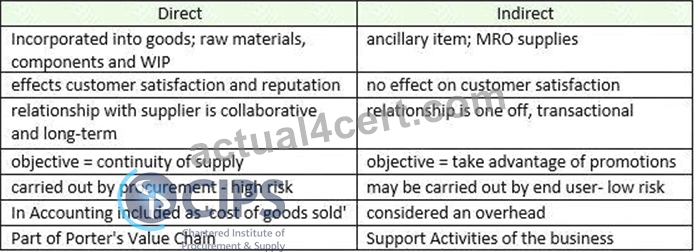
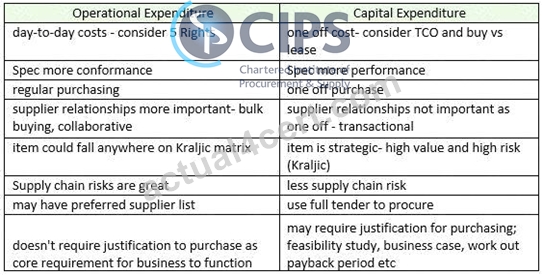
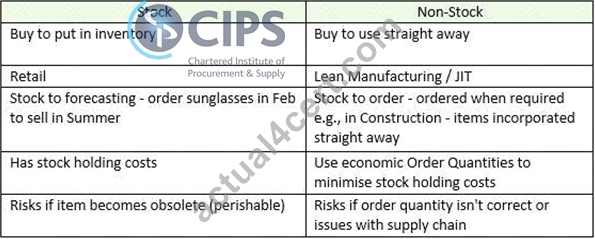
Essay Plan :
Remember to include examples for each of the six categories of spend. This is specifically asked for in the question so it's important to include as many examples as you can. To do this you could take an example organisation such as a cake manufacturer and explain which of their purchases would fall into each category and why.
Introduction - explain why procurement categorises spend
- Direct - these are items that are incorporated into the final goods (the cakes) so would include raw materials such as flour, eggs, sugar etc
- Indirect - these are items that the company needs, but don't go into the end product. For example, cleaning products and MRO supplies for the machines
- Capital Expenditure- these are large one-off purchases, such as buying a new piece of equipment such as a giant oven to cook the cakes.
- Operational Expenditure - these are purchases that are required to ensure the business can function day-to-day. They may include PPE for the workers in the factory and cleaning equipment
- Stock items - these are items procured in advance and held in inventory until they are needed. In a cake manufacturing factory this could be PPE for staff such as hairnets and gloves. The organisation will buy these in bulk and keep them in a stock cupboard, using these as and when they are required
- Non- stock items - items that are not stored and used right away. An example would be eggs- these will need to be put directly into the cakes as they would go off if bought in advance.
Conclusion - the categories are not mutually exclusive - an item can be direct and operational, or indirect and stock. Different companies may use different systems to classify items of spend.
Example Introduction and Conclusion
Introduction
Procurement categorizes spend to efficiently manage resources and make strategic decisions. Three primary ways of categorizing procurement spend include distinguishing between direct and indirect spend, classifying expenditures as capital or operational, and categorizing items as stock or non-stock. These distinctions aid organizations in optimizing their procurement strategies for better resource allocation.
Conclusion:
In conclusion, categorizing procurement spend into direct vs. indirect, capital vs. operational, and stock vs.
non-stock items is essential for strategic resource management. While these categories provide a structured framework, they are not mutually exclusive, as an item can fall into multiple categories. For example, an item may be both direct and operational or indirect and stock. The flexibility of these categories allows organizations to tailor their procurement strategies based on their specific needs, ensuring efficient resource allocation and effective supply chain management. Different companies may adopt varying categorization approaches depending on their industry, size, and operational requirements.
Tutor notes:
- Because you've got 6 categories of spend to talk about you're only going to need 3-4 sentences for each.
Providing you've said the category, explained what it is and given one example, you'll absolutely fly through this type of question
- You could also mention that it is useful to use categories of spend as this helps with budgeting. Different categories may also have different processes to follow for procuring the item (this could form part of your introduction or conclusion).
- This subject is LO 1.3.2 it's quite spread out in the text book but the main info is on p.49
- Note- different companies/ industries classify items of spend differently. Particularly packaging and salaries.
Some say they're direct costs and some say they're indirect costs. Honestly, it's a hotly debated subject and I don't think there is a right or wrong. I'd just avoid those two examples if you can and stick to ones that aren't as contentious like eggs and PPE.
NEW QUESTION # 30
What is an electronic system? Describe the following: e-requisitioning, e-catalogues, e-sourcing, e-payment technologies (25 marks)
Answer:
Explanation:
See the solution in Explanation part below.
Explanation:
How to approach this question:
- Your response will need 5 definitions. For 25 points that means 5 points per section so think about the level of detail you'll need to include. It would be 5 points for electronic system (i.e. your introduction and conclusion), and then do a paragraph on each of the technologies. In the description you could talk about why it's used and the advantages, and give some examples if you know any.
- Definition of electronic system - a system which uses some form of technology and automates a procurement process than would otherwise have been completed manually.
- E-Requisitioning - a way of ordering goods or services. Includes the use of integrated ordering systems such as: ERP/ ERP II / MRP / MRP II
- E-Catalogue- an electronic display of what goods can be ordered. A simple example of this may be a supplier displaying the goods they offer on their website and the prices to purchase the goods.
- E-Sourcing - this involves the early stages of the tender process- using an electronic portal to find a supplier and / or conduct a tender exercise.
- E-Payment - the P2P part of the cycle (procure to pay) - may involve electronic POs and Invoices, BACS, CHAPS and SWIFT payment systems, and the use of Purchasing Cards Example essay:
Electronic systems, commonly refered to as E-procurement, is the business-to-business or business-to- consumer purchase of goods or services, typically using the Internet or other information/ networking systems such as ERP systems. It has developed in the past 20 years as technology has improved and replaces time- consuming manual processes and is now considered the 'norm'. Electronic systems and e-procurement can be used throughout the entire supply chain- not just between a single buyer and supplier. Examples of electronic systems including the following:
E-requisitioning
This is often used in manufacturing organisations to order raw materials. An electronic 'bill of materials' is created and stock levels are automatically updated. As materials get used and a pre-determined level is reached, this triggers a new order which is placed via an e-requisitioning system such as MRP. It is a technological version of the traditional kan-ban (2 bin) system. E-requisition tools are often cloud-based. It helps buyers simplify the buying process, track orders and provides higher levels of visibility on spend. The main disadvantage to this technology is that it requires technology interfacing between the buyer and suppler, which may be expensive.
E-catalogues
This is a digital or online version of a catalogue- a document that details what you can buy and at what price.
There are two main types - buy side catalogues and sell side catalogues. A buy-side catalogue is an internal system used by a buyer which hosts a list of pre-approved suppliers from whom purchases can be made. It may include details of commonly bought items and the prices. The use of this reduces maverick spending and ensures consistency in purchases (e.g. whenever lightbulbs need to be ordered, the same lightbulbs are ordered so the office lighting is consistent). A sell-side catalogue is provided by a supplier and details what they offer- it often includes prices, any discounts for bulk buying and may also let buyers know of availability (e.g. the website may say only two items remaining). This may be as simple as a price list on their website, available for anyone to view.
E-sourcing
This is a tool that helps a buyer find the most suitable supplier. Examples include e-tendering websites where a buyer can host a competition to find a supplier. E-auctions are also a type of e-sourcing tool. The tool (often a website) hosts all of the tendering documents and allows for buyers and suppliers to communicate during the tender process (for example if there are any clarifications needed on the specification). Using this tool allows for transparency and equal treatment, but also saves time in completing the tender exercise. PQQs can be automated and some e-sourcing tools include the use of Artificial Intelligence which can 'read' tender submissions and automatically exclude suppliers who do not fulfil the required criteria.
E-payment technologies
These are methods to pay for goods and services that replace the need for cash and cheques. Examples include online bank transfers, electronic Purchase Orders and Invoices and the use of Pre-Payment cards. These act like credit cards for employees to use when they need to buy supplies. For example, if you have a maintenance team that frequently need to purchase low-value items like screws and paint, you could issue the team with a Pre-Payment card with a certain limit (e.g. £500/ month) so they can buy what they need. The company will then automatically be sent a monthly invoice for all of the purchases. This saves time from having to issue the maintenance team with petty cash for the purchases and allows for greater visibility over spend (e.g. how many screws are typically bought per year?). Another typical use is for staff travel.
In conclusion, procurement teams benefit significantly from leveraging electronic tools, including e- requisitioning, e-catalogues, e-sourcing, and e-payment technologies. The adoption of these electronic tools brings about various advantages that enhance efficiency, transparency, cost-effectiveness, and overall effectiveness in the procurement process. Moreover E-procurement tools has helped develop the procurement function into a professional and respected function and allows for a more pro-active rather than reactive approach to purchasing.
Tutor Notes:
- Fun Fact! In the public sector, it is mandated that electronic systems are used in procurement (Public Contract Regulations 2015) as this helps to achieve the objectives of transparency and equal treatment. Where manual systems are used, it is easy to manipulate the tender process. For example, a buyer could read some tender submissions before the deadline for submission and no one would know, but with an electronic system this is impossible as it locks evaluators out until the deadline has passed and all bidders have submitted their responses. (note PCR 2015 is being replaced in 2024- details are still TBC but the above fun fact will still remain in the new legislation- they're definitely still going to make it compulsory).
- You could also mention the names of systems if you know any. For example, e-sourcing tools include MyTenders.com and Delta E-Sourcing. PO / Invoice systems include Sage, Xero and QuickBooks.
- The question doesn't ask for advantages of using these technologies but you could mention this in your answer. Just be sure that this isn't the focus of your response- the question asks specifically for you to DESCRIBE the systems so detailed Explanation: s and examples are where you will secure the most points.
- p.108
NEW QUESTION # 31
Sarah is thinking of setting up a charity in the UK which will look after animals that have been abandoned.
What regulations and governing bodies should Sarah be aware of when setting up her charity? (25 Points)
Answer:
Explanation:
See the solution in Explanation part below.
Explanation:
How to approach this question
- Your essay should mention at least one regulation and one governing body particular to the charity section and I would recommend these be the Charities Act 2011 and the Charities Commission.
- If you don't know a lot about the sector you can bring up more generalised regulations and governing bodies, such as financial conduct and the Equalities Act, but make sure it's relevant to Sarah. Her charity is a small, local one, so things like Modern Slavery Act will not be appropriate to talk about.
Example Essay
When setting up a charity in the UK, particularly one focused on animal welfare, there are several regulations and governing bodies that Sarah should be aware of. These ensure that the charity operates legally, ethically, and effectively.
A charity's purpose involves raising awareness and helping someone or something, in Sarah's case this will be local animals and potentially their owners. A charity has to satisfy two aspects: The benefit aspect and The public aspect. In the UK, both aspects are regulated by the Charities Act 2011.
To satisfy a benefit aspect, a charity must: have a purpose that must be beneficial to the community it works in - this must be in a way that is identifiable and capable of beingproved by evidence. For Sarah this would be showing that her charity helps animals, potentially by taking them in off the street or removing them from dangerous homes and caring for them.
To satisfy a public aspect, a charity must benefit the public in general, or a sufficient section of the public. In Sarah's case the public benefit may be in removing stray dogs and cats from the streets where they can transport diseases and potentially attack people. Most charities strive to satisfy both aspects but in some cases this is not possible.
All charities are regulated. Because charities are funded by donations from the public, businesses and sometimes from government, their conduct is regulated closely. Key regulatory bodies that Sarah will have to engage with include:
1. Charity Commission for England and Wales:
As the primary regulator for charities in England and Wales, the Charity Commission oversees the registration and regulation of charities. Sarah's organization must meet the legal definition of a charity and apply for registration if its income is over £5,000 per year.
The Commission ensures compliance with the Charities Act, offering guidance on charity governance, financial management, and reporting.
2. HM Revenue and Customs (HMRC):
Charities can apply to HMRC for recognition as a charity for tax purposes. This status allows for tax reliefs and exemptions, including Gift Aid on donations.
HMRC ensures compliance with tax obligations and scrutinizes the use of charity funds.
3. Data Protection:
Under the General Data Protection Regulation (GDPR) and the Data Protection Act 2018, any charity handling personal data must ensure its protection and comply with data privacy laws.
4. Health and Safety Executive (HSE):
The HSE provides guidelines for workplace safety, which are important if the charity has employees or volunteers.
In conclusion there are many regulations and bodies that Sarah should be aware of when setting up her charity. Sarah should consider seeking legal advice or consulting with charity advisory services to ensure full compliance with all relevant laws and regulations. Additionally, staying informed about changes in charity law and animal welfare legislation would be beneficial to the smooth operation of her charity.
Tutor Notes
- With case study questions you're not expected to know anything about the specific topic, in this case Animal Charities. If it happens to be something you know about, you can bring in some of your own knowledge, but this isn't a requirement to get a good score. You're not expected to know, for example about the Animal Welfare Act 2006, but if you happen to do so, it could be a nice little thing to add in. Just don't focus your essay on it. However you can make some sensible guesses on what Sarah will be doing, for example I talked about removing stray animals from the street.
- Charities comes up in LO 4.4 p.232
NEW QUESTION # 32
Analyse FIVE different sources of added value in procurement
and supply.
(25 marks)
Answer:
Explanation:
See the solution in Explanation part below.
Explanation:
In procurement and supply, adding value means going beyond simple cost savings to enhance the overall contribution of procurement to the organization's objectives. Added value can be generated in multiple ways, impacting cost, quality, efficiency, innovation, and sustainability. Below are five key sources of added value in procurement and supply, analysed in detail:
1. Cost Reduction and Cost Avoidance
* Definition: Cost reduction involves lowering the actual purchase price of goods or services, while cost avoidance refers to actions that prevent costs from increasing in the future.
* Explanation: Through effective supplier negotiations, competitive tendering, bulk purchasing, and long-term contracts, procurement can achieve significant cost savings. Cost avoidance can come from proactive management of risks, improving contract terms, or optimizing specifications to prevent future price hikes.
* Impact: This directly improves the organization's profitability by reducing expenditure without compromising quality or service levels.
* Example: Renegotiating supplier contracts to achieve better rates or standardizing materials to reduce complexity and cost.
2. Improved Quality and Performance
* Definition: Enhancing the quality of goods and services procured to meet or exceed organizational needs.
* Explanation: Procurement contributes added value by specifying and sourcing higher quality materials or services that reduce defects, returns, and downtime. Better quality improves customer satisfaction and product reliability.
* Impact: Higher quality inputs lead to better outputs, reducing internal failures and enhancing brand reputation.
* Example: Working with suppliers to implement quality assurance processes or selecting suppliers with robust certification and testing capabilities.
3. Innovation and Supplier Collaboration
* Definition: Encouraging suppliers to contribute innovative ideas, technologies, or processes that benefit the organization.
* Explanation: Procurement can create value by fostering collaborative relationships with suppliers to drive product innovation, process improvements, and new market opportunities. Early supplier involvement can reduce development times and costs.
* Impact: Innovation enhances competitive advantage, supports new product development, and can open up new revenue streams.
* Example: Joint development projects with suppliers or using supplier expertise to redesign components for cost efficiency and performance improvement.
4. Risk Management and Supply Continuity
* Definition: Identifying and mitigating risks in the supply chain to ensure uninterrupted supply.
* Explanation: Procurement adds value by assessing supplier reliability, geopolitical risks, financial stability, and logistical challenges to minimize disruptions. Contingency planning and diversified sourcing reduce vulnerability.
* Impact: Reliable supply chains prevent costly production stoppages and reputational damage, contributing to operational resilience.
* Example: Developing dual sourcing strategies or monitoring supplier performance and compliance continuously.
5. Sustainability and Corporate Social Responsibility (CSR)
* Definition: Integrating environmental and social considerations into procurement decisions.
* Explanation: Procurement adds value by selecting suppliers who comply with sustainability standards, ethical labor practices, and environmental regulations. This aligns with organizational CSR goals and reduces negative impacts.
* Impact: Enhances brand image, meets regulatory requirements, and can reduce waste and resource consumption.
* Example: Choosing suppliers with certified green practices or implementing circular economy principles in supply chains.
Conclusion:
Added value in procurement and supply extends beyond price savings to include quality enhancement, innovation, risk mitigation, and sustainability. By strategically managing supplier relationships and aligning procurement activities with organizational goals, procurement professionals can deliver significant and measurable benefits that improve competitive advantage and organizational performance.
NEW QUESTION # 33
Explain, with examples, the three different ways one can categorise procurement spend: direct vs indirect, capital expenditure vs operational expenditure and stock vs non-stock items. (25 points)
Answer:
Explanation:
See the solution in Explanation part below.
Explanation:
The knowledge to remember:
A table with text on it Description automatically generated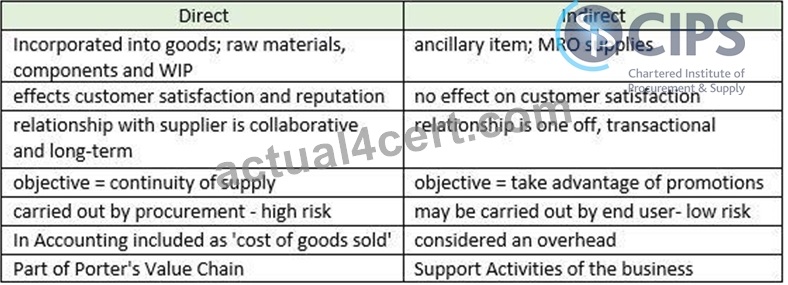
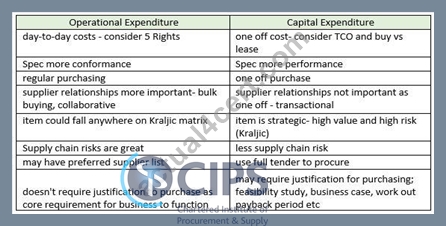
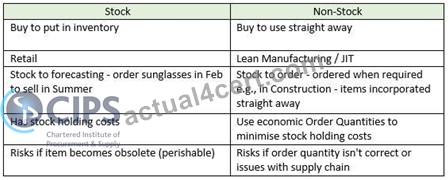
Essay Plan :
Remember to include examples for each of the six categories of spend. This is specifically asked for in the question so it's important to include as many examples as you can. To do this you could take an example organisation such as a cake manufacturer and explain which of their purchases would fall into each category and why.
Introduction - explain why procurement categorises spend
- Direct - these are items that are incorporated into the final goods (the cakes) so would include raw materials such as flour, eggs, sugar etc
- Indirect - these are items that the company needs, but don't go into the end product. For example, cleaning products and MRO supplies for the machines
- Capital Expenditure- these are large one-off purchases, such as buying a new piece of equipment such as a giant oven to cook the cakes.
- Operational Expenditure - these are purchases that are required to ensure the business can function day-to- day. They may include PPE for the workers in the factory and cleaning equipment
- Stock items - these are items procured in advance and held in inventory until they are needed. In a cake manufacturing factory this could be PPE for staff such as hairnets and gloves. The organisation will buy these in bulk and keep them in a stock cupboard, using these as and when they are required
- Non- stock items - items that are not stored and used right away. An example would be eggs- these will need to be put directly into the cakes as they would go off if bought in advance.
Conclusion - the categories are not mutually exclusive - an item can be direct and operational, or indirect and stock. Different companies may use different systems to classify items of spend.
Example Introduction and Conclusion
Introduction
Procurement categorizes spend to efficiently manage resources and make strategic decisions. Three primary ways of categorizing procurement spend include distinguishing between direct and indirect spend, classifying expenditures as capital or operational, and categorizing items as stock or non-stock. These distinctions aid organizations in optimizing their procurement strategies for better resource allocation.
Conclusion:
In conclusion, categorizing procurement spend into direct vs. indirect, capital vs. operational, and stock vs.
non-stock items is essential for strategic resource management. While these categories provide a structured framework, they are not mutually exclusive, as an item can fall into multiple categories. For example, an item may be both direct and operational or indirect and stock. The flexibility of these categories allows organizations to tailor their procurement strategies based on their specific needs, ensuring efficient resource allocation and effective supply chain management. Different companies may adopt varying categorization approaches depending on their industry, size, and operational requirements.
Tutor notes:
- Because you've got 6 categories of spend to talk about you're only going to need 3-4 sentences for each.
Providing you've said the category, explained what it is and given one example, you'll absolutely fly through this type of question
- You could also mention that it is useful to use categories of spend as this helps with budgeting. Different categories may also have different processes to follow for procuring the item (this could form part of your introduction or conclusion).
- This subject is LO 1.3.2 it's quite spread out in the text book but the main info is on p.49
- Note- different companies/ industries classify items of spend differently. Particularly packaging and salaries.
Some say they're direct costs and some say they're indirect costs. Honestly, it's a hotly debated subject and I don't think there is a right or wrong. I'd just avoid those two examples if you can and stick to ones that aren't as contentious like eggs and PPE.
NEW QUESTION # 34
Explain FIVE differences between capital expenditure and operational expenditure categories of spend for an organisation.
(25 marks)
Answer:
Explanation:
See the solution in Explanation part below.
Explanation:
When discussing capital expenditure (CapEx) and operational expenditure (OpEx) in the context of procurement and supply, it is essential to understand how they impact an organization's financial planning, decision-making, and procurement strategy. Below are five key differences between CapEx and OpEx:
1. Definition and Nature of Spend
* Capital Expenditure (CapEx): Refers to investments made by a company to acquire, upgrade, or maintain physical assets such as property, machinery, or equipment. These are typically large, one-time purchases that provide long-term benefits.
* Operational Expenditure (OpEx): Involves day-to-day expenses required to run the business, such as salaries, rent, utilities, and consumables. These costs are necessary for ongoing operations.
2. Accounting Treatment
* CapEx: Considered a long-term investment, it is capitalized and recorded as an asset on the balance sheet. Depreciation or amortization is applied over the useful life of the asset.
* OpEx: Fully expensed in the profit and loss statement in the accounting period in which it is incurred.
It directly impacts the organization's profitability in the short term.
3. Budgeting and Approval Process
* CapEx: Requires substantial financial planning, detailed justification, and approval from senior management due to its high-cost implications. It often involves long-term financial commitment.
* OpEx: Generally included in the organization's operating budget and does not require extensive approval processes, as it consists of routine expenses necessary for daily business functions.
4. Impact on Cash Flow and Financial Planning
* CapEx: Affects cash flow significantly as it requires large upfront payments. Organizations often finance CapEx through loans, leasing, or long-term financial strategies.
* OpEx: Represents smaller, recurring costs that are easier to manage and predict within the financial year, allowing for more flexibility in cash flow management.
5. Examples of Procurement and Supply Considerations
* CapEx Examples: Purchasing manufacturing equipment, acquiring new office buildings, upgrading IT infrastructure (e.g., servers, data centers).
* OpEx Examples: Office supplies, utility bills, employee salaries, maintenance and repair costs, software subscriptions.
Conclusion
Understanding the distinction between capital expenditure and operational expenditure is essential for procurement and supply professionals to make informed financial decisions, align with corporate strategy, and ensure efficient resource allocation. Procurement teams must consider factors such as cost-benefit analysis, funding sources, and long-term value when determining the best approach for an organization's spending strategy.
NEW QUESTION # 35
What is meant by the 'Third Sector'? Describe the sector (10 points) and explain the main objectives of organisations who operate in this sector (15 points).
Answer:
Explanation:
See the solution inExplanation partbelow.
Explanation:
How to approach this question
- Description of the 'third sector' - the part of an economy comprising non-governmental and non-profit-making organisations including charities, voluntary and community groups, and cooperatives.
These organisations reinvest surplus profits back into the enterprise to further their objectives. This is worth 10 points so should be a good 2-3 paragraphs, with examples.
- Main objectives - these could include engaging with stakeholders, social or environmental aims, education, providing a service to the community, stewardship role. There's more points for this question so you should have more content here.
Example Essay
The 'Third Sector' refers to a segment of the economy distinct from the public (government) sector and the private (for-profit) sector. It encompasses a diverse range of non-governmental organizations (NGOs), charities, foundations, social enterprises, cooperatives, and other non-profit entities. These organizations are primarily driven by social, environmental, cultural, or community objectives rather than the pursuit of profit.
They often operate based on values such as democracy, equality, and social justice. The Third Sector plays a crucial role in providing services, advocating for social causes, and filling gaps left by the public and private sectors.
The third sector is often called the 'not-for profit' sector. It's distinguished from the private sector in that the main aim isn't to make money for money's sake. The main aim is to generate money to reinvest back into the organisation so that the organisation can achieve the purpose it was set up for. Whereas the private sector may exist solely to make money, the third sector has a 'higher aim'.
Organisations operate in a very narrow marketplace. They may be the only provider in that marketplace. For example the RNLI is the only operator of lifeboats and the only organisation that sets out to save lives at sea- there is no 'competitor'.
3rd Sector Organisations have multiple sources of income; e.g. subscriptions or donations, or from donated goods that they then sell on (such as Oxfam shops), fundraising activities or selling merchandise. The sector also has a wide range of stakeholders.
The third sector is subject to same regulations as private and public companies but also has its own regulations imposed by the Charities Commission. This is a statutory regulation body which checks charities are run for public benefit and not private advantage, ensures charities are independent, and sets out to remedy serious mismanagement. They can audit, offer advice and investigate complaints. Therefore the sector is highly regulated.
Organisations in this sector have a huge range of objectives depending on why they were set up. These can be very specific, for example: charities such as Cancer Research (objective- find a cure for cancer), Museums (objective- educate the public), CIPS (objective - provide professional services to a particular industry), trade unions (objective- defend the rights of workers), pressure groups (objective- change laws and practices they morally disagree with).
However organisations in this sector do have overarching objectives in common.
1. Survival - Generating Enough Money to Continue Operations: Survival is a fundamental objective for Third Sector organizations. Unlike for-profit entities, these organizations do not aim to generate profits for shareholders but need sufficient funding to sustain their operations. This funding often comes from donations, grants, fundraising activities, and sometimes income from services provided. The challenge lies in balancing the mission with the need for financial stability, ensuring that the organization can continue to serve its community and pursue its goals over the long term. Financial sustainability is crucial, particularly in a sector where funding sources can be uncertain and competition for donations is high.
2. Creating Awareness of Their Cause: Raising awareness is vital for Third Sector organizations, as it helps to educate the public, garner support, attract volunteers, and drive fundraising efforts. Awareness campaigns are essential in highlighting the issues these organizations address, whether it's health, environmental conservation, social justice, or cultural preservation. Effective communication strategies, including the use of social media, public events, and collaborations, are employed to reach a wider audience. The more people know about a cause, the more likely they are to support it, either through donations, volunteering, or advocacy.
3. Compliance with Regulations and the Charities Commission: Compliance with legal and regulatory requirements is a critical objective. In many countries, including the UK, Third Sector organizations are regulated by bodies like the Charities Commission. These organizations must adhere to specific legal standards, including financial transparency, governance practices, and ethical guidelines. Compliance ensures credibility and trustworthiness, which are essential for maintaining public confidence and the continued support of donors and volunteers. It also ensures that the organization operates within the law, avoiding legal issues that could jeopardize its mission.
4. Providing a Service to the Community: The core of a Third Sector organization's mission is to provide services or benefits to the community. These organizations often address needs that are unmet by the private or public sectors, focusing on improving the quality of life for certain populations or addressing specific societal issues. This objective can take many forms, from offering direct services like healthcare and education to advocating for policy changes that benefit underserved communities. The impact of these services on the community can be profound, often bringing about significant social change.
5. Fulfilling a 'Gap in the Market': Many Third Sector organizations exist to fill gaps in services not provided by the public or private sectors. A classic example is the provision of air ambulance services in the UK. While the government provides comprehensive healthcare services, there's a gap in the rapid transportation of critically ill patients, which is filled bycharities operating air ambulances. These organizations identify specific needs that are not adequately addressed and work to meet them, often innovating in the process. By fulfilling these gaps, they play a crucial role in complementing existing services and enhancing the overall welfare of society.
In conclusion, Third Sector organizations operate with a unique set of objectives that distinguish them from other sectors. Their focus on survival, awareness-raising, compliance, community service, and filling market gaps is essential not only for their existence but also for the significant societal impact they make. These objectives align with the overarching mission of the Third Sector to contribute positively to society, addressing needs and issues often overlooked by other sectors.
Tutor Notes:
- A strong essay will use real life examples of organisations in the third sector and their objectives. I've mentioned a couple above such as Cancer Research UK: Our strategy to beat cancer | Cancer Research UK and North West Air Ambulance Charity: Home | North West Air Ambulance Charity (nwairambulance.org.uk) but pick charities you know well.
- LO 4.4. P.230
NEW QUESTION # 36
In the supplier selection part of the Procurement Cycle, what criteria can a Procurement Manager use to ensure they award to the best supplier? (25 points)
Answer:
Explanation:
See the solution inExplanation partbelow.
Explanation:
How to approach this question:
- This is quite an open question and there are many different things you could mention. One way to approach it would be to use Carter's 10 Cs- discuss a couple of these. OR just give a couple of criteria in different paragraphs. Some ideas include: Supplier financial status, Reputation / References, Quality, Availability, CSR Policies / Ethics / Environmental considerations, Accreditations, Added Value. This list is not exhaustive.
- If you're going for Carter's 10 Cs you could name a couple of these: competency, consistency, capability, control, cost, cash, clean, communication, culture, commitment
- I don't think either approach is better or worse. Choose the criteria you know the most about and write about those.
- The question doesn't tell you how many criteria to name, so you have to make a judgement call here. I would aim for 5-6. But if you can only remember 4 that's fine. The main thing they're looking for is that you explain for each one 1) what it is 2) how procurement can check 3) why procurement would look at that criteria 4) an example. If you do too many you risk not going into enough detail on each. It's a balance. 5 is always a good number to aim for if the question doesn't state.
Example Essay
In the procurement cycle, the supplier selection phase is a critical juncture that demands consideration.
Procurement Managers shoulder the responsibility of identifying and awarding contracts to suppliers who not only meet immediate needs, but contribute to the long-term success of the organization. This essay explores various criteria a Procurement Manager can employ to ensure the selection of the best supplier: financial stability, reputation, quality, availability, CSR policies, and added value.
Financial stability is a foundational criterion in supplier selection. Assessing a supplier's financial status involves a multifaceted evaluation, with liquidity and gearing ratio taking center stage. The acid test, comparing short-term assets to liabilities, offers insights into a supplier's ability to settle debts promptly, with a ratio exceeding 1 indicating financial health. Meanwhile, the gearing ratio, reflecting the proportion of capital funded by loans,aids in gauging financial risk, with a ratio below 50% considered low-risk. Relying on published Profit and Loss statements and income statements, along with financial credit checks from platforms like Dun and Bradstreet, empowers Procurement Managers to make informed decisions. This financial scrutiny is imperative to avoid entering contracts with suppliers facing imminent financial struggles, safeguarding against potential disruptions to the supply chain.
Reputation and references are another pivotal criterion. Seeking references from previous contracts allows Procurement Managers to gauge a supplier's track record in successfully delivering on similar commitments.
Independent reviews and informal market inquiries supplement this information, providing a holistic understanding of a supplier's performance. However, caution is advised in overreliance on past performance, as variables like personnel changes or contract scale differences may impact outcomes. Recognizing that past shortcomings may have been addressed internally further emphasizes the need for a balanced approach to reference evaluation.
Thirdly, Quality. Beyond the product itself, considerations extend to the supplier's technological capabilities, manufacturing processes, and relevant accreditations such as ISO 9001. Physical visits to supplier sites may be warranted, especially for products like raw materials where samples can be requested. Adhering to recognized safety standards and assessing factors like fire retardancy ensures that the quality of manufactured goods aligns with established benchmarks.
Next, Availability is another important criteria to consider. Procurement Managers must evaluate a supplier's capacity and capability to meet specific requirements. Inquiries about existing contracts and flexibility in response to demand fluctuations provide insights into a supplier's commitment and responsiveness. Assessing the supplier's workload and the significance of the buyer in their client portfolio helps determine the level of attention and service the buyer can expect. A buyer may wish to avoid working for a supplier who is already stretched very thinly with other contracts.
Corporate Social Responsibility (CSR) policies and ethical considerations have gained prominence in supplier selection. Beyond legal compliance, Procurement Managers may scrutinize a supplier's history for convictions or negative press related to corruption, bribery, or fraud. The presence of a Modern Slavery Policy and Environmental Policy, along with relevant accreditations like ISO14001 or Fair Trade certification, attests to a supplier's commitment to ethical and sustainable practices. Procurement would likely seek to appoint a supplier who's CSR vision aligns with their own company's.
Lastly, added value is an important criteria to consider. This is particularly so for Public Sector Organizations governed by the Social Value Act. In addition to meeting contractual requirements, suppliers may offer knowledge sharing, training, improved processes, or contribute to social value by employing local community members or providing apprenticeships. This criterion aligns procurement decisions with broader organizational goals, enhancing the overall impact of supplier relationships and benefitting the local community.
In conclusion, a careful combination of financial scrutiny, reputation assessment, quality evaluation, availability considerations, CSR policies, and added value analysis forms the bedrock of effective supplier selection in the procurement cycle. Procurement Managers, armed with a holistic understanding of these criteria, should seek not only to fulfil immediate needs, but also consider the long-term impact of supplier appointments.
Tutor Notes
- A 'good' scoring answer (50-70%) will explain the criteria well and give examples. If you're looking for a distinction level answer (70% +) you could also mention advantages, disadvantages and risks associated with each of the criteria. For example, when looking at references and reputation it's important to know that a supplier would only ever provide a good reference to you, they would never tell you of a contract that failed.
Another example is that financial data may be skewed- a supplier may have a low score if they are just starting up or have recently remortgaged a property. It's therefore important to get a commentary as well as the figures
/ scores.
- You could also mention that criteria could be weighted e.g. more importance given to quality than financial status and also consider how easy or difficult it would be to get the information e.g. a supplier may say they have lots of availability to deliver the service you require, but they may just be saying this to win business.
How do you know for sure?
- Social Value Act isn't in this syllabus. If you work in Public Sector procurement it's something you'll be very familiar with. If you don't or you're outside of the UK do not worry about this. I've just included it to show how you can bring in your own knowledge to questions like this. You could think of particular criteria that's important to your industry and write about that. The Social Value Act: What is it, and why is it important? (samtaler.co.uk)
- Study guide p.77
NEW QUESTION # 37
......
L4M1 Dumps PDF - L4M1 Real Exam Questions Answers: https://www.actual4cert.com/L4M1-real-questions.html
L4M1 Exam [2025] Dumps CIPS PDF Questions: https://drive.google.com/open?id=1wD_Cv9oT50DL9ixcySOglf7OoQdk3IJ7