

[2026] Easy To Download H35-211_V2.5 Actual Exam Dumps Resources
Uplift Your H35-211_V2.5 Exam Marks With The Help of H35-211_V2.5 Dumps
Huawei H35-211_V2.5 exam is designed to test professionals' knowledge and skills in network access technologies. It includes a range of topics, such as network security, access control, wireless LAN, and authentication technologies. HCIP-Access V2.5 certification program is ideal for professionals who want to enhance their knowledge and skills in network access technologies and demonstrate their expertise to potential employers. The HCIP-Access V2.5 exam is recognized globally and is a valuable certification for professionals who want to advance their careers in the ICT industry.
NEW QUESTION # 63
If only one ONU connected to a PON port cannot be automatically discovered, the possible cause is that the hardware of the ONU is faulty.
- A. FALSE
- B. TRUE
Answer: B
NEW QUESTION # 64
(Multiple choice) Which of the following measures can be adopted by GPON in terms of traffic control?
- A. Flow-CAR
- B. GEM-CAR
- C. GEM mapping
- D. T-CONT-CAR
Answer: A,B,D
Explanation:
GPON traffic policing/shaping is commonly applied at multiple layers:
T-CONT rate control (T-CONT-CAR): controls upstream bandwidth per T-CONT.
GEM-port rate control (GEM-CAR): limits per GEM port.
Service flow rate control (Flow-CAR): enforces per-service policies.
GEM mapping is a forwarding association (service#GEM) and not itself a rate-control mechanism.
References: HCIP-Access V2.5 Study Guide (GPON QoS model: T-CONT, GEM, and service flow policing
/shaping).
NEW QUESTION # 65
(Multi-select) Network Management U2000 adds line templates to realize the mapping of user traffic flows to
GEM PORTS, including mapping modes(Radio)
- A. MAC
- B. 802.IP
- C. vlan
- D. PORT
Answer: B,C,D
NEW QUESTION # 66
On U2000, if an OLT PON port LED is not green, it indicates the PON port is faulty.
- A. Right
- B. Wrong
Answer: B
Explanation:
This is wrong. A PON port LED not green may indicate several states-not only a hardware fault. It can mean the port is administratively shutdown, no ONUs are registered, or the port is in an alarm or idle state depending on the LED color and blinking pattern. Fault requires correlation with alarms and performance counters in U2000, not LED color alone.
References: HCIP-Access V2.5-OLT maintenance and alarm interpretation; Huawei OLT Hardware Description & Indicator Guide (PON port LED states and meanings).
NEW QUESTION # 67
If the number of user ports configured in a service profile is different from that supported by an ONT, all user services on the ONT are unavailable.
- A. FALSE
- B. TRUE
Answer: B
NEW QUESTION # 68
Max-Forwards fields can be used in S1P messages to solve loop problems and avoid endless packet
forwarding.
- A. wrong
- B. Right
Answer: B
NEW QUESTION # 69
The OLT is configured to use IGMP Version 2. When the OLT receives an IGMPv3 Join (Report) message forwarded from an ONT, what action will it take?
- A. Send a specific-group query message
- B. Discard directly
- C. Normal forwarding
- D. Send a general (universal) group query message
Answer: B
Explanation:
Huawei multicast guidance stresses IGMP version compatibility: devices running an earlier version must interoperate only with hosts using the same or earlier version, otherwise v3 messages may not be processed.
In Huawei's multicast feature guidance for access devices (OLT side vs. user side), the behavior documented is that when the device is operating in IGMPv2, IGMPv3 Report messages from terminals are not processed- interoperation is restored only after the terminal/device side is downgraded to v2 (often driven by periodic queries that induce hosts to respond in v2). This maps operationally to dropping unsolicited IGMPv3 Reports when the OLT is fixed to v2. Huawei also recommends ensuring the device runs an IGMP version the same as or later than member hosts to avoid such loss. Therefore, with OLT fixed at v2, an incoming v3 Join is discarded.
NEW QUESTION # 70
(Radio) follow the multicast IP address 227. The correct multicast MAC address corresponding to 120.1.32 is
- A. 01-00-5e-78-01-20
- B. 01-00-5e-14-01-20
- C. 01-00-5e-78-01-32
- D. 01-00-5e-14-01-32
Answer: A
NEW QUESTION # 71
In video services, if the VOD service is normal but the live service encounters a black screen, which of the following are possible causes?
- A. The traffic profile corresponding to the OLT upstream multicast service flow is set to a low priority.
- B. DWRR is used for upstream congestion management of an OLT.
- C. On the ONU, the VLAN of the VoD service is different from that of the live service. On the OLT, there is only one video service stream.
- D. PQ is used for downstream congestion management of an OLT.
Answer: C
NEW QUESTION # 72
Multicast technology effectively solves the problem of single-point transmission and multipoint reception, and
realizes efficient data transmission from midpoint to multipoint in IP network.
- A. wrong
- B. Right
Answer: B
NEW QUESTION # 73
(Radio) The downstream effective bandwidth of a GPON PON port is:
- A. 1.25 Gbit/s
- B. 2.2 Gbit/s
- C. 2.5 Gbit/s
- D. 2 Gbit/s
Answer: C
Explanation:
GPON (per ITU-T G.984.x and Huawei OLT specifications) provides a downstream line rate of ~2.488 Gbit
/s, commonly denoted as 2.5 Gbit/s, and an upstream rate of ~1.244 Gbit/s (1.25 Gbit/s). Therefore, the downstream effective bandwidth option that matches GPON is 2.5 Gbit/s.
References: HCIP-Access V2.5-PON technology overview (GPON rates); Huawei OLT Product Description (GPON port downstream/upstream rates).
NEW QUESTION # 74
(Multiple choice) When the OLT main control board CPU is detected to be continuously high, the following are possible causes:
- A. Rogue ONU
- B. Network loops
- C. The user logged in illegally
- D. Cyber attacks
Answer: A,B,C,D
Explanation:
A persistently high CPU on the OLT main control board is typically driven by excessive control-plane load or abnormal traffic patterns. Common causes include:
Illegal login attempts generating authentication and logging overhead (A) Layer-2 loops leading to storms and protocol churn (B) DoS/scan/attack traffic stressing control/management processing (C) Rogue/misbehaving ONUs causing frequent state changes, registration flaps, or abnormal report traffic (D) All listed factors are recognized contributors to elevated CPU on access OLTs.
References: HCIP-Access V2.5 Study Guide (OLT Maintenance and Fault Location); Huawei OLT Maintenance Guide (High-CPU Causes and Handling: Loops, Attacks, Unauthorized Access, and ONU Abnormalities).
NEW QUESTION # 75
In the evolution from EPON to 10G-EPON, a smooth transition is achieved at the central office by adding WDM modules, and ODNs can coexist/reuse.
- A. False
- B. True
Answer: B
Explanation:
IEEE 802.3av (10G-EPON) explicitly enables coexistence of 1G-EPON and 10G-EPON on the same outside plant (ODN) by separating downstream wavelengths (1G ~1480-1500 nm vs 10G ~1575-1580 nm) and using dual-rate TDMA in the upstream (10G uses 1260-1280 nm within the broader 1G band). This wavelength plan and OLT capabilities allow operators to reuse existing ODN and achieve a smooth upgrade via WDM overlays at the OLT. Industry and standards materials emphasize this approach for incremental migration.
NEW QUESTION # 76
Different DBA need to be configured for different services. Drag the DBA to corresponding services. (Score only when all the answers are correct.)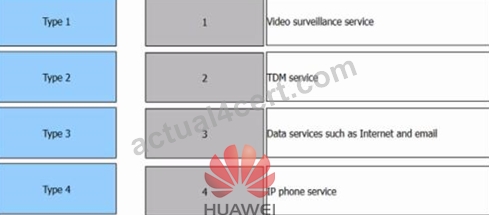
Answer:
Explanation: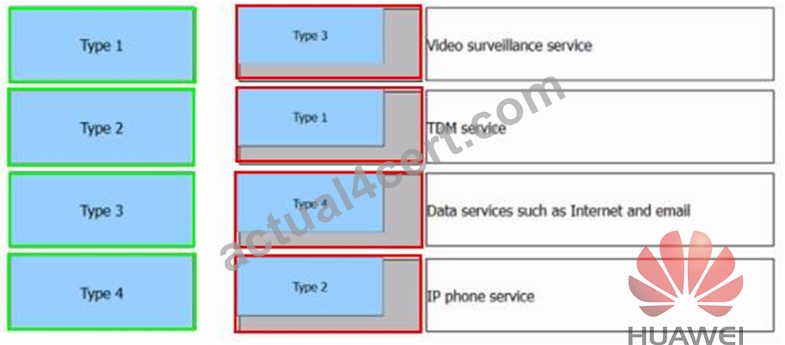
NEW QUESTION # 77
The DBA scheduling of the GPON system is only for the upstream traffic, and the downstream traffic cannot
be scheduled.
- A. False
- B. True
Answer: B
NEW QUESTION # 78
(Single choice) The following statement about ssH connection is incorrect, yes
- A. The ssH protocol is working at the network layer
- B. From a client perspective, SSH provides two levels of security authentication.
- C. ssH can be applied to remote encryption of encrypted file transfers over remote encryption connections
- D. The ssH protocol encrypts all transmitted data, effectively preventing information leakage problems
during remote management
Answer: A
NEW QUESTION # 79
In the evolution of EPON to 10g EPON, a smooth transition is achieved at the local end by adding AWDM
WDM module, and Odn coexists.
- A. True
- B. False
Answer: B
NEW QUESTION # 80
When the H.248 protocol is used to deploy the VoIP service, the registration information sent by the MG to the MGC contains the following information:
Services {Method=Restart Reason=[901]}
Which command can trigger the information?
- A. Reset coldstart
- B. ONT re-register
- C. Board restart
- D. Reboot system
Answer: C
Explanation:
The MG reports availability and restarts to the MGC using H.248 ServiceChange with Method=Restart. The Reason code distinguishes the type of restart. In Huawei implementations aligned with H.248 semantics, Reason=[901] corresponds to a warm/warmboard restart scenario rather than a full cold start.
Board restart triggers a warm restart of the voice board/MG, producing ServiceChange { Method=Restart, Reason=901 }.
Reset coldstart performs a cold start, which would use a different reason code (cold start), not 901.
Reboot system generally implies a broader device reboot similar to cold start semantics, not 901.
ONT re-register affects ONU registration and does not cause the MG to announce a ServiceChange restart to the MGC.
References: HCIP-Access V2.5 Study Guide (H.248 ServiceChange usage and restart reporting); Huawei VoIP/MG Board Maintenance Guide (warm vs cold restart indications in ServiceChange).
NEW QUESTION # 81
In video services, if the VOD service is normal but the live service encounters a black screen, which of the following are possible causes?
- A. The traffic profile corresponding to the OLT upstream multicast service flow is set to a low priority.
- B. DWRR is used for upstream congestion management of an OLT.
- C. On the ONU, the VLAN of the VoD service is different from that of the live service. On the OLT, there is only one video service stream.
- D. PQ is used for downstream congestion management of an OLT.
Answer: A,C
Explanation:
Live TV uses multicast, while VOD uses unicast. If VOD works but live TV is a black screen, typical causes are multicast service-path/config mismatches or priority starvation for multicast control/traffic:
C: If the ONU uses different VLANs for VOD and live but the OLT has only one video service flow, multicast frames will not match the correct service-port, causing black screen.
D: A low-priority traffic profile for multicast join/report or stream on the OLT uplink may drop IGMP joins or multicast packets under load, resulting in black screen while unicast VOD still passes.
Queue scheduling choices such as PQ or DWRR (A/B) are generic congestion schemes; by themselves they are not direct root causes of a live-only black screen unless mis-classified, whereas C and D are recognized multicast-specific fault points.
References: HCIP-Access V2.5 Study Guide - IPTV Multicast Service Flow, IGMP/Multicast QoS and Typical Faults (black screen with VLAN/service-port mismatch; priority of multicast control/stream).
NEW QUESTION # 82
......
Use Huawei H35-211_V2.5 Dumps To Succeed Instantly in H35-211_V2.5 Exam: https://www.actual4cert.com/H35-211_V2.5-real-questions.html
Ultimate Guide to H35-211_V2.5 Dumps - Enhance Your Future Career Now: https://drive.google.com/open?id=1RmT-ZoZPUd2RSegDXWeUefO2wWLTAeNh