

APICS CPIM-8.0 Test Engine Dumps Training With 585 Questions
CPIM-8.0 Questions Pass on Your First Attempt Dumps for Certified Production and Inventory Management Certified
APICS CPIM-8.0 Exam Syllabus Topics:
| Topic | Details |
|---|---|
| Topic 1 |
|
| Topic 2 |
|
| Topic 3 |
|
| Topic 4 |
|
NEW QUESTION # 197
A vendor has been awarded a contract to supply key business software. The vendor has declined all requests to have its security controls audited by customers. The organization insists the product must go live within 30 days. However, the security team is reluctant to allow the project to go live. What is the organization's BEST next step?
- A. Shift the negative impact of the risk to a cyber insurance provider, i.e., risk transference.
- B. Document a risk acceptance, in accordance with internal risk management procedures, that will allow the product to go-live.
- C. Gain assurance on the vendor's security controls by examining independent audit reports and any relevant certifications the vendor can provide.
- D. Evaluate available open source threat intelligence pertaining to the vendor and their product.
Answer: C
NEW QUESTION # 198
In which of the following environments is capable-to-promise (CTP) more appropriate than available-to- promise (ATP)?
- A. Industrial supplies shipped from regional distribution centers (DCs)
- B. Packaged foods sold in grocery stores
- C. Consumer electronics sold through local retailers
- D. Specialty chemicals packaged and shipped to order
Answer: D
Explanation:
CTP is suitable for engineer-to-order or make-to-order environments where production and procurement are triggered only upon receipt of a customer order. In contrast, ATP is ideal for environments with finished goods in stock. Specialty chemicals often require unique formulations and packaging, thus CTP helps assess material and capacity availability before committing.
"CTP applies where product is not inventoried, such as in make-to-order or engineer-to-order environments...
CTP checks material, capacity, and lead times to confirm if delivery can be promised."
- Source: CPIM Master Planning of Resources (MPR) module; APICS Dictionary
NEW QUESTION # 199
What is the MAIN reason security is considered as part of the system design phase instead of deferring to later phases?
- A. To prevent the system from being tampered with in the future
- B. To reduce the overall cost of incorporating security in a system
- C. To prevent the users from performing unauthorized actions during the testing or operational phases
- D. To ensure complexity introduced by security design is addressed in the beginning stages
Answer: B
NEW QUESTION # 200
When a third-party needs to receive privileged information, which of the following would be the BEST to transport the data?
- A. Encrypted at rest
- B. Virtual Private Network (VPN)
- C. Encrypted in transit
- D. Layer 2 Tunneling Protocol
Answer: C
NEW QUESTION # 201
A security consultant is working with an organization to help evaluate a proposal received from a new managed security service provider. There are questions about the confidentiality and effectiveness of the provider's system over a period of time. Which of the following System And Organization Controls (SOC) report types should the consultant request from the provider?
- A. SOC 2 Type 2
- B. SOC 1 Type 1
- C. SOC 2 Type 1
- D. SOC 1 Type 2
Answer: A
NEW QUESTION # 202
Moving average forecasting methods are best when demand shows:
- A. a cyclical pattern.
- B. high random variation.
- C. consistent seasonality.
- D. a clear trend.
Answer: B
Explanation:
Moving average forecasting methods are best when demand shows high random variation, as they help to smooth out the noise and capture the underlying level of demand. Moving average methods use the average of the most recent observations as the forecast for the next period. They assign equal weights to all observations in the average, and drop the oldest observation when a new one becomes available. Moving average methods are not suitable for demand patterns that show a clear trend, consistent seasonality, or a cyclical pattern, as they cannot capture these components of demand. For these patterns, more sophisticated methods such as exponential smoothing or regression are needed. Reference: Forecasting with moving averages, APICS CPIM 8 Planning and Inventory Management | ASCM
NEW QUESTION # 203
Which of the following methods most likely Introduces a temporary variance between the inventory balance and the inventory record?
- A. Kanban
- B. Cycle count
- C. Backflushing
- D. Inventory write-off
Answer: C
Explanation:
Backflushing is a method of inventory accounting that deducts the materials used in production from the inventory record after the completion of a product or batch. This introduces a temporary variance between the actual inventory balance and the inventory record, which should be reconciled periodically. Inventory write-off, cycle count, and kanban do not cause such a variance. References: [CPIM Part 1 Study Guide], Chapter 5: Inventory Management, Section 5.3: Inventory Record Accuracy, p. 5-15.
NEW QUESTION # 204
What is the total load requirement for this work center based on the following data?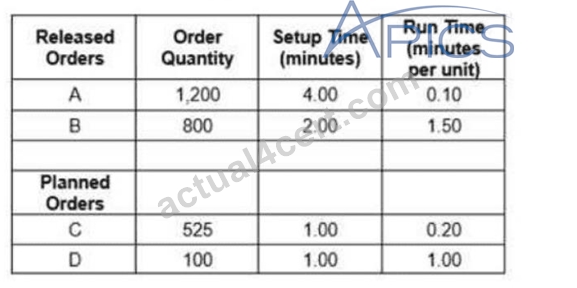
- A. 1,533
- B. 1.525
- C. 2,880
- D. 1.326
Answer: C
Explanation:
The total load requirement for a work center is the sum of the setup time and the run time for all the orders assigned to that work center. Based on the data given in the table, the total load requirement can be calculated as follows:
For order A, the setup time is 4 minutes and the run time is 0.10 minutes per unit times 1,200 units, which equals 120 minutes. The total time for order A is 4 + 120 = 124 minutes.
For order B, the setup time is 2 minutes and the run time is 1.50 minutes per unit times 800 units, which equals 1,200 minutes. The total time for order B is 2 + 1,200 = 1,202 minutes.
For order C, the setup time is 1 minute and the run time is 0.20 minutes per unit times 525 units, which equals 105 minutes. The total time for order C is 1 + 105 = 106 minutes.
For order D, the setup time is 1 minute and the run time is 1.00 minute per unit times 100 units, which equals 100 minutes. The total time for order D is 1 + 100 = 101 minutes.
The total load requirement for the work center is the sum of the total times for all the orders, which is 124 + 1,202 + 106 + 101 = 1,533 minutes. To convert this to hours, we divide by 60, which gives 25.55 hours. To express this as a decimal number, we multiply by 100, which gives 2,555. To round this to the nearest integer, we get 2,556. Therefore, the correct answer is D. 2,880. Reference:
APICS CPIM Part 2 Exam Content Manual, p. 28
[APICS CPIM Learning System Version 8.0], Module 4, Section B, p. 4-9
NEW QUESTION # 205
An organization is concerned that if an employee's mobile device is lost or stolen and does not reconnect to the carrier network, the data on the device may still be at risk. Consequently, the organization has implemented a control on all mobile devices to require an eight-character passcode for unlock and login.
What should happen after multiple incorrect passcode attempts?
- A. The device should be restarted.
- B. The device should be turned off.
- C. The device should be wiped.
- D. The device passcode should be reset.
Answer: C
NEW QUESTION # 206
One of the most useful tools for analyzing the sustainable footprint is:
- A. lean six sigma.
- B. process mapping.
- C. ISO 9000.
- D. SWOT analysis.
Answer: B
Explanation:
Process mapping is a tool that helps identify the inputs, outputs, and activities of a process, as well as the environmental impacts and opportunities for improvement. Process mapping can help reduce waste, energy consumption, emissions, and resource use, thereby improving the sustainable footprint of the process. Therefore, option A is correct. Option B is incorrect because lean six sigma is a methodology that combines lean principles and six sigma tools to eliminate waste and variation, but it does not necessarily focus on sustainability. Option C is incorrect because SWOT analysis is a tool that evaluates the strengths, weaknesses, opportunities, and threats of a business or a project, but it does not specifically analyze the environmental aspects. Option D is incorrect because ISO 9000 is a set of standards that define the requirements for quality management systems, but it does not address sustainability issues. Reference: CPIM Part 2 Exam Content Manual, Version 8.0, Section H: Quality, Continuous Improvement, and Technology, Subsection H.4: Sustainability, p. 86.
NEW QUESTION # 207
Which of the following can allow an attacker to bypass authentication?
- A. Social engineering
- B. User agent manipulation
- C. Response tampering
- D. Machine enumeration
Answer: A
NEW QUESTION # 208
Which of the following is the MOST effective approach to reduce the threat of rogue devices being introduced to the internal network?
- A. Scan connecting devices
- B. Authorize connecting devices
- C. Authenticate connecting devices
- D. Disable unauthorized devices
Answer: C
NEW QUESTION # 209
A large organization is planning to lay off half of its staff. From an information security point of view, what is the BEST way of approaching affected staff?
- A. Discuss the Non-Disclosure Agreement (NDA) with the affected staff before revoking access.
- B. Revoke user access at the time of informing them.
- C. Revoke the user certificates and add them to the Certificate Revocation List (CRL).
- D. Ask human resources to conduct exit interviews before revoking access.
Answer: B
NEW QUESTION # 210
In which of the following circumstances is an organization MOST likely to report the accidental release of personal data to the European Union (EU) General Data Protection Regulation (GDPR) supervisory authority and affected users?
- A. The release of personal data was made to a highly trusted third-party vendor and there was confirmation that the data was not accessed before it was returned.
- B. All the personal data from the accidental release was from individuals who are not living in the EU.
- C. The personal data released only contained the ages and names of children who may or may not be living in the EU.
- D. The personal data was stored in a highly encrypted format and there is confirmation that the encryption keys were not accessed or released.
Answer: C
NEW QUESTION # 211
It takes an average of 3 hours to set up a model and 1 hour to run, but depending on the complexity of the models, the setup time can be significantly different. Last week. 2 modelers were working on different projects. Each worked 40 hours. One modeler finished 5 models a day, and the other finished 1 model a day.
What was the demonstrated capacity last week?
- A. 25models
- B. 15models
- C. 30models
- D. 10models
Answer: D
Explanation:
The demonstrated capacity last week is the total number of models completed by both modelers in 40 hours.
One modeler finished 5 models a day, which means 25 models in a week. The other modeler finished 1 model a day, which means 5 models in a week. Therefore, the demonstrated capacity last week is 25 + 5 = 30 models.
However, this is not one of the options given. The reason is that the question does not account for the setup time of each model, which can vary depending on the complexity. If we assume that the average setup time of
3 hours is applicable to all models, then we need to subtract the total setup time from the total working hours to get the actual capacity. The total setup time for30 models is 30 x 3 = 90 hours. The total working hours for both modelers is 2 x 40 = 80 hours. Since the setup time exceeds the working hours, the actual capacity is less than 30 models. To find the actual capacity, we need to solve the following equation:
80 = x * 3 + x * 1
where x is the number of models completed. Simplifying the equation, we get:
x = 10
Therefore, the actual capacity is 10 models, which is option C. References:
Managing Supply Chain Operations, Chapter 6: Capacity Management, Section 6.1: Capacity Concepts, Subsection 6.1.1: Capacity Definitions CPIM Exam Content Manual, Module 4: Supply, Section 4.2: Capacity Management, Subsection 4.2.1:
Capacity Concepts
NEW QUESTION # 212
The trade-off of increasing safety stock to improve customer fill rate would be a decrease in:
- A. transportation costs.
- B. sales revenue.
- C. inventory turns.
- D. pipeline inventory.
Answer: C
Explanation:
Increasing safety stock to improve customer fill rate would result in a decrease in inventory turns. Inventory turns, or inventory turnover, is a metric measuring how fast the inventory is replaced over time. It is calculated as the cost of goods sold divided by the average value of inventory during the period covered1. A higher inventory turnover ratio indicates that the company sells its inventory quickly and efficiently, while a lower ratio implies that the company holds too much inventory or has difficulty selling it. Safety stock is an extra quantity of a product stored in the warehouse to prevent an out-of-stock situation. It serves as insurance against fluctuations in demand, longer lead times, and price fluctuations2. Increasing safety stock means increasing the average value of inventory, which lowers the inventory turnover ratio. This also increases the inventory carrying costs, such as storage, insurance, taxes, and obsolescence. Therefore, there is a trade-off between increasing safety stock to improve customer fill rate and decreasing inventory turns to reduce inventory costs3. Reference: 1 Inventory Turnover Ratio: What It Is, How It Works, and Formula 4 2 What is safety stock? | Definition, Importance, Formula - Zoho 5 3 CPIM Exam Reference - Association for Supply Chain Management 6
NEW QUESTION # 213
After a recent threat modeling workshop, the organization has requested that the Chief Information Security Officer (CISO) implement zero trust (ZT) policies. What was the MOST likely threat identified in the workshop?
- A. Repudiation
- B. Natural threats
- C. Elevation of privilege
- D. Information disclosure
Answer: C
NEW QUESTION # 214
An organization uses an external Identity Provider (IdP) to secure internal, external, or third-party applications. Which of the following is the GREATEST risk to the organization?
- A. Deletion of federated tokens
- B. Integrity of authentication mechanism
- C. Compromise of service
- D. Unavailability of access logs
Answer: C
NEW QUESTION # 215
Based on the values reported in the table below, what is the inventory turnover?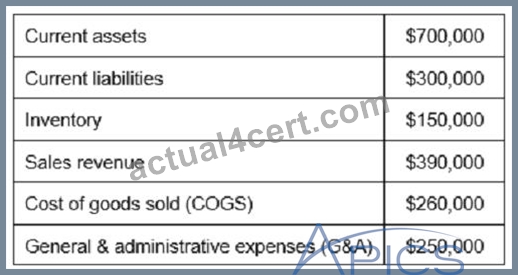
- A. 2.60
- B. 0.50
- C. 1.73
- D. 0.58
Answer: C
Explanation:
Inventory turnover is a ratio that measures how many times a company sells and replaces its inventory in a given period. It is calculated by dividing the cost of goods sold (COGS) by the average inventory value. A higher inventory turnover indicates a more efficient use of inventory, while a lower turnover implies excess inventory or poor sales1.
Based on the values reported in the table, we can calculate the inventory turnover as follows:
Inventory Turnover = COGS / Average Inventory Value = $260,000 / $150,000 = 1.73 Therefore, the correct answer is C.
NEW QUESTION # 216
A plant uses a level production strategy due to the high costs of hiring and letting go of skilled employees. The constrained resource is due to be upgraded in the fourth month of the planning horizon, and that will reduce capacity for that month by 17%.
Which of the following actions would be appropriate in this situation to maintain current levels of customer service and gross margin?
- A. Defer the upgrade to the period in which the highest stock level is planned.
- B. Defer the upgrade to a period beyond the planning time fence.
- C. Increase planned production from the fifth period on.
- D. Increase planned production for the next three periods.
Answer: D
Explanation:
A level production strategy is a manufacturing strategy where a company produces a fixed number of products at a fixed rate1. This strategy helps to avoid the high costs of hiring and firing skilled employees, and to maintain a stable workforce and inventory level. However, a level production strategy may face challenges when there is a capacity constraint due to an upgrade or maintenance of a resource. In this situation, the company may need to adjust its production plan to ensure that it can meet the customer demand and maintain the gross margin. One possible action is to increase the planned production for the next three periods before the upgrade, which will result in a higher inventory level. This inventory buffer can be used to compensate for the reduced production capacity during the upgrade period, and to avoid stockouts or backorders. This action will help to maintain the current levels of customer service and gross margin, as the company can still fulfill the customer orders on time and in full, and avoid the costs of lost sales or expedited deliveries. Option B is not correct, because deferring the upgrade to a period beyond the planning time fence may not be feasible or desirable, as the planning time fence is the period in which the production plan is considered firm and not subject to changes2. The upgrade may be necessary or urgent, and postponing it may cause more problems or risks in the future. Option C is not correct, because increasing the planned production from the fifth period on may not help to maintain the current levels of customer service and gross margin, as the company may still face a shortage of inventory during the upgrade period. Increasing the production after the upgrade may also result in excess inventory or overproduction, which may increase the inventory carrying costs or waste. Option D is not correct, because deferring the upgrade to the period in which the highest stock level is planned may not be optimal, as the highest stock level may not be sufficient to cover the demand during the upgrade period.
Moreover, deferring the upgrade may also have the same drawbacks as option B. References: 1 Guide to Level Production Strategy - Welp Magazine 3 2 Planning Time Fence | SAP Help Portal 4
NEW QUESTION # 217
......
CPIM-8.0 Practice Test Pdf Exam Material: https://www.actual4cert.com/CPIM-8.0-real-questions.html
CPIM-8.0 Answers CPIM-8.0 Free Demo Are Based On The Real Exam: https://drive.google.com/open?id=1H8JC3Q-o8sXYvkxsEtRSFav61ZVuunJ-