

Ultimate Guide to Prepare 1z0-071 with Accurate PDF Questions [Mar 09, 2026]
Pass Oracle With Actual4Cert Exam Dumps
ORACLE 1Z0-071 Exam Certification Path
To be qualified to take the ORACLE 1Z0-071 exam, you must meet the following requirements and prerequisites:
Oracle 1Z0-071 Dumps recommends that you should have at least one year of qualification or experience in the IT industry. If you do not have one year of experience, ORACLEs prerequisites are:
- You must have completed 60 undergraduate credits in Computer Science, Information Systems Management, Information Tech, or related discipline.
- Furthermore, you must complete 15 hours of college graduate coursework* in computer science, information systems management, or information technology coming from a regionally accredited institution.
- You must have scored 600 on the Computer Science Aptitude Test (CSAT) or 700 on the Graduate Management Admissions Test (GMAT).
- A prerequisite for Oracle 1Z0-071 is to have an understanding of the following concepts, which are listed below. The concepts are the foundation on which the Oracle Certification exam will be based. You should understand DML (data manipulation language).
The fundamental tenet of Oracle Database Administration is that before you can administer a database, you must know how to create one. This chapter covers the creation of database objects in general and goes into detail on creating tables, views managing, indexes, sequences, and triggers. It also discusses how to use PL/SQL code inside SQL statements to create object definitions or assignments without having to resort to interactively coding them inside SQL*Plus or through direct DDL statements with CREATE statements.
Oracle Corporation, the developer of the Oracle Database SQL certification exam, provides various resources to help candidates prepare for the exam. These resources include training courses, study guides, practice tests, and online forums. Oracle Corporation also offers a certification program that allows candidates to showcase their skills and knowledge in Oracle databases and SQL.
NEW QUESTION # 111
View the Exhibit and examine the structure of the PRODUCT_INFORMATION table.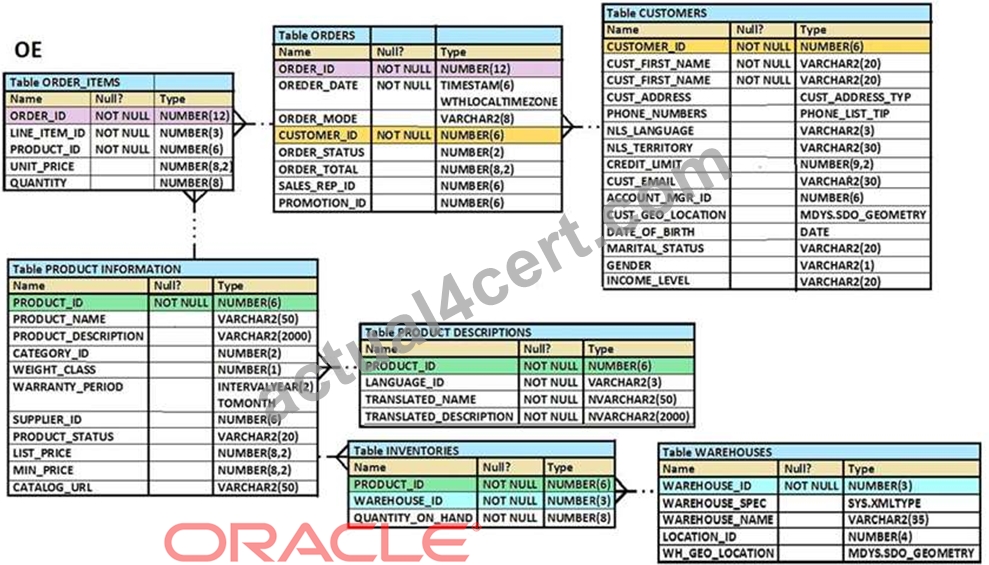
You want to see the product names and the date of expiration of warranty for all the products, if the product is purchased today. The products that have no warranty should be displayed at the top and the products with maximum warranty period should be displayed at the bottom.
Which SQL statement would you execute to fulfill this requirement?
- A. SELECT product_name, SYSDATE+warranty_period AS "Warranty expire date" FROM product_information WHERE warranty_period > SYSDATE
- B. SELECT product_name, SYSDATE+warranty_period AS "Warranty expire date" FROM product_information ORDER BY SYSDATE-warranty_period
- C. SELECT product_name, SYSDATE+warranty_period AS "Warranty expire date" FROM product_information ORDER BY SYSDATE
- D. SELECT product_name, SYSDATE+warranty_period AS "Warranty expire date" FROM product_information ORDER BY SYSDATE+warranty_period
Answer: D
NEW QUESTION # 112
Which three are true about system and object privileges
- A. Adding a foreign key constraint pointing to a table in another schema requires the REFERENCEs object privilege
- B. Adding a primary key constraint to an existing table in another schema requires a system privilege
- C. WITH GRANT OPTION cannot be used when granting an object privilege to PUBLIC
- D. Revoking a system privilege that was granted with the WITH ADMIN OPTION has a cascading effect.
- E. WITH GRANT OPTION can be used when granting an object privilege to both users and roles
- F. Revoking an object privilege that was granted with the WITH GRANT OPTION clause has a cascading effect
Answer: A,B,F
NEW QUESTION # 113
In the EMPLOYEES table there are 1000 rows and employees are working in the company for more than
10 years.
Evaluate the following SQL statement:
What would be the result?
- A. It executes successfully but no rows updated.
- B. It executes successfully and updates the records of those employees who have been working in the company for more than 600 days.
- C. It gives an error because NVL function cannot be used with UPDATE.
- D. It gives an error because multiple NVL functions are used in an expression.
Answer: B
NEW QUESTION # 114
Choose the best answer.
Examine the description of the EMPLOYEES table: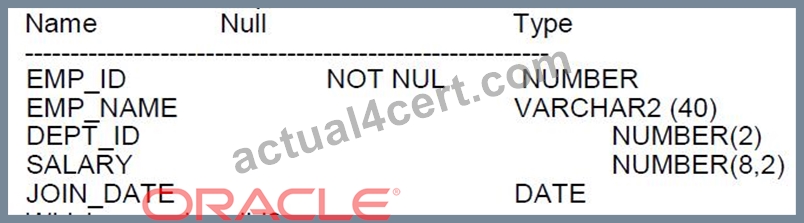
Which query is valid?
- A. SELECT dept_id,AVG(MAX(salary)) FROM employees GROUP BY dapt_id;
- B. SELECT depe_id,join_date,SUM(salary) FROM employees GROUP BY dept_id:
- C. SELECT dept_id,MAX(AVG(salary)) FROM employees GROUP BY dept_id;
- D. SELECT dept_id, join_date,SUM(salary) FROM employees GROUP BY dept_id, join_date;
Answer: D
NEW QUESTION # 115
View the Exhibit and examine the structures of the employees and departments tables.
You must update the employees table according to these requirements::
-Update only those employees who work in Boston or Seattle (locations 2900 and 2700).
-Set department_id for these employees to the department id corresponding to London (locationid 2100).
-Set the employees' salary in iocation_id 2100 to 1.1 times the average salary of their department.
-Set the employees' commission In location_id 2100 to 1.5 times the average commission of their department.
You issue this command:
What is the result?
- A. It executes successfully and produces the desired update.
- B. It generates an error because a subquery cannot have a join condition in an update statement.
- C. It executes successfully but does not produce the desired update.
- D. It generates an error because multiple columns cannot be specified together in an UPDATE statement.
Answer: C
NEW QUESTION # 116
Examine this data in the EMPLOYERS table: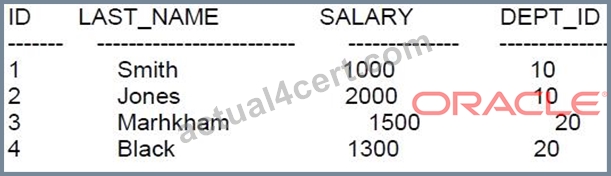
Which statement will execute successfully?
- A. SELECT dept_id, MAX (Last_name), SUM (salary) FROM employees GROUP BY dept_id
- B. SELECT dept_id, LENGTH (last_name), SUM (salary) FROM employees GROUP BY dept_id
- C. SELECT dept_id, INSTR (last_name,'A'), SUM (salary) FROM employees GROUP BY dept_id
- D. SELECT dept_id, STDDEV (last_name), SUM (salary) FROM employees GROUP BY dept_id
Answer: A
NEW QUESTION # 117
View the exhibit for the structure of the STUDENTand FACULTYtables.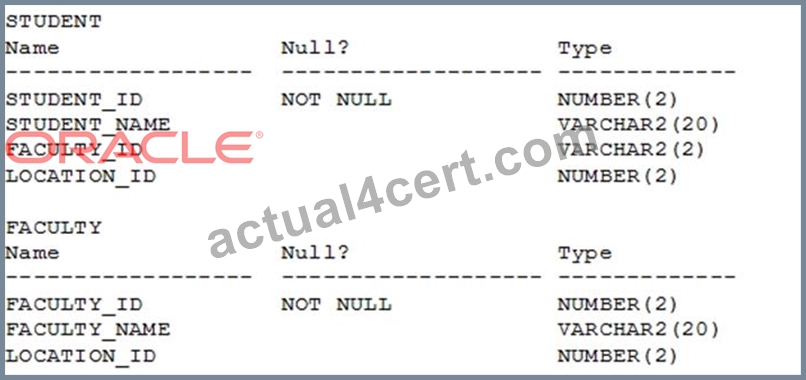
You need to display the faculty name followed by the number of students handled by the faculty at the base location.
Examine the following two SQL statements:
Statement 1
SQL>SELECT faculty_name, COUNT(student_id)
FROM student JOIN faculty
USING (faculty_id, location_id)
GROUP BY faculty_name;
Statement 2
SQL>SELECT faculty_name, COUNT(student_id)
FROM student NATURAL JOIN faculty
GROUP BY faculty_name;
Which statement is true regarding the outcome?
- A. Only statement 2 executes successfully and gives the required result.
- B. Both statements 1 and 2 execute successfully and give the same required result.
- C. Only statement 1 executes successfully and gives the required result.
- D. Both statements 1 and 2 execute successfully and give different results.
Answer: C
NEW QUESTION # 118
View the Exhibit and examine the structure of the PRODUCT_INFORMATION and INVENTORIES tables.
You have a requirement from the supplies department to give a list containing PRODUCT_ID, SUPPLIER_ID, and QUANTITY_ON_HAND for all the products wherein QUANTITY_ON_HAND is less than five.
Which two SQL statements can accomplish the task? (Choose two.)
- A. SELECT i.product_id, i.quantity_on_hand, pi.supplier_idFROM product_information pi JOIN inventories iON (pi.product_id=i.product_id)USING (product_id) AND quantity_on_hand < 5;
- B. SELECT i.product_id, i.quantity_on_hand, pi.supplier_idFROM product_information pi JOIN inventories iON (pi.product_id=i.product_id) AND quantity_on_hand < 5;
- C. SELECT product_id, quantity_on_hand, supplier_idFROM
product_informationNATURAL JOIN inventories AND quantity_on_hand < 5; - D. SELECT i.product_id, i.quantity_on_hand, pi.supplier_idFROM product_information pi JOIN inventories iON (pi.product_id=i.product_id)WHERE quantity_on_hand < 5;
Answer: B,D
NEW QUESTION # 119
Examine the data in the EMPLOYEES table:
Which statement will compute the total annual compensation for each employee?
- A. SELECT last _ name, (monthly _ salary * 12) + (monthly_ commission _ pct * 12) AS FROM employees;
- B. SELECT last _ name, (monthly_ salary * 12) + (monthly_ salary * 12 * NVL (monthly_ commission _pct, 0)) AS annual _comp
- C. SELECT last _ NAME (monthly_ salary + monthly _commission _ pct) * 12 AS annual_ comp FROM employees;
- D. select last _ name, (monthly_ salary * 12) + (monthly_ salary * 12 *monthly_ commission_ pct) AS annual_ camp FROM employees
Answer: B
NEW QUESTION # 120
Which two are SQL features?
- A. providing graphical capabilities
- B. providing variable definition capabilities.
- C. providing update capabilities for data in external files
- D. processing sets of data
- E. providing database transaction control
Answer: D,E
NEW QUESTION # 121
View the Exhibit and examine the description of the EMPLOYEES table.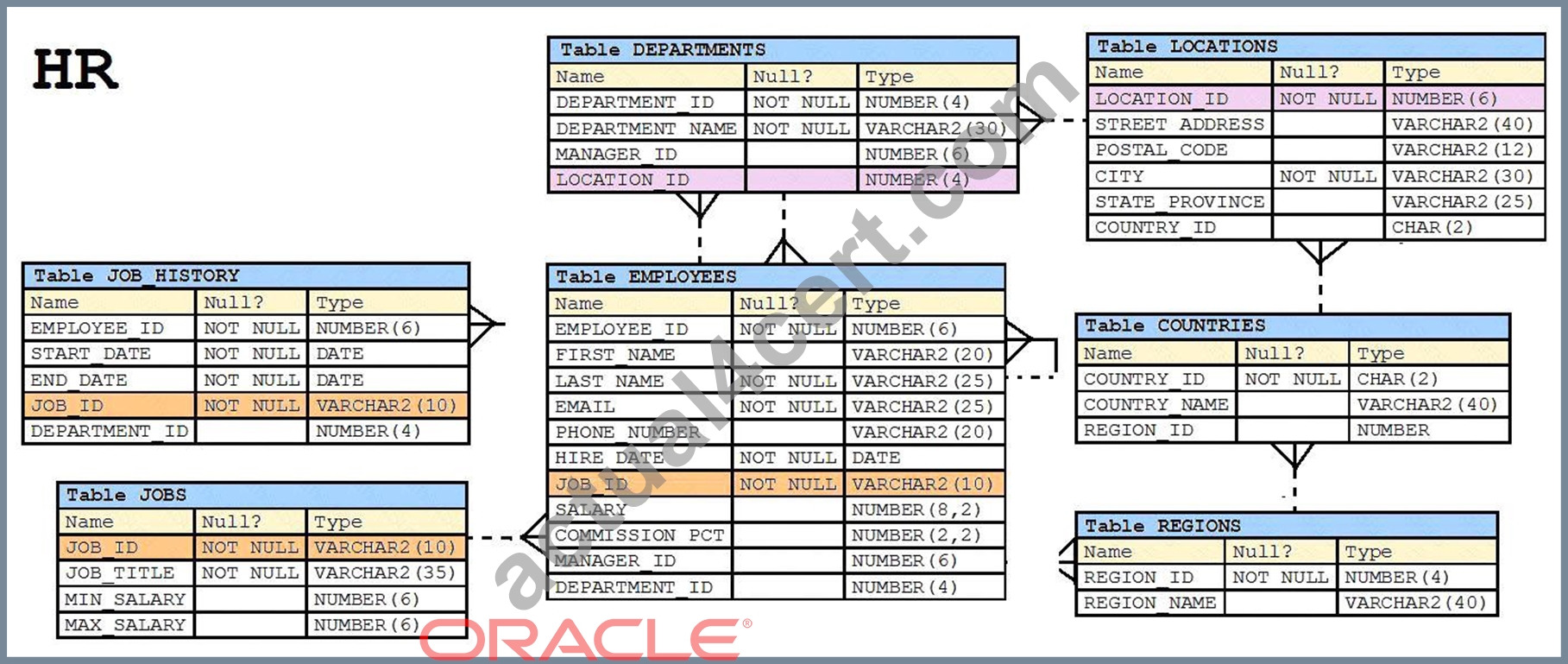
Evaluate the following SQL statement:
SELECT first_name, employee_id, NEXT_DAY(ADD_MONTHS(hire_date, 6), 1) "Review" FROM employees; The query was written to retrieve the FIRST_NAME, EMPLOYEE_ID, and review date for employees. The review date is the firsts Monday after the completion of six months of the hiring. The NLS_TERRITORY parameter is set to AMERICA in the session.
Which statement is true regarding this query?
- A. The query would not execute because the NEXT_DAY function accepts a string as argument.
- B. The query would execute but the output would give review dates that are Sundays.
- C. The query would not execute because date functions cannot be nested.
- D. The query would execute to give the desired output.
Answer: B
NEW QUESTION # 122
View the exhibit and examine the ORDERS table.
ORDERS
Name
Null?
Type
ORDER ID
NOT NULL
NUMBER(4)
ORDATE DATE
DATE
CUSTOMER ID
NUMBER(3)
ORDER TOTAL
NUMBER(7,2)
The ORDERS table contains data and all orders have been assigned a customer ID. Which statement would add a NOT NULL constraint to the CUSTOMER_ID column?
- A. ALTER TABLE ordersMODIFY CONSTRAINT orders_cust_id_nn NOT NULL (customer_id);
- B. ALTER TABLE ordersADD CONSTRAINT orders_cust_id_nn NOT NULL (customer_id);
- C. ALTER TABLE ordersMODIFY customer_id CONSTRAINT orders_cust_nn NOT NULL (customer_id);
- D. ALTER TABLE ordersADD customer_id NUMBER(6)CONSTRAINT orders_cust_id_nn NOT NULL;
Answer: C
NEW QUESTION # 123
Which two statements are true about the SET VERIFY ONcommand? (Choose two.)
- A. It can be used in SQL Developer and SQL*Plus
- B. It can be used only in SQL*Plus
- C. It displays values for variables prefixed with &&
- D. It displays values for variables used only in the WHEREclause of a query
- E. It displays values for variables created by the DEFINEcommand
Answer: B,E
Explanation:
Explanation/Reference: https://blogs.oracle.com/opal/sqlplus-101-substitution-variables#4_1_8
NEW QUESTION # 124
Examine the structure of the BOOKS_TRANSACTIONStable.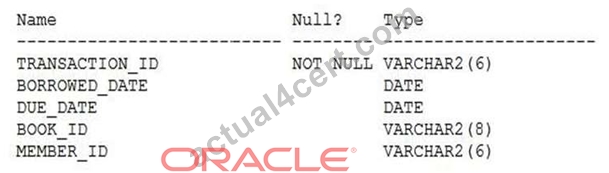
You want to update this table such that BOOK_IDis set to 'INVALID'for all rows where no MEMBER_ID has been entered.
Examine this partial SQL statement: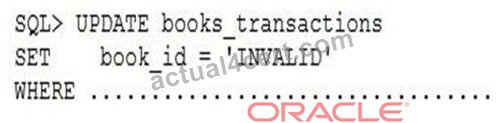
Which condition must be used in the WHEREclause to perform the required update?
- A. MEMBER_ID IS NULL;
- B. MEMBER_ID = '';
- C. MEMBER_ID = "";
- D. MEMBER_ID = NULL;
Answer: A
NEW QUESTION # 125
Examine the structure and data in the PRICE_LIST table: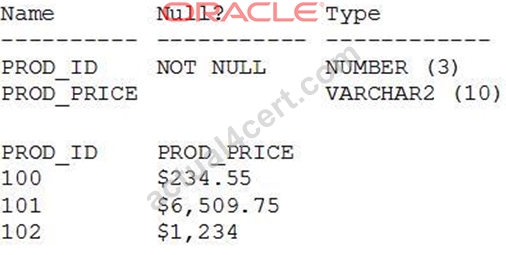
You plan to give a discount of 25% on the product price and need to display the discount amount in the same format as the PROD_PRICE.
Which SQL statement would give the required result?
- A. SELECT TO_CHAR (TO_NUMBER(prod_price, '$99,999.99') * . 25, '$99,999.00')FROM PRICE_LIST
- B. SELECT TO_NUMBER (TO_NUMBER(prod_price, '$99,999.99') * . 25, '$99,999.00')FROM PRICE_LIST
- C. SELECT TO_CHAR (TO_NUMBER(prod_price) * .25, '$99,999.00')FROM PRICE_LIST
- D. SELECT TO_CHAR (prod_price* .25, '$99,999.99')FROM PRICE_LIST
Answer: A
NEW QUESTION # 126
View the Exhibit and examine the structure of ORDERSand CUSTOMERStables.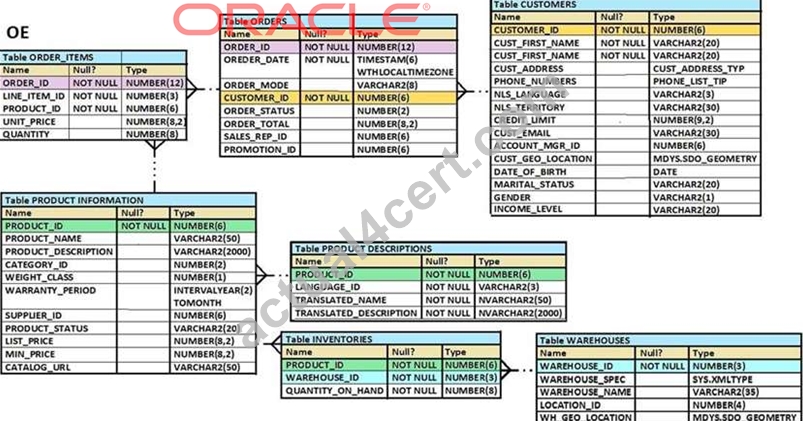
You executed this UPDATEstatement: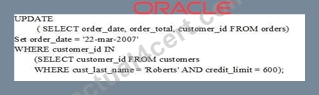
Which statement is true regarding the execution? (Choose the best answer.)
- A. It would not execute because a subquery cannot be used in the WHEREclause of an UPDATEstatement.
- B. It would execute and restrict modifications to the columns specified in the SELECTstatement.
- C. It would not execute because two tables cannot be referenced in a single UPDATEstatement.
- D. It would not execute because a SELECTstatement cannot be used in place of a table name.
Answer: B
Explanation:
Explanation/Reference:
NEW QUESTION # 127
On your Oracle 12c database, you invoked SQL *Loader to load data into the EMPLOYEES table in the HR schema by issuing the following command:
$> sqlldr hr/hr@pdb table=employees
Which two statements are true regarding the command? (Choose two.)
- A. It fails because no SQL *Loader data file location is specified.
- B. It succeeds with default settings if the EMPLOYEES table belonging to HR is already defined in the database.
- C. It fails because no SQL *Loader control file location is specified.
- D. It fails if the HR user does not have the CREATE ANY DIRECTORY privilege.
Answer: B,D
NEW QUESTION # 128
You execute this query:
SELECT TO CHAR (NEXT_DAY(LAST_DAY(SYSDATE),'MON' ),' dd"Monday for" fmMonth rrr') FROM DUAL; What is the result?
- A. It executes successfully but does not return any result.
- B. It returns the date for the last Monday of the current month.
- C. It generates an error.
- D. It returns the date for the first Monday of the next month.
Answer: D
NEW QUESTION # 129
......
Latest 1z0-071 Exam Dumps - Valid and Updated Dumps: https://www.actual4cert.com/1z0-071-real-questions.html
Fully Updated 1z0-071 Dumps - 100% Same Q&A In Your Real Exam: https://drive.google.com/open?id=1dwzK9HSav4C0lTUno2TtsQKlxb5Afwt_