

XSIAM-Analyst Dumps (2025) Prepare Your Exam With 152 Questions
New XSIAM-Analyst Dumps - Real Palo Alto Networks Exam Questions
NEW QUESTION # 29
While analyzing an active malware infection, what actions should an analyst take?
Response:
- A. Initiate live terminal session
- B. Isolate the endpoint
- C. Export logs to CSV
- D. Disconnect the firewall
Answer: A,B
NEW QUESTION # 30
A threat hunter discovers a true negative event from a zero-day exploit that is using privilege escalation to launch "Malware pdf.exe". Which XQL query will always show the correct user context used to launch
"Malware pdf.exe"?
- A. config case_sensitive = false | dataset = xdr_data | filter event_type = ENUM.PROCESS | filter action_process_image_name = "Malware.pdf.exe" | fields actor_process_username
- B. config case_sensitive = false | dataset = xdr_data | filter event_type = ENUM.PROCESS | filter action_process_image_name = "Malware.pdf.exe" | fields causality_actor_effective_username
- C. config case_sensitive = false | datamodel dataset = xdrdata | filter xdm.source.process.name = "Malware.
pdf.exe" | fields xdm.target.user.username - D. config case_sensitive = false | dataset = xdr_data | filter event_type = ENUM.PROCESS | filter action_process_image_name = "Malware.pdf.exe" | fields action_process_username
Answer: B
Explanation:
The correct answer isA- the query using the fieldcausality_actor_effective_username.
When analyzing events where privilege escalation is used, it is essential to identify the original effective user that initiated the causality chain, not merely the process's own running user (as provided by other fields). The fieldcausality_actor_effective_usernamespecifically provides the effective username context of the actor behind the entire chain of actions that resulted in launching the suspicious executable.
Explanation of fields from Official Document:
* causality_actor_effective_username: This field indicates the original effective user who started the entire causality chain.
* actor_process_usernameandaction_process_username: These fields indicate the immediate process username, not necessarily reflecting the correct original context when privilege escalation occurs.
Therefore, to always identify the correct user context in privilege escalation scenarios, optionAis the verified correct answer.
NEW QUESTION # 31
Match each prioritization mechanism with its function:
Mechanism
A) Incident Scoring
B) Alert Starring
C) Featured Fields
D) Incident Domains
Function
1. Assigns dynamic priority to incidents
2. Manually flagging alerts for importance
3. Provide context for faster investigation
4. Group alerts by threat or identity dimension
Response:
- A. A-1, B-2, C-3, D-4
- B. A-1, B-3, C-2, D-4
- C. A-1, B-2, C-4, D-3
- D. A-4, B-2, C-3, D-1
Answer: A
NEW QUESTION # 32
An alert involves credential dumping. Reviewing the causality chain, you notice the following:
- lsass.exe is accessed by powershell.exe
- Prior to this, cmd.exe launched the PowerShell script
What can you infer?
Response:
- A. There is an indicator of defense evasion
- B. Scripted behavior likely launched manually
- C. Possible credential access tactic
- D. It's a known benign service activity
Answer: A,C
NEW QUESTION # 33
Two indicators share a relationship with a command-and-control domain. What can the indicator graph reveal?
(Choose two)
Response:
- A. The causality chain of the indicators
- B. Related file hashes or domains
- C. How indicators are visually linked
- D. Whether an endpoint was isolated
Answer: B,C
NEW QUESTION # 34
What is the causality chain used for in Cortex XSIAM investigations?
Response:
- A. Identifying license usage
- B. Mapping users to devices
- C. Visualizing process relationships and execution flow
- D. Exporting reports for compliance
Answer: C
NEW QUESTION # 35
SCENARIO:
A security analyst has been assigned a ticket from the help desk stating that users are experiencing errors when attempting to open files on a specific network share. These errors state that the file format cannot be opened. IT has verified that the file server is online and functioning, but that all files have unusual extensions attached to them.
The security analyst reviews alerts within Cortex XSIAM and identifies malicious activity related to a possible ransomware attack on the file server. This incident is then escalated to the incident response team for further investigation.
Upon reviewing the incident, the responders confirm that ransomware was successfully executed on the file server. Other details of the attack are noted below:
* An unpatched vulnerability on an externally facing web server was exploited for initial access
* The attackers successfully used Mimikatz to dump sensitive credentials that were used for privilege escalation
* PowerShell was used on a Windows server for additional discovery, as well as lateral movement to other systems
* The attackers executed SystemBC RAT on multiple systems to maintain remote access
* Ransomware payload was downloaded on the file server via an external site "file io" QUESTION STATEMENT:
Which hunt collection category in Cortex XSIAM should the incident responders use to identify all systems where the attackers established persistence during the attack?
- A. Network Data
- B. Command History
- C. Process Execution
- D. Remote Access
Answer: D
Explanation:
The correct answer isA - Remote Access.
TheRemote Accesshunt collection category in Cortex XSIAM is specifically designed to help incident responders identify endpoints where attackers have installed remote access tools (RATs) or backdoors, which are classic methods of attacker persistence. In this scenario, the attackers executedSystemBC RATon multiple systems to maintain remote access, making the "Remote Access" category the most relevant for finding all endpoints where persistence was established.
"Remote Access hunt collections in Cortex XSIAM identify the presence of remote access tools such as RATs and backdoors used by attackers to maintain persistence on endpoints. Analysts should review this collection category after incidents involving tools like SystemBC RAT." Document Reference:XSIAM Analyst ILT Lab Guide.pdf, Page 28 (Alerting and Detection / Threat Intel Management sections)
NEW QUESTION # 36
Which configuration will ensure any alert involving a specific critical asset will always receive a score of 100?
- A. A user scoring rule for the critical asset
- B. An asset as critical in Asset Inventory
- C. A risk scoring policy for the critical asset
- D. SmartScore to apply the specific score to the critical asset
Answer: C
Explanation:
The correct answer isD, a risk scoring policy for the critical asset.
In Cortex XSIAM, to consistently apply a high score (e.g., 100) to any alert involving a particular asset, analysts should define and apply a risk scoring policy. Such policies allow organizations to specifically customize and enforce a scoring framework to reflect the critical nature of certain assets, ensuring they are always prioritized during incident response activities.
* Asset criticality alone (option A) doesn't automatically assign a static high score to every alert.
* SmartScore (option B) is AI-driven and dynamic; it cannot guarantee a fixed, always-maximized score.
* User scoring rules (option C) target user entities, not specifically the assets themselves.
"Risk scoring policies are explicitly defined to consistently assign specific scores to incidents or alerts involving critical assets, ensuring prioritized visibility in the incident queue."
NEW QUESTION # 37
Based on the image below, which two additional steps should a SOC analyst take to secure the endpoint?
(Choose two.)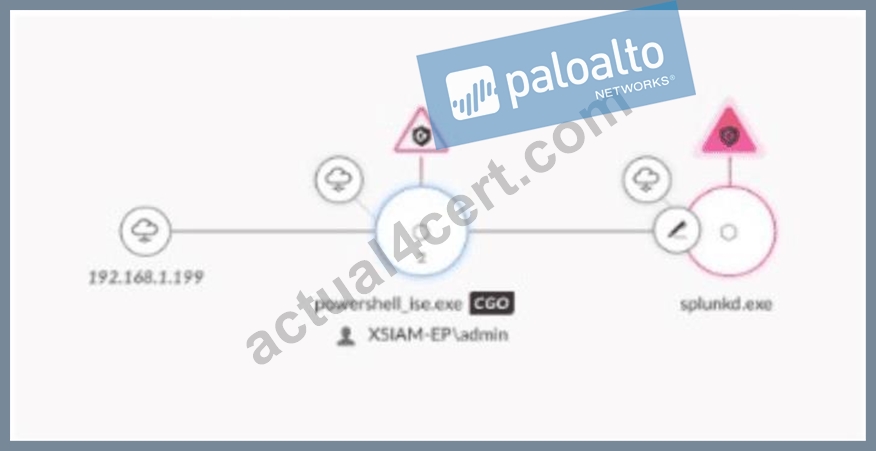
- A. Live Terminal into the workstation to verify.
- B. Reboot the machine.
- C. Block 192.168.1.199.
- D. Isolate the affected workstation.
Answer: C,D
Explanation:
Comprehensive and Detailed Explanation From Exact Extract:
The correct answers areC - Block 192.168.1.199andD - Isolate the affected workstation.
* Block 192.168.1.199:The image shows that the suspicious or malicious activity originated from this source IP address, making it a potential threat actor or compromised system on the network. Blocking this IP helps prevent further communication or lateral movement from the suspected attacker.
* Isolate the affected workstation:Since suspicious activities (like powershell_ise.exe running as an admin and launching splunkd.exe) are detected, isolating the workstation is a critical containment measure. This action disconnects the endpoint from the network, stopping any ongoing attack, lateral movement, or command-and-control activity, while allowing for forensic investigation.
"Isolating an endpoint and blocking the source IP address are best practices for immediate containment in the event of detected compromise or suspicious activity." Document Reference:XSIAM Analyst ILT Lab Guide.pdf Page:Page 40 (Incident Handling section)
NEW QUESTION # 38
Match each XDM type with the type of data it organizes:
XDM Type
A) xdm.network_traffic
B) xdm.endpoint_alert
C) xdm.process
D) xdm.file_event
Data Organized
1. Communication details between hosts
2. Alert data from XDR agent or third-party systems
3. Executed process and command-line activity
4. File read/write, access, and creation actions
Response:
- A. A-1, B-2, C-3, D-4
- B. A-1, B-3, C-2, D-4
- C. A-4, B-2, C-3, D-1
- D. A-1, B-4, C-3, D-2
Answer: A
NEW QUESTION # 39
What is a schema in the context of XQL?
Response:
- A. A structured description of dataset fields and types
- B. A list of SOC policies
- C. A prebuilt playbook
- D. A threat scoring mechanism
Answer: A
NEW QUESTION # 40
Which query will hunt for only incoming traffic from 99.99.99.99 when all log sources have been mapped to XDM?
- A. datamodel dataset = * filter XDM.ALIAS.ipv4 = "99.99.99.99"
- B. preset = network_story | filter agent_ip_addresses = "99.99.99.99"
- C. datamodel dataset = * | fields fieldset.xdm_network | filter xdm.source.ipv4 = "99.99.99.99"
- D. datamodel preset = * | filter XDM.ALIAS.ip = "99.99.99.99"
Answer: C
Explanation:
The correct answer isC. This query correctly filters only the incoming traffic from the specific IP address
"99.99.99.99":
* datamodel dataset = * sets the scope to all XDM-mapped datasets.
* fields fieldset.xdm_network explicitly limits the results to network events.
* filter xdm.source.ipv4 = "99.99.99.99" specifically targets traffic coming from (incoming) this source IP.
This query adheres to XDM standard data modeling and accurately captures incoming traffic from the specified IP address.
Other provided queries either incorrectly specify fields, presets, or filtering methods.
Therefore,Option Cis the verified, accurate query.
NEW QUESTION # 41
You're analyzing a suspicious process chain. Which two XDM datasets would help correlate process behavior with alert generation?
Response:
- A. xdm.asset
- B. xdm.file_event
- C. xdm.process
- D. xdm.endpoint_alert
Answer: C,D
NEW QUESTION # 42
You are reviewing incidents with similar sources. One incident is scored 80, another 35. What factors could account for this difference?
(Choose two)
Response:
- A. The alert volume in the queue
- B. Domain mapping within the alert
- C. Starring by the administrator
- D. Confidence level and alert severity
Answer: B,D
NEW QUESTION # 43
What is the role of importing indicators into Cortex XSIAM?
Response:
- A. To enrich investigations with external threat data
- B. To update firewall firmware
- C. To reset alert policies
- D. To automate endpoint isolation
Answer: A
NEW QUESTION # 44
What is the cause when alerts generated by a correlation rule are not creating an incident?
- A. The rule is using the preconfigured Cortex XSIAM alert field mapping.
- B. The rule does not have a drill-down query configured
- C. The rule has alert suppression enabled
- D. The rule is configured with alert severity below Medium.
Answer: D
Explanation:
The correct answer isA - The rule is configured with alert severity below Medium.
By default, in Cortex XSIAM,only alerts with a severity of Medium or higher will automatically generate incidents. If a correlation rule creates alerts with severity set below Medium (such as Low or Informational), these alerts willnotresult in the automatic creation of an incident. This ensures that incident queues are not filled with low-priority events.
"Incidents are generated only for alerts with severity of Medium or higher. Alerts below this threshold will not automatically create incidents." Document Reference:XSIAM Analyst ILT Lab Guide.pdf Page:Page 28 (Alerting and Detection section)
NEW QUESTION # 45
Which Cortex XSIAM feature displays the latest agent health and connection status?
Response:
- A. Incident scoring
- B. Correlation center
- C. Agent monitoring dashboard
- D. Live terminal
Answer: C
NEW QUESTION # 46
What is the primary purpose of XQL in Cortex XSIAM?
Response:
- A. Validating SOC analyst performance
- B. Querying telemetry data using structured commands
- C. Managing firewall rules
- D. Creating IOC suppression lists
Answer: B
NEW QUESTION # 47
What is the purpose of detection indicator rules?
Response:
- A. To detect specific behaviors and generate alerts
- B. To define alert suppression criteria
- C. To correlate XDR agent policies
- D. To manage threat hunting queries
Answer: A
NEW QUESTION # 48
Which action can be taken from the live terminal in XSIAM?
Response:
- A. Run custom OS commands on an isolated endpoint
- B. Create prevention indicator rules
- C. Export raw telemetry logs
- D. Block domains across all endpoints
Answer: A
NEW QUESTION # 49
What is the core purpose of attack surface rules?
Response:
- A. To define user access roles
- B. To detect and classify exposed services or CVEs
- C. To apply endpoint policy configurations
- D. To monitor email phishing attacks
Answer: B
NEW QUESTION # 50
Which of the following best defines a Cortex Data Model (XDM)?
Response:
- A. A script engine for executing remediation
- B. A predefined schema for organizing and querying telemetry data
- C. A policy validation tool
- D. A user-specific threat intelligence feed
Answer: B
NEW QUESTION # 51
An alert triggered by a correlation rule includes BIOC evidence and an IOC match. What can be inferred?
(Choose two)
Response:
- A. The alert contains evidence from multiple detection sources
- B. IOC-based alerts cannot be used in correlation
- C. Correlation rules can aggregate different alert types
- D. The alert was triggered by external threat feeds only
Answer: A,C
NEW QUESTION # 52
You notice a sudden spike in alerts from multiple endpoints. Cortex XSIAM automatically creates an incident. What are the two most likely factors that triggered this?
Response:
- A. Manual case creation by analyst
- B. Aggregated alerts with common indicators
- C. Predefined incident scoring threshold
- D. Matching a high-priority threat intelligence feed
Answer: B,D
NEW QUESTION # 53
You need to test a custom malware quarantine playbook. Why would you use the Playground?
(Choose two)
Response:
- A. To trigger alert notifications to users
- B. To simulate and debug response logic
- C. To avoid impacting live environments
- D. To export playbook results to XQL
Answer: B,C
NEW QUESTION # 54
......
Get Ready with XSIAM-Analyst Exam Dumps: https://www.actual4cert.com/XSIAM-Analyst-real-questions.html
Dependable XSIAM-Analyst Exam Dumps to Become Palo Alto Networks Certified: https://drive.google.com/open?id=1ZDgVcxN93ldXDe5nbwyElbXGL9fTggS2