

100% Pass Your 1Z0-931-20 Exam Dumps at First Attempt with Actual4Cert
Penetration testers simulate 1Z0-931-20 exam PDF
NEW QUESTION 56
When you choose to scale your Autonomous Database, which statement is true in regards to OCPUs and storage?
- A. Storage in TB cannot be larger than the number of OCPUs.
- B. OCPUs and storage can be scaled independently.
- C. OCPUs and storage must remain in sync.
- D. Increasing OCPUs will automatically increase storage.
Answer: D
Explanation:
You simply specify the number of OCPUs and the storage capacity in TB's for the database. At any time, you may scale, increase or decrease either the OCPUs or the storage capacity.
https://www.oracle.com/database/technologies/datawarehouse-bigdata/adb-faqs.html
NEW QUESTION 57
Which statement is FALSE about Autonomous Database Maintenance on dedicated Exadata infrastructure?
- A. You can change your container database maintenance window or reschedule a single container database maintenance run to ensure that your container database maintenance runs follow infrastructure maintenance within the same quarter.
- B. Autonomous Exadata Infrastructure maintenance runs are for infrastructure patching (including patching of the Exadata grid infrastructure code and operating systems updates), and include database patching.
- C. Autonomous Exadata Infrastructure maintenance takes place at least once each quarter and is mandatory.
- D. If a scheduled container database maintenance run cannot take place, Oracle will automatically reschedule the container database maintenance for the following quarter.
Answer: B
NEW QUESTION 58
When scaling OCPUs in Autonomous Database, which statement is true in regards to active transactions?
- A. Active transactions are paused.
- B. Scaling cannot happen while there are active transactions in the database.
- C. Active transactions continue running unaffected.
- D. Active transactions are terminated and rolled back.
Answer: C
Explanation:
Oracle allows you to scale compute and storage independently, no need to do it together, these scaling activities fully online (no downtime required)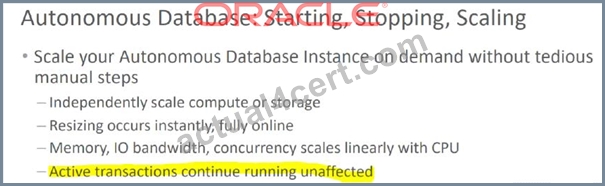
NEW QUESTION 59
Which Autonomous Database Service is NOT used to conned to an Autonomous Transaction Processing instance?
- A. HIGH
- B. TPPERFORMANT
- C. MEDIUM
- D. TPURGENT
- E. LOW
Answer: B
Explanation:
https://docs.oracle.com/en/cloud/paas/atp-cloud/atpug/connect-predefined.html#GUID-9747539B-FD46-
44F1-8FF8-F5AC650F15BE
NEW QUESTION 60
When running lots of high concurrent queries in Autonomous Database, you should use which predefined service connection?
- A. DBNAME_MEDIUM
- B. DBNAME_HIGH
- C. DBNAME_LOW
- D. DBNAME_CONCURRENT
Answer: C
Explanation:
https://docs.oracle.com/en/cloud/paas/autonomous-data-warehouse-cloud/user/manage-priorities.html#GUID-80E464A7-8ED4-45BB-A7D6-E201DD4107B7
https://docs.oracle.com/en/cloud/paas/atp-cloud/atpug/manage-priorities.html#GUID-80E464A7-8ED4-45BB-A7D6-E201DD4107B7
NEW QUESTION 61
A Corporation is building a web application to allow its customers to schedule service requests online. There is also a need to run operational reports at times during non-peak hours. The architecture team is debating whether such reports should be run on the OLTP database or in a separate data mart. The DBA Manager does not want to add anymore admin responsibility to the team and is looking for a database option that's low to zero maintenance, but meets their strict performance requirements as well.
Which Oracle Cloud Infrastructure database service is appropriate for this scenario?
- A. ATP. Using 'tpurgent' and 'high' TNS services to separate connection types.
- B. Since the application needs to be highly available, it should to be deployed on a Kubernetes Cluster.
- C. It is best to build a separate data warehouse, and move the OLTP data on a nightly basis.
- D. ADW since operational reporting is a higher priority in this scenario.
Answer: A
Explanation:
Autonomous Transaction Processing provides all of the performance of the market leading Oracle Database in an environment that is tuned and optimized to meet the demands of a variety of applications, including: mission-critical transaction processing, mixed transactions and analytics, loT, and JSON document store.
As a service Autonomous Transaction Processing does not require database administration. With Autonomous Transaction Processing you do not need to configure or manage any hardware, or install any software. Autonomous Transaction Processing handles creating the database, backing up the database, patching and upgrading the database, and growing or shrinking the database.
NEW QUESTION 62
Which three tasks by default are taken care of by the Autonomous Database? (Choose three.)
- A. Application User Creation
- B. Backups
- C. Data Loading
- D. Firmware Patching
- E. Database Upgrades
Answer: C,D,E
Explanation:
http://www.oracle.com/us/products/database/autonomous-database-self-securing-5116048.pdf (6)
NEW QUESTION 63
Which two statements are true with regards to Oracle Data Sync? (Choose two.)
- A. Data Sync can connect to any jdbc compatible source like MongoDB, RedShift and Sybase.
- B. Data Sync can use a normal OCI (thick) client connection to connect to an Oracle database.
- C. Data Sync has default drivers available that supported loading data from DB2, Microsoft SQL Server, MySQL and Teradata.
- D. Data Sync can load your data in parallel in order to speed up the loading process.
Answer: A,D
Explanation:
http://www.ateam-oracle.com/configuring-the-data-sync-tool-for-bi-cloud-service-bics
NEW QUESTION 64
What are two differentiators of Oracle Autonomous Database Dedicated Infrastructure?
- A. Users have OS access to the database machine.
- B. Users can customize the OS stack and add additional packages
- C. It offers greater control and isolation starting at the Exadata cloud infrastructure level.
- D. Users can customize the maintenance schedule.
- E. Users have SYS privileges in the database.
Answer: C,E
NEW QUESTION 65
For Fleet admins to access dedicated Exadata infrastructure, which policy should be assigned?
- A. Allow group ADB-Admins to manage autonomous-database in tenancy where target.workloadType =
'OLTP' - B. Allow group ADB-Admins to manage autonomous-database in tenancy where target.workloadType =
`DW' - C. Allow group ADB-Admins to manage autonomous-database-family in tenancy.
- D. Allow group ADB-Admins to manage autonomous-database in tenancy.
Answer: A
NEW QUESTION 66
If you need to connect to Autonomous Data Warehouse (ADW) using Java Database Connectivity (JDBC) via an HTTP proxy, where do you set the proxy details?
- A. ojdbc.properties
- B. keystore.jks
- C. sqlnet.ora
- D. tnsnames.ora
- E. cwallet.sso
Answer: D
Explanation:
JDBC Thin Connections with an HTTP Proxy
To connect to Autonomous Data Warehouse through an HTTPS proxy, open and update your tnsnames.ora file. Add the HTTP proxy hostname(https_proxy) and port (https_proxy_port) to the connection string.
JDBC Thin client versions earlier than 18.1 do not support connections through HTTP proxy If you need lo use the HTTP proxy to get to your Autonomous Data Warehouse, then you will need to edit the tnsnames.ora file and add the parameters https_proxy and https_proxy_port. This will also require a JDBC Thin Client 18.1 or higher.
https://docs.oracle.com/en/cloud/paas/autonomous-data-warehouse-cloud/user/connect-jdbc-thin-wallet.html#GUID-D583E056-CB47-4860-B303-039DEDEC49B8
NEW QUESTION 67
You have a requirement to create an Autonomous Transaction Processing database that can support at least 200 concurrent statements per OCPU as well as parallelism.
Which service will you need to connect to?
- A. TPURGENT
- B. MEDIUM
- C. TP
- D. LOW
Answer: A
Explanation:
tpurgent: The highest priority application connection service for time critical transaction processing operations. This connection service supports manual parallelism.
https://docs.oracle.com/en/cloud/paas/atp-cloud/atpug/connect-predefined.html#GUID-9747539B-FD46-
44F1-8FF8-F5AC650F15BE
NEW QUESTION 68
You have an Autonomous Transaction Processing Database with three OCPUs and auto scaling turned on and your application is using the TPURGENT service.
The load on the database increases from three OCPUs to nine OCPUs.
What is the total number of concurrent statements that the TPURGENT service can support?
- A. 0
- B. 1
- C. 2
- D. 3
Answer: B
NEW QUESTION 69
Which two are correct actions to take in order to Download the Autonomous Database Credentials? (Choose two.)
- A. Click on the Autonomous Data Warehouse section, pick a database, then Choose Actions, then Download the Wallet.
- B. Click on the Object Storage and find your Autonomous Bucket and Download the Wallet Credentials.
- C. Click the Compute section of the menu, then choose Instance Configurations, then Download Wallet.
- D. Click on the Autonomous Data Warehouse in the menu, click a database name, then Choose DB Connection button, then Download the Wallet.
- E. Find the Service Console for your Autonomous Database, then pick Administration, then Download the Client Credentials (Wallet).
Answer: D,E
NEW QUESTION 70
Which Autonomous Database Cloud service ignores hints in SQL Statements by default?
- A. Neither service ignores hints by default.
- B. Both services ignore hints by default.
- C. Autonomous Data Warehouse.
- D. Autonomous Transaction Processing.
Answer: C
Explanation:
Optimizer Hints Ignored by default in ADW, where honored by default in ATP When migrating data to Autonomous Database, table statistics are gathered automatically during direct path load operations. If direct path load operations are not used, such as with SQL Developer loads, the user can gather statistics manually as needed. When migrating an existing database that uses optimizer in parallel hints, ADB will ignore those by default. Because ADB runs in a highly tuned exadata environment, most database operations should run faster or at least as well as database tune with lots of hints to perform faster. Should hints be required for some reason, they can be explicitly re-enabled.
Autonomous Data Warehouse ignores optimizer hints and PARALLEL hints in SQL statements by default
NEW QUESTION 71
Which can be Scaled independently of the number of CPUs in an Autonomous Database?
- A. Storage
you can independently scale the number of CPUs in Autonomous Database
https://www.oracle.com/database/technologies/datawarehouse-bigdata/adb-faqs.html#GENERAL - B. Sessions
- C. Parallelism
- D. Concurrency
- E. Memory
Answer: A
NEW QUESTION 72
Which operating system can Data Visualization Desktop be run on?
- A. Solaris
- B. AIX
- C. Linux
- D. Windows
Answer: D
Explanation:
https://www.oracle.com/middleware/technologies/oracle-data-visualization-desktop.html
NEW QUESTION 73
A customer wants to migrate to Autonomous Database (ADB) but only allows for a very small window of downtime. Golden Gate was advised to be used during the migration. For maximum reassurance of their end-users, the customer also would like to use Golden Gate as a fall-back scenario for the first 6 months after the migration. If customers complain, the on-premise data can be synchronised with the ADB Instance for a switch back.
Which statement about the migration using Golden Gate is correct?
- A. Migration to ADB is not possible using Golden Gate because the apply-process cannot be installed on ADB.
- B. Golden Gate on premise is not certified with ADB because Golden Gate Cloud Service exists for this.
- C. The described scenario is correct, can be used for migration and fallback scenarios.
- D. Only the migration to ADB is possible from an on-premise installation of Golden Gate.
- E. The fallback scenario is not possible using Golden Gate because the capture-process cannot be installed on ADB.
Answer: E
Explanation:
You can replicate data to Oracle Autonomous Data Warehouse Cloud and Autonomous Transaction Processing using Oracle GoldenGate On Premises and Oracle GoldenGate Cloud Service.
- You can configure the Autonomous Database instance as a target database for Oracle GoldenGate On Premises.
- You can't set up Oracle Autonomous Database Cloud database as a source database for Oracle GoldenGate On Premises.
https://www.oracle.com/database/technologies/datawarehouse-bigdata/adb-faqs.html#MIGRATION-BOOKMARK
NEW QUESTION 74
Your customer wants to permanently disable scheduled maintenance on Autonomous Dedicated Infrastructure to keep their current database version(s).
How can they achieve this?
- A. Change the Automatic Maintenance Schedule to 'Specify a Schedule' but do not select any month, week or day.
- B. Change the Automatic Maintenance Schedule to 'No Preference'.
- C. Change the Automatic Maintenance Schedule to 'None'd.
- D. You cannot permanently disable scheduled Automatic Maintenance.
Answer: A
NEW QUESTION 75
Which two options are available to restore an Autonomous Data Warehouse? (Choose two.)
- A. Backup and recovery must be done using Recovery Manager(RMAN).
- B. Select the archived redo logs.
- C. Select the snapshot of the backup.
- D. Select the backup from which restore needs to be done.
- E. Specify the point in time (timestamp) to restore.
Answer: D,E
Explanation:
In the Restore prompt, select Specify Timestamp or Select Backup to restore to a point in time or to restore from a specified backup.
https://docs.oracle.com/en/cloud/paas/autonomous-data-warehouse-cloud/user/backkup- recover.html#GUID-78C28C41-AA87-4AD7-BEB6-693235C73F3C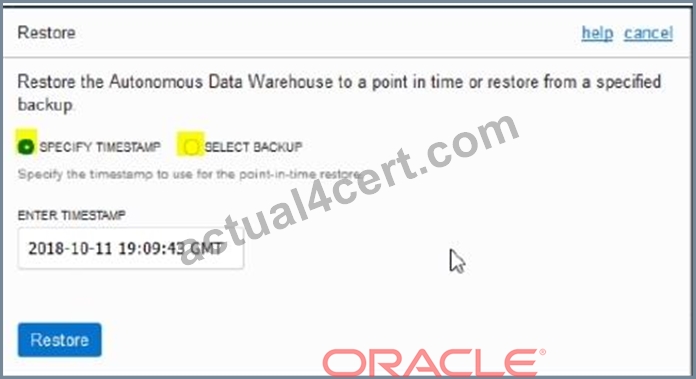
NEW QUESTION 76
During the provisioning of an Autonomous Database on Dedicated hardware, what does the Database Administrator need to select to determine where the Autonomous Database is created on the Dedicated infrastructure?
- A. the Compartment of the Dedicated infrastructure as each compartment only runs 1 Dedicated environment
- B. the Listener endpoint where the Autonomous Database should register on
- C. the name or OCID of the Exadata infrastructure which was assigned by the the Fleet Administrator
- D. the 'High Availability Container Database' in which the Autonomous instance should run
- E. the Client Credentials wallet which is used to connect to the Autonomous Database
Answer: E
NEW QUESTION 77
Which two statements are true when running DBMS_CLOUD.COPY_DATA? (Choose two.)
- A. The source file can be in either Oracle Standard Storage or Oracle Archive Storage bucket in the Object Store.
- B. The source files can reside in Oracle Object Storage, Amazon S3 Object storage, or Azure Blob storage.
- C. A valid credential must be created prior to running the DBMS_CLOUD.COPY_DATA procedure.
- D. The source file will be automatically removed after the DBMS_CLOUD.COPY_DATA procedure finishes successfully.
- E. The target table will be created in Autonomous Database if it does not already exist.
Answer: B,C
Explanation:
https://docs.oracle.com/en/cloud/paas/autonomous-data-warehouse-cloud/user/file-uri-formats.html#GUID-5D3E1614-ADF2-4DB5-B2B2-D5613F10E4FA
https://docs.oracle.com/en/cloud/paas/autonomous-data-warehouse-cloud/user/dbms-cloud.html#GUID-9428EA51-5DDD-43C2-B1F5-CD348C156122
NEW QUESTION 78
Which three security features are available in Oracle Autonomous Database Shared Infrastructure?
- A. Database Vault
- B. Data Redaction
- C. Audit Vault
- D. Customer Managed Keys
- E. Transparent Data Encryption
Answer: A,D,E
Explanation:
https://docs.oracle.com/en/cloud/paas/atp-cloud/atpfg/security-features-adb1.html#GUID-89E3C22E-D4EB-472B-8287-41682C2B61B3
NEW QUESTION 79
......
All 1Z0-931-20 Dumps and Training Courses: https://www.actual4cert.com/1Z0-931-20-real-questions.html