

FCSS_LED_AR-7.6 Revolutionary Guide To Exam Fortinet Dumps
FCSS_LED_AR-7.6 Free Study Guide! with New Update 127 Exam Questions
Fortinet FCSS_LED_AR-7.6 Exam Syllabus Topics:
| Topic | Details |
|---|---|
| Topic 1 |
|
| Topic 2 |
|
| Topic 3 |
|
| Topic 4 |
|
NEW QUESTION # 19
Which features does FortiAuthenticator support when acting as a certificate authority (CA)?
Response:
- A. It can issue and revoke digital certificates but cannot act as an OCSP server.
- B. It functions solely as a CRL repository and does not support certificate signing requests (CSR).
- C. It can integrate with third-party certificate authorities to validate external certificates.
- D. It can act as a self-signer for issuing and revoking digital certificates.
Answer: D
NEW QUESTION # 20
You are setting up a captive portal to provide Wi-Fi access for visitors. To simplify the process, your team wants visitors to authenticate using their existing social media accounts instead of creating new accounts or entering credentials manually.
Which two actions are required to enable this functionality? (Choose two.)
- A. Enable Account Login as the authentication type and configure a remote LDAP server.
- B. Set up the FortiAuthenticator internal database as the primary source for user credentials
- C. Configure the social login profiles for the supported platforms.
- D. Configure only the email login option because a social media login cannot be used with captive portals.
- E. Set up a remote open authorization (OAuth) server for each selected social media platform.
Answer: B,E
NEW QUESTION # 21
Which encryption protocols can CAPWAP use to secure the data channel when communicating between a FortiGate wireless controller and FortiAP?
Response:
- A. SSL/TLS and IPsec
- B. WPA3 and TLS
- C. SSH and SSL
- D. DTLS and IPsec
Answer: D
NEW QUESTION # 22
What is the default behavior of a factory-reset FortiGate with internet access and no configuration?
Response:
- A. It starts in transparent mode
- B. It waits for manual config via console
- C. It requests a dynamic IP from DHCP
- D. It self-registers to FortiManager via FortiDeploy
Answer: D
NEW QUESTION # 23
To view FortiAP debug logs in the CLI, which command is used?
Response:
- A. diagnose wireless-controller wlac -c
- B. debug controller-ap
- C. diagnose debug enable → diagnose debug application cw_ac -1
- D. execute wireless ap debug start
Answer: C
NEW QUESTION # 24
What is the expected behavior when enabling auto TX power control on a FortiAP interface?
- A. FortiGate monitors the signal strength of nearby AP interfaces and adjusts its own transmit power every
30 seconds to match the signal strength of the adjacent AP - B. The AP periodically evaluates the signal strength of its own transmission from the client perspective and adjusts its power to ensure the signal is detected at -70 dBm.
- C. FortiGate periodically measures the signal strength of the weakest associated client and adjusts the AP radio power to align with the detected signal strength of that client.
- D. FortiGate measures the signal strength of nearby FortiAP interfaces every 30 seconds and adjusts their transmit power to ensure they remain detectable at -70 dBm.
Answer: C
Explanation:
Auto TX power control on FortiAP is an RF-optimization feature:
* FortiGate (as wireless controller) continuously evaluatesRSSI of associated clientson each FortiAP radio.
* The algorithm focuses on theweakest client(the one with the worst signal) and adjusts the AP's transmit power so that this client's signal level stays within a configured / target range.
* This helps balance coverage and limit co-channel interference: APs don't transmit at maximum power when clients are close, but will increase power when the weakest client signal drops too low.
Therefore the correct behavior description is:
#C- AP power is adjusted based on the weakest associated client's signal.
Why the others are wrong:
* AandBtalk about matching nearby APs' power or forcing everything to -70 dBm, which is not how FortiAP auto TX works.
* Dincorrectly states the AP "evaluates its own transmission from the client perspective"; the AP can only infer client-side conditions from theclient's RSSI at the AP, not the inverse.
NEW QUESTION # 25
What logs or tools can be used to troubleshoot wireless AP communication issues in FortiGate?
(Choose two)
Response:
- A. Event Logs > WiFi Events
- B. CAPWAP logs
- C. VLAN trunk statistics
- D. Application control profiles
Answer: A,B
NEW QUESTION # 26
Refer to the exhibits.

A NAC policy has been configured to apply traffic that flows through FortiSwitch port 2. Traffic that meets the NAC policy criteria will be assigned to the Students VLAN. However, the NAC policy does not seem to be taking effect.
Which configuration is missing?
- A. The Students VLAN should be set to Allowed VLANs instead of Native VLAN.
- B. Port2 Access mode should be set to NAC mode.
- C. The MAC address or OS might be misconfigured for the connected device.
- D. Port2 Access mode should be set to Port Policy mode.
Answer: B
Explanation:
From the exhibits:
* FortiSwitch Ports viewshows:
* port2
* Mode: Static
* Native VLAN: Students
* Allowed VLANs: quarantine.fortilink (quarantine)
* NAC policy "Training":
* Switch FortiLink: fortilink
* Category:Device
* Matching criteria:
* MAC Address: 70:88:6b:8c:4b:0e (enabled)
* Operating System:Linux(enabled)
* Switch Controller Action:
* Assign VLAN = Students
* Bounce Port = enabled
Design intent:
Device with that MAC + OS Linux, when plugged intoport2, should be dynamically moved to VLAN Studentsby the NAC policy.
Why it doesn't work now
On FortiLink NAC,dynamic NAC decisions only apply on ports whose "Access Mode" is set to NAC:
* NAC mode = FortiGate controls theonboarding VLAN, evaluates NAC policies, and then dynamically reassigns the switch port VLAN (access, quarantine, etc.).
* Static mode(what we see on port2) means the port just uses its configurednative/allowed VLANs, and no NAC classificationhappens.
Right now:
* port2 is astatic access portwith Native VLAN = Students.
* The NAC policy exists, butFortiSwitch is not in NAC enforcement mode on that port, so the policy is never evaluated for traffic on port2.
Therefore, themissing configurationis:
Setport2toNAC mode(sometimes called "Access mode: NAC" or "NAC LAN edge port").
Once port2 is changed to NAC mode:
* Device initially lands in the onboarding/quarantine VLAN.
* FortiGate collects device info (MAC, OS, etc.).
* NAC policy "Training" matches MAC + Linux.
* Switch controller actionAssign VLAN = Studentsis applied.
* Port is bounced (if configured), bringing the device back up in VLAN Students.
Why the other options are wrong
* B. MAC or OS misconfigured
* Possible in general, but the question asks forwhich configuration is missing, and the exhibits clearly focus on port mode. Also, even with wrong MAC/OS, the port would still be in NAC mode; here NAC isn't even active.
* C. Port Policy mode
* Port policy (edge/trunk) is separate from NAC; NAC requires the specificNAC access mode.
* D. Students VLAN should be Allowed VLANs instead of Native VLAN
* For an access port, having Students as thenative VLANis correct. NAC policy's Assign VLAN will set that as access VLAN; no need to make it an allowed trunk VLAN.
NEW QUESTION # 27
You are configuring a new wireless network for your organization. The network requires users to authenticate through a RADIUS server for secure access. Which two security modes should you select when creating the SSID to ensure compatibility with the RADIUS server?
(Choose two.)
Response:
- A. WPA3-Enterprise
- B. WPA2-Enterprise
- C. WPA/WPA2 Mixed Mode
- D. WPA-Personal
- E. WEP
Answer: A,C
NEW QUESTION # 28
Refer to the exhibit.
On FortiGate, a RADIUS server is configured to forward authentication requests to FortiAuthenticator, which acts as a RADIUS proxy. FortiAuthenticator then relays these authentication requests to a remote Windows AD server using LDAP.
While testing authentication using the CLI command diagnose test authserver. the administrator observed that authentication succeeded with PAP but failed when using MS-CHAFV2.
Which two solutions can the administrator implement to enable MS-CHAPv2 authentication? (Choose two.)
- A. Enable Windows Active Directory domain authentication on FortiAuthenticator.
- B. Enable RADIUS attribute filtering on FortiAuthenticator.
- C. Configure FortiAuthenticator to use RADIUS instead of LDAP as the back-end authentication server
- D. Change the FortiGate authentication method to CHAP instead of MS-CHAPv2.
Answer: C,D
NEW QUESTION # 29
Which two statements about the use of digital certificates are true?
(Choose two.)
Response:
- A. A certificate signed by an intermediate CA is still part of a trusted chain.
- B. A certificate revocation list (CRL) automatically removes revoked certificates from all systems in real time.
- C. Intermediate CAs help establish a hierarchical chain of trust.
- D. CRLs are required only for self-signed certificates.
Answer: A,C
NEW QUESTION # 30
You are setting up FortiAuthenticator to query users from Active Directory. Which bind method must be used for secure authentication?
Response:
- A. Local User Bind
- B. Anonymous Bind
- C. Simple Bind over SSL
- D. NTLM
Answer: C
NEW QUESTION # 31
Refer to the exhibits.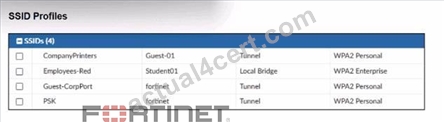

A set of SSID profiles has been configured on FortiManager, and an AP profile has been assigned to a group of AP managed by FortiGate. However, none of the designated SSIDs are being broadcast by these APs.
Which configuration change is required to make the APs broadcast these SSIDs as intended?
- A. Change the AP profile to use a platform that supports the configured mix of SSIDs.
- B. Adjust the AP profile to ensure all SSIDs are configured in a supported mode, either bridge or tunnel, but not a mix of both.
- C. Set the Transmit Power Mode to Auto.
- D. Choose Manual in the SSIDs setting and select the SSIDs to broadcast.
Answer: D
Explanation:
From the exhibits:
* The AP profile shows:
* SSIDs: Tunnel | Bridge | Manual
* The current setting isBridge, not Manual.
* WhenBridgeorTunnelis selected, the AP profiledoes NOT automatically broadcast SSIDsunless the corresponding VAPs were explicitly mapped in the AP profile.
* FortiManager SSID profiles are created, but unless these are explicitly applied underManual SSIDs selection, the AP will not broadcast any SSID.
Fortinet documentation states:
"To control which SSIDs an AP broadcasts, the AP Profile must have SSIDs set toManual, and the desired SSIDs must be selected." Therefore, to make the AP broadcast the intended SSIDs:
#You must switch the SSIDs setting to Manual, and manually select the SSIDs (CompanyPrinters, Student01, Guest-CorpPort, PSK).
Why the other options are incorrect:
* A. Adjust AP profile to avoid mixing bridge/tunnelMixed modes ARE supported. Not the issue.
* B. Change platformThe platform (FAP231F) already supports all listed SSIDs.
* D. Set transmit power mode to autoPower settings have nothing to do with SSID broadcasting.
NEW QUESTION # 32
You're configuring FortiAuthenticator to authenticate users via LDAP. Which syntax correctly defines the LDAP query filter to retrieve users from a specific OU named "Engineering"?
Response:
- A. (OU=Engineering,DC=example,DC=com)
- B. (&(objectClass=person)(ou=Engineering))
- C. (cn=Engineering)
- D. (ou=Engineering)
Answer: B
NEW QUESTION # 33
APs have been manually configured to connect to FortiGate over an IPsec network, and FortiGate successfully detects and authorizes them. However, the APs remain unmanaged because FortiGate is unable to establish a CAPWAP tunnel with them.
What configuration change can resolve this issue and enable FortiGate to establish the CAPWAP tunnel over the IPsec connection?
- A. Decrease the CAPWAP tunnel MTU size for APs to prevent fragmentation.
- B. Assign a custom AP profile for the remote APs with the set mpls-connection option enabled.
- C. Upgrade the FortiAP firmware image to ensure compatibility with the FortiOS version.
- D. Configure a static route on FortiGate to reach the APs over the IPsec tunnel.
Answer: B
Explanation:
When FortiAPs connect to FortiGate overIPsec tunnels, this is treated similarly to WAN/MPLS deployments.
In these scenarios, FortiGate must know that CAPWAP must traverse anon-L2transport.
FortiAP profiles include:
set mpls-connection enable
This setting is required so that:
* FortiGate can encapsulate CAPWAP inside the transport tunnel
* Remote FortiAPs can establish CAPWAP even when behind routed/IPsec networks Without this option, the FortiGate detects the AP butcannot bring CAPWAP UP, leaving the AP in
"discovered/unauthorized" or "offline" state.
Why others are wrong
* A. Static route# Discovery already succeeds, so routing is not the issue.
* C. Reduce MTU# Sometimes useful for IPsec, but not required for CAPWAP establishment.
* D. Firmware upgrade# Firmware mismatch would show "Managed (upgrade required)," not CAPWAP tunnel failure.
Therefore,set mpls-connection enableis the required fix.
NEW QUESTION # 34
Which policy components are essential in a FortiGate NAC policy for wireless networks?
(Choose three)
Response:
- A. Authentication rules
- B. Role assignment
- C. VLAN assignment
- D. Posture check condition
- E. IPsec VPN enforcement
Answer: A,B,C
NEW QUESTION # 35
Connectivity tests are being performed on a newly configured VLAN. The VLAN is configured on a FortiSwitch device that is managed by FortiGate. During testing, it is observed that devices within the VLAN can successfully ping FortiGate. and FortiGate can also ping these devices.
Inter-VLAN communication is working as expected. However, devices within the same VLAN are unable to communicate with each other.
What could be causing this issue?
- A. Access VLAN is enabled on the VLAN.
- B. The FortiGate ARP table is missing entries.
- C. The native VLAN configured on the ports is incorrect.
- D. The FortiSwitch MAC address table is missing entries.
Answer: A
Explanation:
Observed behavior:
* Devices in the VLANcan ping FortiGate# gateway reachability OK.
* FortiGatecan ping devicesin that VLAN # return path OK.
* Inter-VLAN routingworks # FortiGate's L3 and policies are fine.
* Devices in the same VLAN cannot ping each other# problem is on theL2 switching plane, not L3.
On FortiSwitch (managed by FortiGate), there is a feature calledAccess VLAN(sometimes described in NAC
/dynamic segmentation context):
* WhenAccess VLANis enabled on a VLAN, the switchdoes not perform normal L2 forwarding between hosts in that VLAN.
* Instead, all traffic from endpoints in that VLAN isforced upstream to FortiGate, as if every frame were destined for the gateway.
* This is used for designs where you wantall intra-VLAN traffic inspected by the firewall, implementing micro-segmentation.
Resulting behavior:
* Host # FortiGate: works (frames are forwarded to FortiGate).
* FortiGate # Host: works (routed back).
* Host A # Host B (same VLAN):
* Frame from A goes to FortiGate.
* FortiGate seessource and destination in same subnet; depending on policy, it may drop or not have a policy allowing that traffic.
* Even if allowed, certain designs still break pure L2 expectations.
In the exam scenario, the key point is:
IfAccess VLAN is enabled,local L2 communication within that VLAN is disabled, so hosts in the same VLAN cannot communicate directly.
That perfectly explains:
* Same VLAN hosts can't ping each other
* But they can both reach FortiGate and beyond
Why the other options are less likely / incorrect
* B. FortiSwitch MAC address table is missing entries
* If MAC table were empty/bad,nothingin that VLAN would work properly, including pinging FortiGate.
* C. FortiGate ARP table is missing entries
* Then FortiGate couldn't ping the devices either; but it can.
* D. Native VLAN misconfigured on ports
* That would affect connectivity to FortiGate too, not only host-to-host.
NEW QUESTION # 36
What is the main benefit of VLAN pooling in wireless deployments?
Response:
- A. Forces clients to connect via MAC address
- B. Reduces DHCP exhaustion and improves load distribution
- C. Enables NAT between VLANs
- D. Disables rogue AP detection
Answer: B
NEW QUESTION # 37
Which configuration file or setting should be modified to enable OCSP checking for certificate revocation on FortiAuthenticator?
Response:
- A. syslog.conf
- B. LDAP bind profile
- C. Certificate Validation Policy
- D. radiusd.conf
Answer: C
NEW QUESTION # 38
Refer to the exhibits.
FortiGate RSSO configuration
FortiGate RSSO Group
FortiGate interface configuration
RSSO authentication has been configured on FortiGate. Port3 has been enabled to receive RADIUS accounting messages. Internet access is available through port1. FortiGate is successfully handling incoming RADIUS accounting messages, ensuring that RSSO users are correctly mapped to the RSSO Group user group. The administrator realized that internet access is open to all users and aims to enforce access restrictions, ensuring that only RSSO users are permitted to have internet access. Which configuration change should the administrator apply to address this issue? Response:
- A. Change the RADIUS attribute value setting to match the name of the RADIUS attribute containing the group membership information of the RSSO users.
- B. Modify the firewall policy and add RSSO Group as a Source.
- C. Create a second firewall policy from port3 to port1, and select the target destination subnets.
- D. Configure a local user group and manually add users to enforce authentication-based restrictions.
Answer: B
NEW QUESTION # 39
Which three conditions can FortiLink NAC use to enforce network access control?
(Choose three)
Response:
- A. Interface MTU
- B. MAC address
- C. Switch stack priority
- D. Device type
- E. User identity
Answer: B,D,E
NEW QUESTION # 40
When configuring FortiLink in FortiManager to manage FortiSwitch, which of the following steps are mandatory?
(Choose two)
Response:
- A. Apply provisioning template to FortiAP
- B. Enable FortiLink interface on FortiGate
- C. Import FortiSwitch configuration template into FortiManager
- D. Configure switch controller in FortiGate policies
Answer: B,C
NEW QUESTION # 41
......
Get up-to-date Real Exam Questions for FCSS_LED_AR-7.6: https://www.actual4cert.com/FCSS_LED_AR-7.6-real-questions.html
Pass FCSS_LED_AR-7.6 Exam Latest Practice Questions: https://drive.google.com/open?id=1wyU4T1j5NHP9AVGP3O5uZc311Jcld4xv