

Fortinet NSE7_LED-7.0 Real 2025 Braindumps Mock Exam Dumps
NSE7_LED-7.0 Exam Questions | Real NSE7_LED-7.0 Practice Dumps
Fortinet NSE7_LED-7.0 certification exam covers a wide range of topics related to Fortinet LAN Edge solutions, including network topology, routing, switching, security policies, and more. Fortinet NSE 7 - LAN Edge 7.0 certification is ideal for IT professionals who work with Fortinet LAN Edge solutions on a regular basis and want to demonstrate their expertise in this area.
To prepare for the Fortinet NSE7_LED-7.0 certification exam, candidates can take advantage of a variety of resources provided by Fortinet, including online courses, self-paced learning modules, and practical labs. These resources cover all the topics that are included in the exam, and provide candidates with the knowledge and skills they need to succeed. Once certified, professionals can be confident in their ability to secure LAN Edge environments using Fortinet products, and can add this valuable certification to their professional credentials.
NEW QUESTION # 27
Which two statements about FortiSwitch trunks are true? (Choose two.)
- A. Trunks do not support tagged Ethernet frames.
- B. By default, when connecting two FortiSwitch devices to each other, a trunk is automatically created between the switches.
- C. A trunk is a link aggregation group interface.
- D. LACP is not supported.
Answer: B,C
NEW QUESTION # 28
Refer to the exhibit.
By default FortiOS creates the following DHCP server scope for the FortiLink interface as shown in the exhibit What is the objective of the vci-string setting?
- A. To restrict the IP address assignment to devices that have FortiSwitch or FortiExtender as their hostname
- B. To restrict the IP address assignment to FortiSwitch and FortiExtender devices
- C. To ignore DHCP requests coming from FortiSwitch and FortiExtender devices
- D. To reserve IP addresses for FortiSwitch and FortiExtender devices
Answer: B
Explanation:
According to the exhibit, the DHCP server scope for the FortiLink interface has a vci-string setting with the value "Cisco AP c2700". This setting is used to match the vendor class identifier (VCI) of the DHCP clients that request an IP address from the DHCP server. The VCI is a text string that uniquely identifies a type of vendor device. Therefore, option C is true because the vci-string setting restricts the IP address assignment to FortiSwitch and FortiExtender devices, which use the VCI "Cisco AP c2700". Option A is false because the vci-string setting does not ignore DHCP requests coming from FortiSwitch and FortiExtender devices, but rather accepts them. Option B is false because the vci-string setting does not reserve IP addresses for FortiSwitch and FortiExtender devices, but rather assigns them dynamically. Option D is false because the vci- string setting does not restrict the IP address assignment to devices that have FortiSwitch or FortiExtender as their hostname, but rather to devices that have "Cisco AP c2700" as their VCI.
NEW QUESTION # 29
Refer to the exhibits.
In the WTP profile configuration shown in the exhibit, the AP profile is assigned to two FAP-320 APs that are installed in an open plan office.
The first AP has 32 clients associated with the 5 GHz radios and 22 clients associated with the 2.4 GHz radio.
The second AP has 12 clients associated with the 5 GHz radios and 20 clients associated with the 2.4 GHz radio.
A dual-band-capable client enters the office near the first AP and the first AP measures the new client at -33 dBm signal strength. The second AP measures the new client at 2 -43 dBm signal strength.
If the new client attempts to connect to the corporate wireless network, with which AP radio will the client be associated?
- A. The first AP 2.4 GHz interface.
- B. The first AP 5 GHz interface.
- C. The second AP 2.4 GHz interface.
- D. The second AP 5 GHz interface.
Answer: D
NEW QUESTION # 30
Where can FortiGate learn the FortiManager IP address or FQDN for zero-touch provisioning'?
- A. From a DHCP server using options 240 and 241
- B. From a TFTP server
- C. From a DNS server using A or AAAA records
- D. From an LDAP server using a simple bind operation
Answer: A
Explanation:
FG retrieves the FortiManager IP address or FQDN through DHCP options 240 or 241 respectively.
NEW QUESTION # 31
Exhibit.
Refer to the exhibit showing a network topology and SSID settings.
FortiGate is configured to use an external captive portal However wireless users are not able to see the captive portal login page Which configuration change should the administrator make to fix the problem?
- A. Enable the captive-portal-exempt option in the firewall policy with the ID 12
- B. Add the FortiAuthenticator and WindowsAD address objects as exempt destinations services
- C. Enable NAT in the firewall policy with the ID 13.
- D. Remove the guest.portal user group in the firewall policy with the ID 12
Answer: B
Explanation:
According to the exhibit, the network topology and SSID settings show that FortiGate is configured to use an external captive portal hosted on FortiAuthenticator, which is connected to a Windows AD server for user authentication. However, wireless users are not able to see the captive portal login page, which means that they are not redirected to the external captive portal URL. Therefore, option B is true because adding the FortiAuthenticator and WindowsAD address objects as exempt destinations services will allow the wireless users to access the external captive portal URL without being blocked by the firewall policy. Option A is false because enabling NAT in the firewall policy with the ID 13 will not affect the redirection to the external captive portal URL, but rather the source IP address of the wireless traffic. Option C is false because enabling the captive-portal-exempt option in the firewall policy with the ID 12 will bypass the captive portal authentication for the wireless users, which is not the desired outcome. Option D is false because removing the guest.portal user group in the firewall policy with the ID 12 will prevent the wireless users from being authenticated by FortiGate, which is required for accessing the external captive portal.
NEW QUESTION # 32
Refer to the exhibit. Examine the FortiGate RSSO configuration shown in the exhibit.
FortiGate is configured to receive RADIUS accounting messages on port3 to authenticate RSSO users. The users are located behind port3, and the internet link is connected to port1. FortiGate is processing incoming RADIUS accounting messages successfully, and RSSO users are getting associated with the RSSO Group user group. However, all the users are able to access the internet, and the administrator wants to restrict internet access to RSSO users only.
Which configuration change should the administrator make to fix the problem?
- A. Create a second firewall policy from port3 lo port1 and select the target destination subnets
- B. Change the RADIUS Attribute Value selling to match the name of the RADIUS attribute containing the group membership information of the RSSO users
- C. Add RSSO Group to the firewall policy
- D. Enable Security Fabric Connection on port3
Answer: C
Explanation:
According to the exhibit, the firewall policy from port3 to port1 has no user group specified, which means that it allows all users to access the internet.
NEW QUESTION # 33
Refer to the exhibits.
Firewall Policy
Examine the firewall policy configuration and SSID settings
An administrator has configured a guest wireless network on FortiGate using the external captive portal The administrator has verified that the external captive portal URL is correct However wireless users are not able to see the captive portal login page Given the configuration shown in the exhibit and the SSID settings which configuration change should the administrator make to fix the problem?
- A. Disable the user group from the SSID configuration
- B. Include the wireless client subnet range in the Exempt Source section
- C. Apply a guest.portal user group in the firewall policy with the ID 11.
- D. Enable the captivs-portal-exempt option in the firewall policy with the ID 11.
Answer: C
Explanation:
According to the FortiGate Administration Guide, "To use an external captive portal, you must configure a user group that uses the external captive portal as the authentication method and apply it to a firewall policy." Therefore, option C is true because it will allow the wireless users to be redirected to the external captive portal URL when they try to access the Internet. Option A is false because disabling the user group from the SSID configuration will prevent the wireless users from being authenticated by the FortiGate device. Option B is false because enabling the captive-portal-exempt option in the firewall policy will bypass the captive portal authentication for the wireless users, which is not the desired outcome. Option D is false because including the wireless client subnet range in the Exempt Source section will also bypass the captive portal authentication for the wireless users, which is not the desired outcome.
NEW QUESTION # 34
Refer to the exhibit.
Examine the FortiGate logs, widget, and CLI output shown in the exhibit.
An administrator is testing the Security Fabric quarantine automation. The test device (10.0.2.2) is connected to a managed FortiSwitch device.
A few seconds after trying to access a malicious website from the test device, the test device can no longer access the internet and other VLANs in the network. However, the device is still able to access other devices in the same VLAN.
Based on the information shown in the exhibit, which modification should the administrator make to fix the problem?
- A. Enable the access layer quarantine action on the Quarantine_Devices automation stitch.
- B. Change the quarantine mode to by redirect mode.
- C. Configure a firewall policy on FortiGate to block the intra-VLAN traffic.
- D. Change the quarantine mode to by VLAN mode.
Answer: A
NEW QUESTION # 35
Which FortiSwitch VLANs are automatically created on FortGate when the first FortiSwitch device is discovered1?
- A. default quarantine rspan voice video and nac_segment
- B. default quarantine, rspan voice video onboarding and nac_segment
- C. fortilink. quarantine erspan voice video and onboarding
- D. access, quarantine, rspan. voice, video, and onboarding
Answer: B
Explanation:
Based on LAN Edge 7.0 Study Guide page 217 When FortiGate discovers the first switch, it automatically adds to its configuration some settings that are default, quarantine, rspan, voice, video, onboarding, and nac_segment
NEW QUESTION # 36
Refer to the exhibit
A device connected to port2 on FortiSwitch cannot access the network The port is assigned a security policy to enforce 802 1X authentication While troubleshooting the issue, the administrator obtains the debug output shown in the exhibit Which two scenarios are likely to cause this issue? (Choose two.)
- A. The device has been assigned the guest VLAN
- B. The device does not support 802 1X authentication
- C. The device has been quarantined for 3600 seconds.
- D. The device is not configured for 802 IX authentication.
Answer: B,D
Explanation:
According to the exhibit, the debug output shows that the device connected to port2 on FortiSwitch is sending an EAPOL-Start message, which is the first step of the 802.1X authentication process. However, the output also shows that the device is not sending any EAP-Response messages, which are required to complete the authentication process. Therefore, option A is true because the device is not configured for 802.1X authentication, which means that it does not have the correct credentials or settings to authenticate with the RADIUS server. Option D is also true because the device does not support 802.1X authentication, which means that it does not have the capability or software to perform 802.1X authentication. Option B is false because the device has not been quarantined for 3600 seconds, but rather has a session timeout of 3600 seconds, which is the default value for 802.1X sessions. Option C is false because the device has not been assigned the guest VLAN, but rather has been assigned the default VLAN, which is VLAN 1.
NEW QUESTION # 37
Which two pieces of information can the diagnose test authserver ldap command provide? (Choose two.)
- A. It displays the LDAP groups found for the user
- B. It displays whether the user credentials are correct
- C. It displays the LDAP codes returned by the LDAP server
- D. It displays whether the admin bind user credentials are correct
Answer: B,C
Explanation:
Explanation
According to the FortiGate CLI Reference Guide, "The diagnose test authserver ldap command tests LDAP authentication with a specific LDAP server. The command displays whether the user credentials are correct and whether the user belongs to any groups that match a firewall policy. The command also displays the LDAP codes returned by the LDAP server." Therefore, options B and C are true because they describe the information that the diagnose test authserver ldap command can provide. Option A is false because the command does not display whether the admin bind user credentials are correct, but rather whether the user credentials are correct. Option D is false because the command does not display the LDAP groups found for the user, but rather whether the user belongs to any groups that match a firewall policy.
NEW QUESTION # 38
Refer to the exhibits. Examine the troubleshooting outputs shown in the exhibits.
Users have been reporting issues with the speed of their wireless connection in a particular part of the wireless network. The interface that is having issues is the 2.4 GHz interface that is currently configured on channel 6.
The administrator of the wireless network has investigated and surveyed the local RF environment using the tools available at the AP and FortiGate.
Which configuration would improve the wireless connection?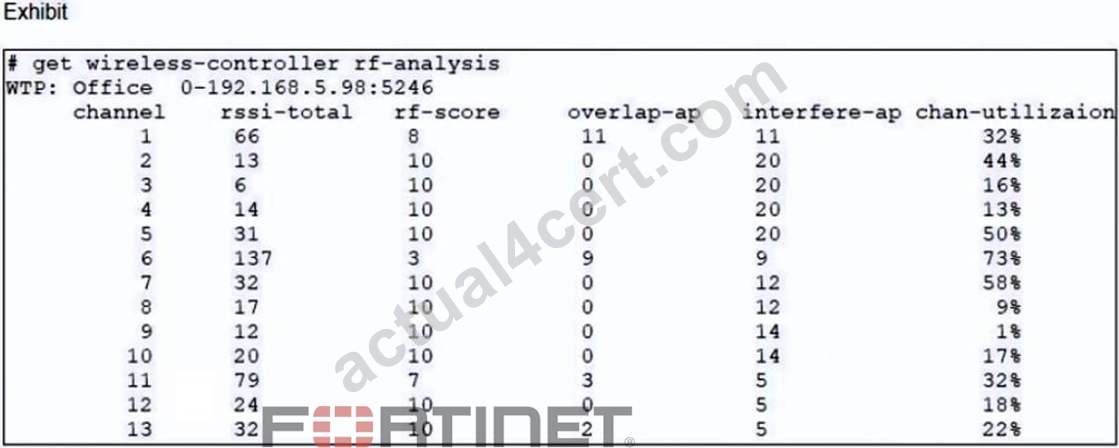

- A. Change the AP 2.4 GHz channel to 13.
- B. Change the AP 2.4 GHz channel to 9.
- C. Change the AP 2.4 GHz channel to 1.
- D. Change the AP 2.4 GHz channel to 11
Answer: C
Explanation:
According to the exhibits, the AP 2.4 GHz interface is currently configured on channel 6, which is overlapping with other nearby APs on channels 4 and 8. This can cause interference and reduce the wireless performance. Therefore, changing the AP 2.4 GHz channel to 1 would improve the wireless connection, as it would avoid the overlapping channels and use a non-overlapping channel instead.
NEW QUESTION # 39
Refer to the exhibit.
Examine the debug output shown in the exhibit
Which two statements about the RADIUS debug output are true'' (Choose two)
- A. The user student belongs to the SSLVPN group
- B. User authentication failed
- C. The RADIUS server sent a vendor-specific attribute in the RADIUS response
- D. User authentication succeeded using MSCHAP
Answer: A,D
Explanation:
Explanation
According to the exhibit, the debug output shows a RADIUS debug output from FortiGate. The output shows that FortiGate sent a RADIUS Access-Request packet to FortiAuthenticator with the username student and received a RADIUS Access-Accept packet from FortiAuthenticator with a Class attribute containing SSLVPN.
Therefore, option A is true because it indicates that the user student belongs to the SSLVPN group on FortiAuthenticator. The output also shows that FortiGate used MSCHAP as the authentication method and received a MS-MPPE-Send-Key and a MS-MPPE-Recv-Key from FortiAuthenticator. Therefore, option D is true because it indicates that user authentication succeeded using MSCHAP. Option B is false because user authentication did not fail, but rather succeeded. Option C is false because FortiAuthenticator did not send a vendor-specific attribute in the RADIUS response, but rather standard attributes defined by RFCs.
NEW QUESTION # 40 
Wireless guest users are unable to authenticate because they are getting a certificate error while loading the captive portal login page. This URL string is the HTTPS POST URL guest wireless users see when attempting to access the network using the web browser
Which two settings are the likely causes of the issue? (Choose two.)
- A. The wireless user's browser is missing a CA certificate
- B. The external server FQDN is incorrect
- C. The user address is not in DDNS form
- D. The FortiGate authentication interface address is using HTTPS
Answer: A,B
Explanation:
According to the exhibit, the wireless guest users are getting a certificate error while loading the captive portal login page. This means that the browser cannot verify the identity of the server that is hosting the login page.
Therefore, option A is true because the external server FQDN is incorrect, which means that it does not match the common name or subject alternative name of the server certificate. Option B is also true because the wireless user's browser is missing a CA certificate, which means that it does not have the root or intermediate certificate that issued the server certificate. Option C is false because the FortiGate authentication interface address is using HTTPS, which is a secure protocol that encrypts the communication between the browser and the server. Option D is false because the user address is not in DDNS form, which is not related to the certificate error.
NEW QUESTION # 41
To troubleshoot configuration push issues on a managed FortiSwitch, which FortiGate process should an administrator enable debug for?
- A. flcfgd
- B. httpsd
- C. cu_acd
- D. fortilinkd
Answer: A
NEW QUESTION # 42
Refer to the exhibit.
Examine the partial debug output shown in the exhibit.
Which two statements about the debug output are true? (Choose1 two.)
- A. The Training-Lab LDAP server is configured to use regular bind.
- B. The connection to the Training-Lab LDAP server timed out.
- C. The LDAP DN search did not match any LDAP user.
- D. The credentials provided for student are correct.
Answer: A,D
NEW QUESTION # 43
Refer to the exhibit
Examine the sections of the configuration shown in the output
What action will FortiGate take when verifying the student certificate through OCSP?
- A. Use the OCSP URL included in the student certificate to verify the student certificate
- B. Consider the student certificate status as valid if the OCSP server is unreachable
- C. Reject the student certificate if the OCSP server replies that the student certificate status is unknown
- D. Not verify the OCSP server certificate
Answer: C
NEW QUESTION # 44
Refer to the exhibit
A device connected to port2 on FortiSwitch cannot access the network The port is assigned a security policy to enforce 802 1X authentication While troubleshooting the issue, the administrator obtains the debug output shown in the exhibit Which two scenarios are likely to cause this issue? (Choose two.)
- A. The device has been assigned the guest VLAN
- B. The device does not support 802 1X authentication
- C. The device has been quarantined for 3600 seconds.
- D. The device is not configured for 802 IX authentication.
Answer: B,D
Explanation:
Explanation
According to the exhibit, the debug output shows that the device connected to port2 on FortiSwitch is sending an EAPOL-Start message, which is the first step of the 802.1X authentication process. However, the output also shows that the device is not sending any EAP-Response messages, which are required to complete the authentication process. Therefore, option A is true because the device is not configured for 802.1X authentication, which means that it does not have the correct credentials or settings to authenticate with the RADIUS server. Option D is also true because the device does not support 802.1X authentication, which means that it does not have the capability or software to perform 802.1X authentication. Option B is false because the device has not been quarantined for 3600 seconds, but rather has a session timeout of 3600 seconds, which is the default value for 802.1X sessions. Option C is false because the device has not been assigned the guest VLAN, but rather has been assigned the default VLAN, which is VLAN 1.
NEW QUESTION # 45
Refer to the exhibit. Examine the FortiGate configuration, FortiAnalyzer logs, and FortiGate widget shown in the exhibit.
An administrator is testing the Security Fabric quarantine automation. The administrator added FortiAnalyzer to the Security Fabric, and configured an automation stitch to automatically quarantine compromised devices. The test device (10.0.2.1) is connected to a managed FortiSwitch device.
After trying to access a malicious website from the test device, the administrator verifies that FortiAnalyzer has a log for the test connection. However, the device is not getting quarantined by FortiGate, as shown in the quarantine widget.
Which two scenarios are likely to cause this issue? (Choose two.)
- A. FortiAnalyzer does not consider the malicious website an indicator of compromise (IOC)
- B. The device does not have FortiClient installed
- C. The web filtering rating service is not working
- D. FortiAnalyzer does not have a valid threat detection services license
Answer: A,D
Explanation:
According to the exhibits, the administrator has configured an automation stitch to automatically quarantine compromised devices based on FortiAnalyzer's threat detection services. However, according to the FortiAnalyzer logs, the test device is not detected as compromised by FortiAnalyzer, even though it tried to access a malicious website. Therefore, option B is true because FortiAnalyzer does not have a valid threat detection services license, which is required to enable the threat detection services feature. Option D is also true because FortiAnalyzer does not consider the malicious website an indicator of compromise (IOC), which is a criterion for identifying compromised devices.
NEW QUESTION # 46
What is the purpose of enabling Windows Active Directory Domain Authentication on FortiAuthenticator?
- A. It enables FortiAuthenticator to use a Windows CA certificate when authenticating RADIUS users
- B. It enables FortiAuthenticator to import users from Windows AD
- C. It enables FortiAuthenticator to register itself as a Windows trusted device to proxy authentication using Kerberos
- D. It enables FortiAuthenticator to use Windows administrator credentials to perform an LDAP lookup for a user search
Answer: C
Explanation:
Windows Active Directory domain authentication enables FortiAuthenticator to join a Windows Active Directory domain as a machine entity and proxy authentication requests using Kerberos.
NEW QUESTION # 47
An administrator has deployed multiple dual-band wireless APs in a wireless network. APs are installed at measured distances to ensure fast roaming for the clients. Multiple 2.4 GHz-only wireless clients are connecting to the network, and subsequent monitoring shows that individual AP 2.4 GHz interfaces are being overloaded with wireless connections.
Which configuration change would best resolve the overloading issue?
- A. Configure a client limit on all AP 2.4 GHz interfaces.
- B. Configure load balancing frequency handoff on both AP interfaces.
- C. Configure load balancing AP handoff on both AP interfaces on all Aps.
- D. Configure load balancing AP handoff on only the 2.4 GHz interfaces of all APs.
Answer: A
NEW QUESTION # 48
An administrator has configured an SSID in bridge mode for corporate employees All APs are online and provisioned using default AP profiles Employees are unable to locate the SSID to conned Which two configurations can the administrator verify? (Choose two)
- A. Verify that the broadcast SSID option is enabled in the SSID configuration
- B. Verify that the SSID to an AP group that should be broadcasting the SSID is applied
- C. Verify that the Block Intra-SSID Traffic (intra-vap-privacy) option in the SSID configuration is disabled
- D. Verify that the SSID is manually applied on AP profiles for both 2 4 GHz and 5 GHz radios
Answer: A,B
Explanation:
Explanation
According to the FortiAP Configuration Guide1, "To enable the SSID, you must select at least one channel for the radio. If no channels are selected, the SSID will not be enabled. You must also enable Broadcast SSID." Therefore, option A is true because the broadcast SSID option allows the SSID to be visible to wireless clients.
Option C is also true because the SSID must be applied to an AP group that contains the APs that should be broadcasting the SSID. According to the same guide1, "You can create AP groups and assign them to different locations or departments. You can then apply different settings, such as SSIDs, to each group." Option B is false because blocking intra-SSID traffic prevents wireless clients on the same SSID from communicating with each other, which is not related to broadcasting the SSID. Option D is false because the SSID can be applied to an AP group or a global profile, which will automatically apply to all APs, without manually configuring each AP profile.
NEW QUESTION # 49
Refer to the exhibit.
Examine the debug output shown in the exhibit
Which two statements about the RADIUS debug output are true'' (Choose two)
- A. The user student belongs to the SSLVPN group
- B. User authentication succeeded using MSCHAP
- C. User authentication failed
- D. The RADIUS server sent a vendor-specific attribute in the RADIUS response
Answer: A,D
NEW QUESTION # 50
......
Verified NSE7_LED-7.0 Exam Dumps Q&As - Provide NSE7_LED-7.0 with Correct Answers: https://www.actual4cert.com/NSE7_LED-7.0-real-questions.html
Pass Your NSE7_LED-7.0 Dumps Free Latest Fortinet Practice Tests: https://drive.google.com/open?id=1c5ANa69F1CtrfGbmsiQFFjJOPCN7z1nD