

Latest Google Associate-Android-Developer PDF and Dumps (2021) Free Exam Questions Answers
Pass Your Google Developers Associate-Android-Developer Exam on Nov 03, 2021 with 125 Questions
Introduction to Google Associate Android Developer Certified Exam
Google Associate Android Developer Certified Exam is a certification exam that is conducted by Google to validates candidate knowledge and skills of working as an android developer in the IT industry.
After passing this Associate Android Developer Certified exam test, candidates get a certificate from Google that helps them to demonstrate their proficiency in Google Associate Android Developer Certified to their clients and employers.
How to Prepare for Google Associate Android Developer Certified Exam
Preparation Guide for Google Associate Android Developer Certified Exam
Introduction
Google has designed a track for IT professionals to endorse as a cloud DevOps Engineer on the GCP platform. This accreditation program gives Google cloud professionals a way to endorse their skills. The evaluation relies on a meticulous exam using the industry-standard methodology to conclude whether or not an aspirant meets GoogleâÂÂs proficiency standards.
According to Google, Associate Android Developer Certified exam test facilitates organizations to influence android application development. By leveraging the experience of the android studio for the development of the applications that’s why the latest version of Android Studio will be used in this certification.
Certification is evidence of your skills, expertise in those areas in which you like to work. If a candidate wants to work as Google Associate Android Developer Certified and prove his knowledge, certification is offered by Google. This Google Associate Android Developer Certified Certification helps a candidate to validates his skills in Google Associate Android Developer Certified Technology.
In this guide, we will cover the Google Associate Android Developer Certified practice exams, Google Associate Android Developer Certified Professionals salary, and all aspects of the Google Associate Android Developer Certification.
Google Associate-Android-Developer Exam Syllabus Topics:
| Topic | Details |
|---|---|
| Topic 1 |
|
| Topic 2 |
|
| Topic 3 |
|
| Topic 4 |
|
| Topic 5 |
|
| Topic 6 |
|
| Topic 7 |
|
| Topic 8 |
|
| Topic 9 |
|
| Topic 10 |
|
NEW QUESTION 67
Assume that you have the following situation: The app code calls for R.string.text_a Three relevant resource files are available:
- res/values/strings.xml, which includes text_a in the app's default language, in this case English.
- res/values-mcc404/strings.xml, which includes text_a in the app's default language, in this case English.
- res/values-hi/strings.xml, which includes text_a in Hindi.
The app is running on a device that has the following configuration:
- The SIM card is connected to a mobile network in India (MCC 404).
- The language is set to Hindi (hi).
Which is the correct statement below?
- A. Android loads text_a from res/values-hi/strings.xml (in Hindi)
- B. Android loads text_a from res/values-mcc404/strings.xml (in English)
- C. Android loads text_a from res/values/strings.xml (in English)
Answer: B
Explanation:
Android loads text_a from res/values-mcc404/strings.xml (in English), even if the device is configured for Hindi. That is because in the resource-selection process, Android prefers an MCC match over a language match (as a priority Exception).
Reference:
https://developer.android.com/guide/topics/resources/localization
NEW QUESTION 68
"Set the activity content to an explicit view. This view is placed directly into the activity's view hierarchy. It can itself be a complex view hierarchy." This can be done by calling method:
- A. findViewById
- B. setActionBar
- C. setContentTransitionManager
- D. setTheme
- E. setContentView
Answer: E
NEW QUESTION 69
An example. In our ViewModelFactory (that implements ViewModelProvider.Factory) we have an instance of our Repository, named mRepository. Our ViewModel has such constructor:
class MyViewModel(private val mRepository: MyRepository) : ViewModel() ...
Next, in our ViewModelFactory create ViewModel method (overriden) looks like this:
override fun <T : ViewModel?> create(modelClass: Class<T>): T {
return try {
//MISSED RETURN VALUE HERE"
} catch (e: InstantiationException) {
throw RuntimeException("Cannot create an instance of $modelClass", e)
} catch (e: IllegalAccessException) {
throw RuntimeException("Cannot create an instance of $modelClass", e)
} catch (e: NoSuchMethodException) {
throw RuntimeException("Cannot create an instance of $modelClass", e)
} catch (e: InvocationTargetException) {
throw RuntimeException("Cannot create an instance of $modelClass", e)
}
}
What should we write instead of "//MISSED RETURN VALUE HERE"?
- A. modelClass.getConstructor()
.newInstance(mRepository) - B. modelClass.getConstructor(MyRepository::class.java)
.newInstance() - C. modelClass.getConstructor(MyRepository::class.java)
.newInstance(mRepository)
Answer: C
NEW QUESTION 70
SharedPreferences.Editor is an interface used for modifying values in a SharedPreferences object. To mark in the editor that a preference value should be removed, which will be done in the actual preferences once commit() or apply() is called, what method in SharedPreferences.Editor should we use?
- A. delete(String key)
- B. remove(String key)
- C. removeAll()
- D. clear()
Answer: D
Explanation:
clear() method marks in the editor to remove ALL values from the preferences. Once commit is called, the only remaining preferences will be any that you have defined in this editor.
And no delete and removeAll method exists in SharedPreferences.Editor
NEW QUESTION 71
In a class extended PreferenceFragmentCompat. What method is used to inflate the given XML resource and add the preference hierarchy to the current preference hierarchy?
- A. findPreference
- B. setPreferenceScreen
- C. addPreferencesFromResource
- D. getPreferenceManager
Answer: C
NEW QUESTION 72
In a common Paging Library architecture scheme, move instances to the correct positions.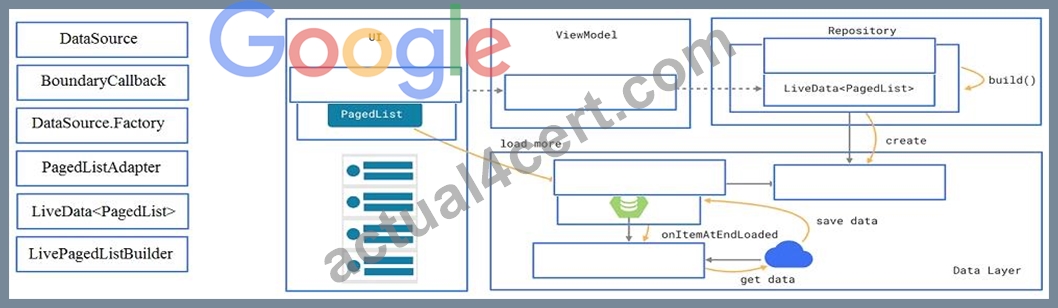
Answer:
Explanation: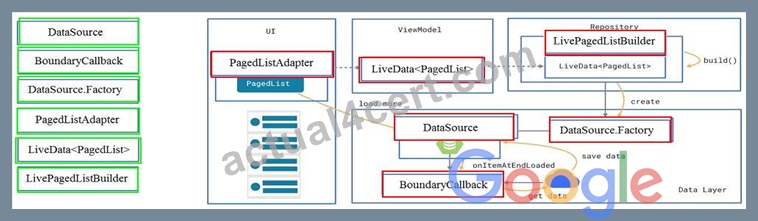
Reference:
https://developer.android.com/topic/libraries/architecture/paging/ui
NEW QUESTION 73
To run your local unit tests, follow these steps:
1. Be sure your project is synchronized with Gradle by clicking Sync Project in the toolbar.
2. Run your test in one of the following ways (select possible): (Choose three.)
- A. To run all tests in Project, open the Project window, and then right-click a test and click Run .
- B. To run a single test, open the Project window, and then right-click a test and click Run .
- C. To test all methods in a class, right-click a class or method in the test file and click Run .
- D. To run all tests in a directory, right-click on the directory and select Run tests .
Answer: B,C,D
NEW QUESTION 74
RecyclerView is a subclass of ViewGroup and is a more resource-efficient way to display scrollable lists. Instead of creating a View for each item that may or may not be visible on the screen, RecyclerView:
- A. creates a single list item and reuses it for visible content.
- B. creates a single list item and never reuses it
- C. creates an unlimited number of list items and never reuses them
- D. creates a limited number of list items and reuses them for visible content.
Answer: D
Explanation:
Reference:
https://developer.android.com/guide/topics/ui/layout/recyclerview
NEW QUESTION 75
With recommended app architecture. Fill the following diagram, which shows how all the modules usually should interact with one another after designing the app (drag modules to correct places).
Answer:
Explanation:
NEW QUESTION 76
For example, we have a file in our assets folder app/src/main/assets/sample_teas.json. To get an InputStream for reading it, from out Context context, we can try do this:
- A. val input = context!!.resources.assets.open("sample_teas.json")
- B. val input = context!!.assets.open("sample_teas.json")
- C. val input = context!!.resources.openRawResource(R.raw.sample_teas)
Answer: B
NEW QUESTION 77
The Log class allows you to create log messages that appear in logcat. Generally, you could use the following log methods: (Choose five.)
- A. Log.w(String, String) (warning)
- B. Log.i(String, String) (information)
- C. Log.q(String, String) (questions)
- D. Log.v(String, String) (verbose)
- E. Log.e(String, String) (error)
- F. Log.a(String, String) (all outputs)
- G. Log.d(String, String) (debug)
Answer: A,B,D,E,G
NEW QUESTION 78
Select correct statements about Hardware Abstraction Layer (HAL). (Choose two.)
- A. The HAL function both as apps for users and to provide key capabilities that developers can access from their own app. For example, if your app would like to deliver an SMS message, you don't need to build that functionality yourself - you can instead invoke whichever SMS app is already installed to deliver a message to the recipient you specify
- B. The HAL consists of multiple library modules, each of which implements an interface for a specific type of hardware component, such as the camera or bluetooth module. When a framework API makes a call to access device hardware, the Android system loads the library module for that hardware component.
- C. The HAL provides standard interfaces that expose device hardware capabilities to the higher-level Java API framework.
- D. Using a HAL, not using a Linux kernel, allows Android to take advantage of key security features and allows device manufacturers to develop hardware drivers for a well-known kernel.
Answer: B,C
Explanation:
The system apps function both as apps for users and to provide key capabilities that developers can access from their own app. For example, if your app would like to deliver an SMS message, you don't need to build that functionality yourself - you can instead invoke whichever SMS app is already installed to deliver a message to the recipient you specify Using a Linux kernel allows Android to take advantage of key security features and allows device manufacturers to develop hardware drivers for a well-known kernel.
Reference:
https://developer.android.com/guide/platform
NEW QUESTION 79
To create a basic JUnit 4 test class, create a class that contains one or more test methods. A test method begins with the specific annotation and contains the code to exercise and verify a single functionality in the component that you want to test. What is the annotation?
- A. @Rule
- B. @LargeTest
- C. @RunWith
- D. @Test
Answer: D
NEW QUESTION 80
A content label sometimes depends on information only available at runtime, or the meaning of a View might change over time. For example, a Play button might change to a Pause button during music playback. In these cases, to update the content label at the appropriate time, we can use:
- A. View#setContentLabel(CharSequence contentDescription)
- B. View#setContentLabel(int contentDescriptionResId)
- C. View#setContentDescription(CharSequence contentDescription)
- D. View#setContentDescription(int contentDescriptionResId)
Answer: C
Explanation:
Reference:
https://support.google.com/accessibility/android/answer/7158690?hl=en
NEW QUESTION 81
About running a debuggable build variant. Usually, you can just select the default "debug" variant that's included in every Android Studio project (even though it's not visible in the build.gradle file). But if you define new build types that should be debuggable, you must add 'debuggable true' to the build type. Is that mostly true?
- A. Yes.
- B. No, if you define new build types that should be debuggable, you must add 'debuggable false'
- C. No, the debug variant should be visible in the build.gradle file anyway.
Answer: A
NEW QUESTION 82
Filter logcat messages. If in the filter menu, a filter option "Edit Filter Configuration"? means:
- A. Display the messages produced by the app code only (the default). Logcat filters the log messages using the PID of the active app.
- B. Apply no filters. Logcat displays all log messages from the device, regardless of which process you selected.
- C. Create or modify a custom filter. For example, you could create a filter to view log messages from two apps at the same time.
Answer: C
NEW QUESTION 83
What method should we use with Notification.Builder to supply a PendingIntent to be sent when the notification is clicked?
- A. setContentIntent
- B. setContentInfo
- C. setDeleteIntent
Answer: A
Explanation:
Reference:
https://developer.android.com/training/notify-user/build-notification
NEW QUESTION 84
If you are working with a Builder that creates a PeriodicWorkRequest to run periodically once within the flex period of every interval period. What statement is correct?
- A. The repeat interval must be greater than or equal to PeriodicWorkRequest.MIN_PERIODIC_INTERVAL_MILLIS and the flex interval can be anything in relation to PeriodicWorkRequest.MIN_PERIODIC_FLEX_MILLIS.
- B. The repeat interval must be lower than or equal to PeriodicWorkRequest.MIN_PERIODIC_INTERVAL_MILLIS and the flex interval must be lower than or equal to PeriodicWorkRequest.MIN_PERIODIC_FLEX_MILLIS.
- C. The repeat interval must be greater than or equal to PeriodicWorkRequest.MIN_PERIODIC_INTERVAL_MILLIS and the flex interval must be greater than or equal to PeriodicWorkRequest.MIN_PERIODIC_FLEX_MILLIS.
- D. The repeat interval must be greater than PeriodicWorkRequest.MIN_PERIODIC_INTERVAL_MILLIS and the flex interval must be greater than PeriodicWorkRequest.MIN_PERIODIC_FLEX_MILLIS.
Answer: C
Explanation:
Working with WorkManager, from the 2018 Android Dev Summit
WorkManager: Beyond the basics, from the 2019 Android Dev Summit
Reference:
https://developer.android.com/reference/androidx/work/WorkManager?hl=en
NEW QUESTION 85
Under the hood WorkManager uses an underlying job dispatching service based on the following criteri a. You need to move services to the correct places.
Answer:
Explanation: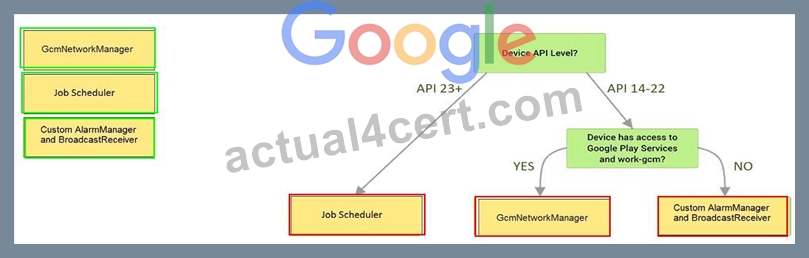
Explanation:
Videos:
Working with WorkManager, from the 2018 Android Dev Summit
WorkManager: Beyond the basics, from the 2019 Android Dev Summit
Reference:
https://developer.android.com/reference/androidx/work/WorkManager?hl=en
NEW QUESTION 86
Each time your test invokes onView(), Espresso waits to perform the corresponding UI action or assertion until the following synchronization conditions are met: (Choose three.)
- A. All developer-defined idling res
- B. The message queue is empty.
- C. There are some instances of AsyncTask currently executing a task.
- D. Some developer-defined idling resources are not idle.
- E. The message queue is not empty.
- F. There are no instances of AsyncTask currently executing a task.
Answer: A,B,F
NEW QUESTION 87
Working with Custom View. Once you define the custom attributes, you can use them in layout XML files just like built-in attributes. The only difference is that your custom attributes belong to a different namespace. Instead of belonging to the http://schemas.android.com/apk/res/android namespace, they belong to:
- A. http://schemas.android.com/apk/res/[your package name]
- B. http://schemas.android.com/[your package name]
- C. http://schemas.android.com/apk/[your package name]
Answer: A
Explanation:
Reference:
https://developer.android.com/guide/topics/ui/custom-components
NEW QUESTION 88
......
Associate-Android-Developer Dumps for Google Developers Certified Exam Questions & Answer: https://www.actual4cert.com/Associate-Android-Developer-real-questions.html