

Vault-Associate Actual Questions - Instant Download Tests Free Updated Today!
Get instant access of 100% real HashiCorp Vault-Associate exam questions with verified answers
HashiCorp Vault-Associate Exam Syllabus Topics:
| Topic | Details |
|---|---|
| Topic 1 |
|
| Topic 2 |
|
| Topic 3 |
|
| Topic 4 |
|
| Topic 5 |
|
| Topic 6 |
|
| Topic 7 |
|
NEW QUESTION # 26
The vault lease renew command increments the lease time from:
- A. The current time
- B. The end of the lease
Answer: A
Explanation:
The vault lease renew command increments the lease time from the current time, not the end of the lease. This means that the user can request a specific amount of time they want remaining on the lease, termed the increment. This is not an increment at the end of the current TTL; it is an increment from the current time. For example, vault lease renew -increment=3600 my-lease-id would request that the TTL of the lease be adjusted to 1 hour (3600 seconds) from now. Having the increment be rooted at the current time instead of the end of the lease makes it easy for users to reduce the length of leases if they don't actually need credentials for the full possible lease period, allowing those credentials to expire sooner and resources to be cleaned up earlier. The requested increment is completely advisory. The backend in charge of the secret can choose to completely ignore it1. Reference:
Lease, Renew, and Revoke | Vault | HashiCorp Developer
NEW QUESTION # 27
Use this screenshot to answer the question below: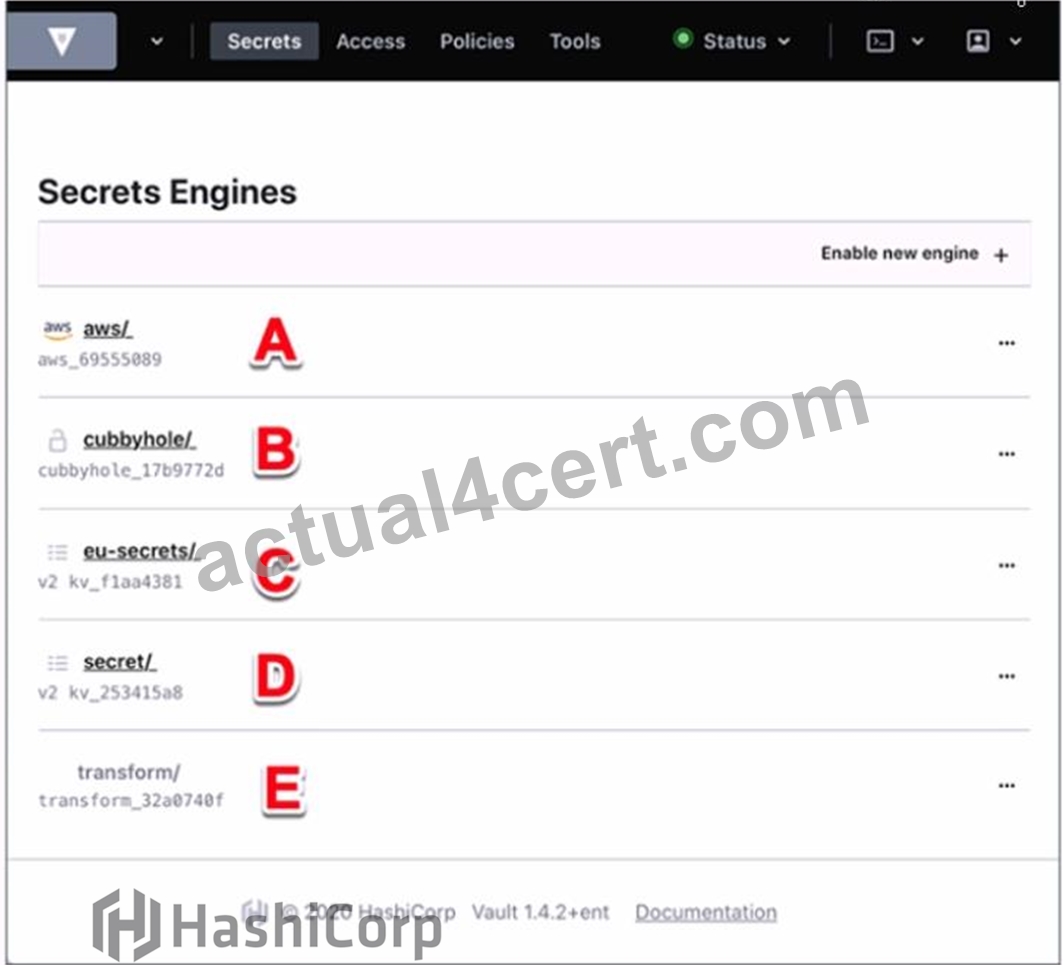
Where on this page would you click to view a secret located at secret/my-secret?
- A. D
- B. C
- C. B
- D. E
- E. A
Answer: B
Explanation:
In the HashiCorp Vault UI, secrets are organized in a tree-like structure. To view a secret located at secret/my-secret, you would click on the "secret/" folder in the tree, then click on the "my-secret" file. In this screenshot, the "secret/" folder is located at option C. This folder contains the secrets that are stored in the key/value secrets engine, which is the default secrets engine in Vault. The key/value secrets engine allows you to store arbitrary secrets as key/value pairs. The key is the path of the secret, and the value is the data of the secret. For example, the secret located at secret/my-secret has a key of "my-secret" and a value of whatever data you stored there.
Reference:
[KV - Secrets Engines | Vault | HashiCorp Developer]
NEW QUESTION # 28
You are using the Vault userpass auth method mounted at auth/userpass. How do you create a new user named "sally" with password "h0wN0wB4r0wnC0w"? This new user will need the power-users policy.
- A.

- B.

- C.

- D.

Answer: B
Explanation:
To create a new user named "sally" with password "h0wN0wB4r0wnC0w" and the power-users policy, you would use the Vault userpass auth method mounted at auth/userpass. You would use the following command: "vault write auth/userpass/users/sally password=h0wN0wB4r0wnC0w policies=power-users". This command would create a new user named "sally" with the specified password and policy. Reference:
[Userpass Auth Method | Vault | HashiCorp Developer]
[Create Vault policies | Vault | HashiCorp Developer]
NEW QUESTION # 29
What can be used to limit the scope of a credential breach?
- A. Sharing credentials between applications
- B. Use of a short-lived dynamic secrets
- C. Enable audit logging
- D. Storage of secrets in a distributed ledger
Answer: B
Explanation:
Using a short-lived dynamic secrets can help limit the scope of a credential breach by reducing the exposure time of the secrets. Dynamic secrets are generated on-demand by Vault and automatically revoked when they are no longer needed. This way, the credentials are not stored in plain text or in a static database, and they can be rotated frequently to prevent unauthorized access. Dynamic secrets also provide encryption as a service, which means that they perform cryptographic operations on data in-transit without storing any data. This adds an extra layer of security and reduces the risk of data leakage or tampering. Reference: Dynamic secrets | Vault | HashiCorp Developer, What are dynamic secrets and why do I need them? - HashiCorp
NEW QUESTION # 30
You are using Vault's Transit secrets engine to encrypt your dat
a. You want to reduce the amount of content encrypted with a single key in case the key gets compromised. How would you do this?
- A. Use 4096-bit RSA key to encrypt the data
- B. Periodically re-key the Vault's unseal keys
- C. Periodically rotate the encryption key
- D. Upgrade to Vault Enterprise and integrate with HSM
Answer: C
Explanation:
The Transit secrets engine supports the rotation of encryption keys, which allows you to change the key that is used to encrypt new data without affecting the ability to decrypt data that was already encrypted. This reduces the amount of content encrypted with a single key in case the key gets compromised, and also helps you comply with the NIST guidelines for key rotation. You can rotate the encryption key manually by invoking the /transit/keys/<name>/rotate endpoint, or you can configure the key to automatically rotate based on a time interval or a number of encryption operations. When you rotate a key, Vault generates a new key version and increments the key's latest_version metadata. The new key version becomes the encryption key used for encrypting any new data. The previous key versions are still available for decrypting the existing data, unless you specify a minimum decryption version to archive the old key versions. You can also delete or disable old key versions if you want to revoke access to the data encrypted with those versions. Reference: https://developer.hashicorp.com/vault/docs/secrets/transit1, https://developer.hashicorp.com/vault/api-docs/secret/transit2
NEW QUESTION # 31
Vault supports which type of configuration for source limited token?
- A. CIDR-bound tokens
- B. Certificate-bound tokens
- C. Domain-bound tokens
- D. Cloud-bound tokens
Answer: A
Explanation:
Vault supports CIDR-bound tokens, which are tokens that can only be used from a specific set of IP addresses or network ranges. This is a way to limit the scope and exposure of a token in case it is compromised or leaked. CIDR-bound tokens can be created by specifying the bound_cidr_list parameter when creating or updating a token role, or by using the -bound-cidr option when creating a token using the vault token create command. CIDR-bound tokens can also be created by some auth methods, such as AWS or Kubernetes, that can automatically bind the tokens to the source IP or network of the client. Reference: Token - Auth Methods | Vault | HashiCorp Developer, vault token create - Command | Vault | HashiCorp Developer
NEW QUESTION # 32
What is the Vault CLI command to query information about the token the client is currently using?
- A. vault token lookup
- B. vault self-lookup
- C. vault lookup self
- D. vault lookup token
Answer: A
Explanation:
The Vault CLI command to query information about the token the client is currently using is vault token lookup. This command displays information about the token or accessor provided as an argument, or the locally authenticated token if no argument is given. The information includes the token ID, accessor, policies, TTL, creation time, and metadata. This command can be useful for debugging and auditing purposes, as well as for renewing or revoking tokens. Reference: token lookup - Command | Vault | HashiCorp Developer, Tokens | Vault | HashiCorp Developer
NEW QUESTION # 33
What are orphan tokens?
- A. Orphan tokens do not expire when their own max TTL is reached
- B. Orphan tokens are tokens with no policies attached
- C. Orphan tokens are tokens with a use limit so you can set the number of uses when you create them
- D. Orphan tokens are not children of their parent; therefore, orphan tokens do not expire when their parent does
Answer: A
Explanation:
Orphan tokens are tokens that are root of their own token tree. This means that they do not have any parent token associated with them, and they do not expire when their parent token expires. Orphan tokens are useful for scenarios where you need a short-lived and independent token, such as for testing or debugging purposes. Orphan tokens can also be used to create temporary access tokens for applications or services that need to communicate with Vault without using a long-lived root token. Reference: Tokens | Vault | HashiCorp Developer, Vault cli: how to create orphan token with role - HashiCorp Discuss
NEW QUESTION # 34
As a best practice, the root token should be stored in which of the following ways?
- A. Should be stored in configuration automation tooling
- B. Should be stored in another password safe
- C. Should be revoked and never stored after initial setup
- D. Should be stored in Vault
Answer: C
Explanation:
The root token is the initial token created when initializing Vault. It has unlimited privileges and can perform any operation in Vault. As a best practice, the root token should be revoked and never stored after initial setup. This is because the root token is a single point of failure and a potential security risk if it is compromised or leaked. Instead of using the root token, Vault operators should create other tokens with appropriate policies and roles that allow them to perform their tasks. If a new root token is needed in an emergency, the vault operator generate-root command can be used to create one on-the-fly with the consent of a quorum of unseal key holders. Reference: Tokens | Vault | HashiCorp Developer, Generate root tokens using unseal keys | Vault | HashiCorp Developer
NEW QUESTION # 35
To give a role the ability to display or output all of the end points under the /secrets/apps/* end point it would need to have which capability set?
- A. read
- B. None of the above
- C. list
- D. update
- E. sudo
Answer: E
Explanation:
To give a role the ability to display or output all of the end points under the /secrets/apps/* end point, it would need to have the list capability set. The list capability allows a role to perform any operation on any path in Vault, including reading, writing, deleting, and listing. The list capability is required for roles that need to access sensitive data or perform administrative tasks in Vault. The other capabilities are not relevant for this scenario, as they only allow specific operations on specific paths or secrets engines. Reference: Policies | Vault | HashiCorp Developer, token capabilities - Command | Vault | HashiCorp Developer
NEW QUESTION # 36
Which Vault secret engine may be used to build your own internal certificate authority?
- A. PKI
- B. Transit
- C. PostgreSQL
- D. Generic
Answer: A
Explanation:
The Vault secret engine that can be used to build your own internal certificate authority is the PKI secret engine. The PKI secret engine generates dynamic X.509 certificates on-demand, without requiring manual processes of generating private keys and CSRs, submitting to a CA, and waiting for verification and signing. The PKI secret engine can act as a root CA or an intermediate CA, and can issue certificates for various purposes, such as TLS, code signing, email encryption, etc. The PKI secret engine can also manage the certificate lifecycle, such as rotation, revocation, renewal, and CRL generation. The PKI secret engine can also integrate with external CAs, such as Venafi or Entrust, to delegate the certificate issuance and management. Reference: PKI - Secrets Engines | Vault | HashiCorp Developer, Build Your Own Certificate Authority (CA) | Vault - HashiCorp Learn
NEW QUESTION # 37
To make an authenticated request via the Vault HTTP API, which header would you use?
- A. The X-Vault-Token HTTP Header
- B. The x-Vault-Request HTTP Header
- C. The X-Vault-Namespace HTTP Header
- D. The Content-Type HTTP Header
Answer: A
Explanation:
To make an authenticated request via the Vault HTTP API, you need to use the X-Vault-Token HTTP Header or the Authorization HTTP Header using the Bearer <token> scheme. The token is a string that represents your identity and permissions in Vault. You can obtain a token by using an authentication method, such as userpass, approle, aws, etc. The token can also be a root token, which has unlimited access to Vault, or a wrapped token, which is a response-wrapping token that can be used to unwrap the actual token. The token must be sent with every request to Vault that requires authentication, except for the unauthenticated endpoints, such as sys/init, sys/seal-status, sys/unseal, etc. The token is used by Vault to verify your identity and enforce the policies that grant or deny access to various paths and operations. Reference: https://developer.hashicorp.com/vault/api-docs3, https://developer.hashicorp.com/vault/docs/concepts/tokens4, https://developer.hashicorp.com/vault/docs/concepts/auth5
NEW QUESTION # 38
Which of the following cannot define the maximum time-to-live (TTL) for a token?
- A. By the client system f credentials leaking
- B. By the authentication method t natively provide a method of expiring credentials
- C. A parent token TTL e password rotation tools and practices
- D. By the mount endpoint configuration very password used
- E. System max TTL
Answer: A
Explanation:
The maximum time-to-live (TTL) for a token is defined by the lowest value among the following factors:
The authentication method that issued the token. Each auth method can have a default and a maximum TTL for the tokens it generates. These values can be configured by the auth method's mount options or by the auth method's specific endpoints.
The mount endpoint configuration that the token is accessing. Each secrets engine can have a default and a maximum TTL for the leases it grants. These values can be configured by the secrets engine's mount options or by the secrets engine's specific endpoints.
A parent token TTL. If a token is created by another token, it inherits the remaining TTL of its parent token, unless the parent token has an infinite TTL (such as the root token). A child token cannot outlive its parent token.
System max TTL. This is a global limit for all tokens and leases in Vault. It can be configured by the system backend's max_lease_ttl option.
The client system that uses the token cannot define the maximum TTL for the token, as this is determined by Vault's configuration and policies. The client system can only request a specific TTL for the token, but this request is subject to the limits imposed by the factors above.
NEW QUESTION # 39
How would you describe the value of using the Vault transit secrets engine?
- A. The transit secrets engine ensures encryption in-transit and at-rest is enforced enterprise wide
- B. Encryption for application data is best handled by a storage system or database engine, while storing encryption keys in Vault
- C. Vault has an API that can be programmatically consumed by applications
- D. The transit secrets engine relieves the burden of proper encryption/decryption from application developers and pushes the burden onto the operators of Vault
Answer: D
Explanation:
The transit secrets engine relieves the burden of proper encryption/decryption from application developers and pushes the burden onto the operators of Vault. The transit secrets engine provides encryption as a service, which means that it performs cryptographic operations on data in-transit without storing any data. This allows developers to delegate the responsibility of managing encryption keys and algorithms to Vault operators, who can define and enforce policies on the transit secrets engine. This way, developers can focus on their application logic and data, while Vault handles the encryption and decryption of data in a secure and scalable manner. Reference: Transit - Secrets Engines | Vault | HashiCorp Developer, Encryption as a service: transit secrets engine | Vault | HashiCorp Developer
NEW QUESTION # 40
Which of the following statements describe the CLI command below?
S vault login -method-1dap username-mitche11h
- A. By default the generated token is valid for 24 hours
- B. Generates a token which is response wrapped
- C. You will be prompted to enter the password
- D. Fails because the password is not provided
Answer: B
Explanation:
The CLI command vault login -method ldap username=mitchellh generates a token that is response wrapped. This means that the token contains a base64-encoded response wrapper, which is a JSON object that contains information about the token, such as its policies, metadata, and expiration time. The response wrapper is used to verify the authenticity and integrity of the token, and to prevent replay attacks. The response wrapper also allows Vault to automatically renew the token when it expires, or to revoke it if it is compromised. The -method ldap option specifies that the authentication method is LDAP, which requires a username and password to be provided. The username mitchellh is an example of an LDAP user name, and the password will be hidden when entered. Reference: Vault CLI Reference | Vault | HashiCorp Developer, Vault CLI Reference | Vault | HashiCorp Developer
NEW QUESTION # 41
You can build a high availability Vault cluster with any storage backend.
- A. False
- B. True
Answer: A
Explanation:
Not all storage backends support high availability mode for Vault. Only the storage backends that support locking can enable Vault to run in a multi-server mode where one server is active and the others are standby. Some examples of storage backends that support high availability mode are Consul, Integrated Storage, and ZooKeeper. Some examples of storage backends that do not support high availability mode are Filesystem, MySQL, and PostgreSQL. Reference: https://developer.hashicorp.com/vault/docs/concepts/ha1, https://developer.hashicorp.com/vault/docs/configuration/storage2
NEW QUESTION # 42
How many Shamir's key shares are required to unseal a Vault instance?
- A. One or more keys
- B. All key shares
- C. The threshold number of key shares
- D. A quorum of key shares
Answer: C
Explanation:
Shamir's Secret Sharing is a cryptographic algorithm that allows a secret to be split into multiple parts, called key shares, such that a certain number of key shares are required to reconstruct the secret. The number of key shares and the threshold number are configurable parameters that depend on the desired level of security and availability. Vault uses Shamir's Secret Sharing to protect its master key, which is used to encrypt and decrypt the data encryption key that secures the Vault data. When Vault is initialized, it generates a master key and splits it into a configured number of key shares, which are then distributed to trusted operators. To unseal Vault, the threshold number of key shares must be provided to reconstruct the master key and decrypt the data encryption key. This process ensures that no single operator can access the Vault data without the cooperation of other key holders. Reference: https://developer.hashicorp.com/vault/docs/concepts/seal4, https://developer.hashicorp.com/vault/docs/commands/operator/init5, https://developer.hashicorp.com/vault/docs/commands/operator/unseal6
NEW QUESTION # 43
......
Download Latest & Valid Questions For HashiCorp Vault-Associate exam: https://www.actual4cert.com/Vault-Associate-real-questions.html
Exam Dumps for the Preparation of Latest Vault-Associate Exam Questions: https://drive.google.com/open?id=1AXgQ8WmK3sx7mohpockYVPMWo_GnuUul