

DP-100 Questions PDF [2024] Use Valid New dump to Clear Exam
Passing Microsoft DP-100 Exam Using 2024 Practice Tests
To prepare for the Microsoft DP-100 certification exam, candidates can take advantage of various resources provided by Microsoft, including online training courses, study guides, and practice exams. The training courses cover all the topics in the exam and provide hands-on experience with Azure technologies. The study guides provide a detailed overview of the exam topics and help candidates understand what to expect on the day of the exam. The practice exams allow candidates to test their knowledge and identify areas where they need to improve.
Microsoft DP-100 (Designing and Implementing a Data Science Solution on Azure) certification exam is designed for data professionals who use Azure technologies to build and implement data science solutions. DP-100 exam measures the candidate's ability to design and implement data storage solutions, data processing solutions, and data analysis solutions using Azure technologies. Candidates who pass the DP-100 exam will receive the Microsoft Certified: Azure Data Scientist Associate certification.
NEW QUESTION # 221
You collect data from a nearby weather station. You have a pandas dataframe named weather_df that includes the following data:
The data is collected every 12 hours: noon and midnight.
You plan to use automated machine learning to create a time-series model that predicts temperature over the next seven days. For the initial round of training, you want to train a maximum of 50 different models.
You must use the Azure Machine Learning SDK to run an automated machine learning experiment to train these models.
You need to configure the automated machine learning run.
How should you complete the AutoMLConfig definition? To answer, select the appropriate options in the answer area.
NOTE: Each correct selection is worth one point.

Answer:
Explanation:
Explanation:
Box 1: forcasting
Task: The type of task to run. Values can be 'classification', 'regression', or 'forecasting' depending on the type of automated ML problem to solve.
Box 2: temperature
The training data to be used within the experiment. It should contain both training features and a label column (optionally a sample weights column).
Box 3: observation_time
time_column_name: The name of the time column. This parameter is required when forecasting to specify the datetime column in the input data used for building the time series and inferring its frequency. This setting is being deprecated. Please use forecasting_parameters instead.
Box 4: 7
"predicts temperature over the next seven days"
max_horizon: The desired maximum forecast horizon in units of time-series frequency. The default value is 1.
Units are based on the time interval of your training data, e.g., monthly, weekly that the forecaster should predict out. When task type is forecasting, this parameter is required.
Box 5: 50
"For the initial round of training, you want to train a maximum of 50 different models." Iterations: The total number of different algorithm and parameter combinations to test during an automated ML experiment.
Reference:
https://docs.microsoft.com/en-us/python/api/azureml-train-automl-client/azureml.train.automl.automlconfig.automlconfig
NEW QUESTION # 222
You manage an Azure Machine Learning won pace named workspace 1 by using the Python SDK v2. You create a Gene-al Purpose v2 Azure storage account named mlstorage1. The storage account includes a pulley accessible container name micOTtalnerl. The container stores 10 blobs with files in the CSV format.
You must develop Python SDK v2 code to create a data asset referencing all blobs in the container named mtcontamer1.
You need to complete the Python SDK v2 code.
How should you complete the code? To answer select the appropriate options in the answer area.
NOTE: Each correct selection is worth one point.
Answer:
Explanation:
NEW QUESTION # 223
Note: This question is part of a series of questions that present the same scenario. Each question in the series contains a unique solution that might meet the stated goals. Some question sets might have more than one correct solution, while others might not have a correct solution.
After you answer a question in this section, you will NOT be able to return to it. As a result, these questions will not appear in the review screen.
You create a model to forecast weather conditions based on historical data.
You need to create a pipeline that runs a processing script to load data from a datastore and pass the processed data to a machine learning model training script.
Solution: Run the following code:
Does the solution meet the goal?
- A. No
- B. Yes
Answer: A
Explanation:
Explanation
train_step is missing.
Reference:
https://docs.microsoft.com/en-us/python/api/azureml-pipeline-core/azureml.pipeline.core.pipelinedata?view=azu
NEW QUESTION # 224
You must use the Azure Machine Learning SDK to interact with data and experiments in the workspace.
You need to configure the config.json file to connect to the workspace from the Python environment.
Which two additional parameters must you add to the config.json file in order to connect to the workspace? Each correct answer presents part of the solution.
NOTE: Each correct selection is worth one point.
- A. Login
- B. Key
- C. resource_group
- D. subscription_Id
- E. region
Answer: D,E
Explanation:
Topic 1, Case Study
Overview
You are a data scientist in a company that provides data science for professional sporting events. Models will be global and local market data to meet the following business goals:
* Understand sentiment of mobile device users at sporting events based on audio from crowd reactions.
* Access a user's tendency to respond to an advertisement.
* Customize styles of ads served on mobile devices.
* Use video to detect penalty events.
Current environment
Requirements
* Media used for penalty event detection will be provided by consumer devices. Media may include images and videos captured during the sporting event and snared using social media. The images and videos will have varying sizes and formats.
* The data available for model building comprises of seven years of sporting event media. The sporting event media includes: recorded videos, transcripts of radio commentary, and logs from related social media feeds feeds captured during the sporting events.
* Crowd sentiment will include audio recordings submitted by event attendees in both mono and stereo Formats.
Advertisements
* Ad response models must be trained at the beginning of each event and applied during the sporting event.
* Market segmentation nxxlels must optimize for similar ad resporr.r history.
* Sampling must guarantee mutual and collective exclusivity local and global segmentation models that share the same features.
* Local market segmentation models will be applied before determining a user's propensity to respond to an advertisement.
* Data scientists must be able to detect model degradation and decay.
* Ad response models must support non linear boundaries features.
* The ad propensity model uses a cut threshold is 0.45 and retrains occur if weighted Kappa deviates from 0.1 +/-5%.
* The ad propensity model uses cost factors shown in the following diagram:
The ad propensity model uses proposed cost factors shown in the following diagram:
Performance curves of current and proposed cost factor scenarios are shown in the following diagram: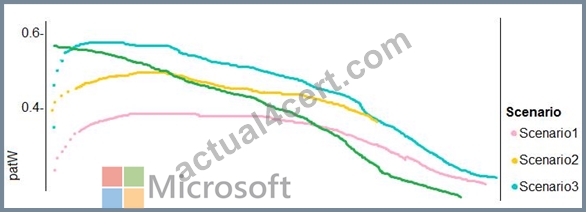
Penalty detection and sentiment
Findings
* Data scientists must build an intelligent solution by using multiple machine learning models for penalty event detection.
* Data scientists must build notebooks in a local environment using automatic feature engineering and model building in machine learning pipelines.
* Notebooks must be deployed to retrain by using Spark instances with dynamic worker allocation
* Notebooks must execute with the same code on new Spark instances to recode only the source of the data.
* Global penalty detection models must be trained by using dynamic runtime graph computation during training.
* Local penalty detection models must be written by using BrainScript.
* Experiments for local crowd sentiment models must combine local penalty detection data.
* Crowd sentiment models must identify known sounds such as cheers and known catch phrases. Individual crowd sentiment models will detect similar sounds.
* All shared features for local models are continuous variables.
* Shared features must use double precision. Subsequent layers must have aggregate running mean and standard deviation metrics Available.
segments
During the initial weeks in production, the following was observed:
* Ad response rates declined.
* Drops were not consistent across ad styles.
* The distribution of features across training and production data are not consistent.
Analysis shows that of the 100 numeric features on user location and behavior, the 47 features that come from location sources are being used as raw features. A suggested experiment to remedy the bias and variance issue is to engineer 10 linearly uncorrected features.
Penalty detection and sentiment
* Initial data discovery shows a wide range of densities of target states in training data used for crowd sentiment models.
* All penalty detection models show inference phases using a Stochastic Gradient Descent (SGD) are running too stow.
* Audio samples show that the length of a catch phrase varies between 25%-47%, depending on region.
* The performance of the global penalty detection models show lower variance but higher bias when comparing training and validation sets. Before implementing any feature changes, you must confirm the bias and variance using all training and validation cases.
NEW QUESTION # 225
You are developing a machine learning, experiment by using Azure. The following images show the input and output of a machine learning experiment:
Use the drop-down menus to select the answer choice that answers each question based on the information presented in the graphic.
NOTE: Each correct selection is worth one point.
Answer:
Explanation:
NEW QUESTION # 226
You need to replace the missing data in the AccessibilityToHighway columns.
How should you configure the Clean Missing Data module? To answer, select the appropriate options in the answer area.
NOTE: Each correct selection is worth one point.
Answer:
Explanation:
NEW QUESTION # 227
You use the Azure Machine Learning service to create a tabular dataset named training.dat a. You plan to use this dataset in a training script.
You create a variable that references the dataset using the following code:
training_ds = workspace.datasets.get("training_data")
You define an estimator to run the script.
You need to set the correct property of the estimator to ensure that your script can access the training.data dataset Which property should you set?
- A.

- B.

- C.

- D.

Answer: A
Explanation:
Example:
# Get the training dataset
diabetes_ds = ws.datasets.get("Diabetes Dataset")
# Create an estimator that uses the remote compute
hyper_estimator = SKLearn(source_directory=experiment_folder,
inputs=[diabetes_ds.as_named_input('diabetes')], # Pass the dataset as an input compute_target = cpu_cluster, conda_packages=['pandas','ipykernel','matplotlib'], pip_packages=['azureml-sdk','argparse','pyarrow'], entry_script='diabetes_training.py') Reference:
https://notebooks.azure.com/GraemeMalcolm/projects/azureml-primers/html/04%20-%20Optimizing%20Model%20Training.ipynb
NEW QUESTION # 228
You are creating a new experiment in Azure Machine Learning Studio. You have a small dataset that has missing values in many columns. The data does not require the application of predictors for each column. You plan to use the Clean Missing Data module to handle the missing data.
You need to select a data cleaning method.
Which method should you use?
- A. Normalization
- B. Synthetic Minority Oversampling Technique (SMOTE)
- C. Replace using MICE
- D. Replace using; Probabilistic PCA
Answer: D
Explanation:
Explanation
Replace using Probabilistic PCA: Compared to other options, such as Multiple Imputation using Chained Equations (MICE), this option has the advantage of not requiring the application of predictors for each column. Instead, it approximates the covariance for the full dataset. Therefore, it might offer better performance for datasets that have missing values in many columns.
References:
https://docs.microsoft.com/en-us/azure/machine-learning/studio-module-reference/clean-missing-data
NEW QUESTION # 229
You have a Python script that executes a pipeline. The script includes the following code:
from azureml.core import Experiment
pipeline_run = Experiment(ws, 'pipeline_test').submit(pipeline)
You want to test the pipeline before deploying the script.
You need to display the pipeline run details written to the STDOUT output when the pipeline completes.
Which code segment should you add to the test script?
- A. pipeline_run.wait_for_completion(show_output=True)
- B. pipeline_run.get.metrics()
- C. pipeline_run.get_status()
- D. pipeline_param = PipelineParameter(name="stdout",
default_value="console")
Answer: A
Explanation:
Explanation
wait_for_completion: Wait for the completion of this run. Returns the status object after the wait.
Syntax: wait_for_completion(show_output=False, wait_post_processing=False, raise_on_error=True) Parameter: show_output Indicates whether to show the run output on sys.stdout.
NEW QUESTION # 230
You need to define an evaluation strategy for the crowd sentiment models.
Which three actions should you perform in sequence? To answer, move the appropriate actions from the list of actions to the answer area and arrange them in the correct order.
Answer:
Explanation:
1 - Add new features for retraining supervised models.
2 - Evaluate the changes in correlation...
3 - Filter labeled cases for retraining...
Reference:
https://en.wikipedia.org/wiki/Nearest_centroid_classifier
https://docs.microsoft.com/en-us/azure/machine-learning/studio-module-reference/sweep-clustering
NEW QUESTION # 231
You create an Azure Machine Learning workspace. You use the Azure Machine Learning Python SDK v2 to create a compute cluster.
The compute cluster must run a training script. Costs associated with running the training script must be minimized.
You need to complete the Python script to create the compute cluster.
How should you complete the script? To answer, select the appropriate options in the answer area.
NOTE: Each correct selection is worth one point.
Answer:
Explanation:
Explanation
NEW QUESTION # 232
You create an Azure Machine learning workspace and load a Python training script named tram.py in the src subfolder. The dataset used to train your model is available locally. You run the following script to tram the model:
instructions: For each of the following statements, select Yes if the statement is true. Otherwise, select No.
NOTE: Each correct selection is worth one point
Answer:
Explanation:
NEW QUESTION # 233
You manage an Azure Machine Learning workspace. You create an experiment named experiment1 by using the Azure Machine Learning Python SDK v2 and MLflow.
For each of the following statements, select Yes if the statement is true. Otherwise, select No.
Answer:
Explanation:
Explanation
NEW QUESTION # 234
You manage an Azure Machine Learning workspace. You train a model named model1.
You must identify the features to modify for a differing model prediction result.
You need to configure the Responsible Al (RAI) dashboard for model1.
Which three actions should you perform in sequence? To answer move the appropriate actions from the list of actions to the answer area and arrange them in the correct order.
Answer:
Explanation:
Explanation
NEW QUESTION # 235
You train a classification model by using a decision tree algorithm.
You create an estimator by running the following Python code. The variable feature_names is a list of all feature names, and class_names is a list of all class names.
from interpret.ext.blackbox import TabularExplainer
You need to explain the predictions made by the model for all classes by determining the importance of all features.
For each of the following statements, select Yes if the statement is true. Otherwise, select No.
NOTE: Each correct selection is worth one point.
Answer:
Explanation:
Explanation
Box 1: Yes
TabularExplainer calls one of the three SHAP explainers underneath (TreeExplainer, DeepExplainer, or KernelExplainer).
Box 2: Yes
To make your explanations and visualizations more informative, you can choose to pass in feature names and output class names if doing classification.
Box 3: No
TabularExplainer automatically selects the most appropriate one for your use case, but you can call each of its three underlying explainers underneath (TreeExplainer, DeepExplainer, or KernelExplainer) directly.
Reference:
https://docs.microsoft.com/en-us/azure/machine-learning/how-to-machine-learning-interpretability-aml
NEW QUESTION # 236
You create a script that trains a convolutional neural network model over multiple epochs and logs the validation loss after each epoch. The script includes arguments for batch size and learning rate.
You identify a set of batch size and learning rate values that you want to try.
You need to use Azure Machine Learning to find the combination of batch size and learning rate that results in the model with the lowest validation loss.
What should you do?
- A. Create a PythonScriptStep object for the script and run it in a pipeline
- B. Use the Automated Machine Learning interface in Azure Machine Learning studio
- C. Run the script in an experiment based on a HyperDriveConfig object
- D. Run the script in an experiment based on an AutoMLConfig object
- E. Run the script in an experiment based on a ScriptRunConfig object
Answer: C
Explanation:
Reference:
https://docs.microsoft.com/en-us/azure/machine-learning/how-to-tune-hyperparameters
NEW QUESTION # 237
You create a datastore named training_data that references a blob container in an Azure Storage account. The blob container contains a folder named csv_files in which multiple comma-separated values (CSV) files are stored.
You have a script named train.py in a local folder named ./script that you plan to run as an experiment using an estimator. The script includes the following code to read data from the csv_files folder:
You have the following script.
You need to configure the estimator for the experiment so that the script can read the data from a data reference named data_ref that references the csv_files folder in the training_data datastore.
Which code should you use to configure the estimator?
- A. Option B
- B. Option E
- C. Option D
- D. Option C
- E. Option A
Answer: A
Explanation:
Besides passing the dataset through the inputs parameter in the estimator, you can also pass the dataset through script_params and get the data path (mounting point) in your training script via arguments. This way, you can keep your training script independent of azureml-sdk. In other words, you will be able use the same training script for local debugging and remote training on any cloud platform.
Example:
from azureml.train.sklearn import SKLearn
script_params = {
# mount the dataset on the remote compute and pass the mounted path as an argument to the training script
'--data-folder': mnist_ds.as_named_input('mnist').as_mount(),
'--regularization': 0.5
}
est = SKLearn(source_directory=script_folder,
script_params=script_params,
compute_target=compute_target,
environment_definition=env,
entry_script='train_mnist.py')
# Run the experiment
run = experiment.submit(est)
run.wait_for_completion(show_output=True)
Incorrect Answers:
A: Pandas DataFrame not used.
Reference:
https://docs.microsoft.com/es-es/azure/machine-learning/how-to-train-with-datasets
NEW QUESTION # 238
You need to build a feature extraction strategy for the local models.
How should you complete the code segment? To answer, select the appropriate options in the answer area.
NOTE: Each correct selection is worth one point.
Answer:
Explanation:
Topic 1,
Overview
You are a data scientist in a company that provides data science for professional sporting events. Models will be global and local market data to meet the following business goals:
* Understand sentiment of mobile device users at sporting events based on audio from crowd reactions.
* Access a user's tendency to respond to an advertisement.
* Customize styles of ads served on mobile devices.
* Use video to detect penalty events.
Current environment
Requirements
* Media used for penalty event detection will be provided by consumer devices. Media may include images and videos captured during the sporting event and snared using social medi a. The images and videos will have varying sizes and formats.
* The data available for model building comprises of seven years of sporting event media. The sporting event media includes: recorded videos, transcripts of radio commentary, and logs from related social media feeds feeds captured during the sporting events.
* Crowd sentiment will include audio recordings submitted by event attendees in both mono and stereo Formats.
Advertisements
* Ad response models must be trained at the beginning of each event and applied during the sporting event.
* Market segmentation nxxlels must optimize for similar ad resporr.r history.
* Sampling must guarantee mutual and collective exclusivity local and global segmentation models that share the same features.
* Local market segmentation models will be applied before determining a user's propensity to respond to an advertisement.
* Data scientists must be able to detect model degradation and decay.
* Ad response models must support non linear boundaries features.
* The ad propensity model uses a cut threshold is 0.45 and retrains occur if weighted Kappa deviates from 0.1 +/-5%.
* The ad propensity model uses cost factors shown in the following diagram:
The ad propensity model uses proposed cost factors shown in the following diagram:
Performance curves of current and proposed cost factor scenarios are shown in the following diagram:
Penalty detection and sentiment
Findings
* Data scientists must build an intelligent solution by using multiple machine learning models for penalty event detection.
* Data scientists must build notebooks in a local environment using automatic feature engineering and model building in machine learning pipelines.
* Notebooks must be deployed to retrain by using Spark instances with dynamic worker allocation
* Notebooks must execute with the same code on new Spark instances to recode only the source of the data.
* Global penalty detection models must be trained by using dynamic runtime graph computation during training.
* Local penalty detection models must be written by using BrainScript.
* Experiments for local crowd sentiment models must combine local penalty detection data.
* Crowd sentiment models must identify known sounds such as cheers and known catch phrases. Individual crowd sentiment models will detect similar sounds.
* All shared features for local models are continuous variables.
* Shared features must use double precision. Subsequent layers must have aggregate running mean and standard deviation metrics Available.
segments
During the initial weeks in production, the following was observed:
* Ad response rates declined.
* Drops were not consistent across ad styles.
* The distribution of features across training and production data are not consistent.
Analysis shows that of the 100 numeric features on user location and behavior, the 47 features that come from location sources are being used as raw features. A suggested experiment to remedy the bias and variance issue is to engineer 10 linearly uncorrected features.
Penalty detection and sentiment
* Initial data discovery shows a wide range of densities of target states in training data used for crowd sentiment models.
* All penalty detection models show inference phases using a Stochastic Gradient Descent (SGD) are running too stow.
* Audio samples show that the length of a catch phrase varies between 25%-47%, depending on region.
* The performance of the global penalty detection models show lower variance but higher bias when comparing training and validation sets. Before implementing any feature changes, you must confirm the bias and variance using all training and validation cases.
NEW QUESTION # 239
You define a datastore named ml-data for an Azure Storage blob container. In the container, you have a folder named train that contains a file named data.csv. You plan to use the file to train a model by using the Azure Machine Learning SDK.
You plan to train the model by using the Azure Machine Learning SDK to run an experiment on local compute.
You define a DataReference object by running the following code:
You need to load the training data.
Which code segment should you use?

- A. Option E
- B. Option D
- C. Option C
- D. Option A
- E. Option B
Answer: A
Explanation:
Explanation
Example:
data_folder = args.data_folder
# Load Train and Test data
train_data = pd.read_csv(os.path.join(data_folder, 'data.csv'))
Reference:
https://www.element61.be/en/resource/azure-machine-learning-services-complete-toolbox-ai
NEW QUESTION # 240
You create a binary classification model using Azure Machine Learning Studio.
You must use a Receiver Operating Characteristic (RO C) curve and an F1 score to evaluate the model.
You need to create the required business metrics.
How should you complete the experiment? To answer, select the appropriate options in the dialog box in the answer area.
NOTE: Each correct selection is worth one point.

Answer:
Explanation:
NEW QUESTION # 241
......
DP-100 Study Guide Brilliant DP-100 Exam Dumps PDF: https://www.actual4cert.com/DP-100-real-questions.html
View DP-100 Exam Question Dumps With Latest Demo: https://drive.google.com/open?id=1iZZ8mIkALMpr_pJsyCbHDxc5WDLuDaU8