

Get Microsoft DP-100 Dumps Questions [2022] To Gain Brilliant Result
DP-100 dumps - Actual4Cert - 100% Passing Guarantee
Skills measured
- Manage Azure resources for machine learning (25–30%)
- Implement responsible machine learning (5–10%)
- Run experiments and train models (20–25%)
- Deploy and operationalize machine learning solutions (35–40%)
- The content of this exam was updated on May 20, 2021. Please download the exam skills outline below to see what changed.
NEW QUESTION 106
You create and register a model in an Azure Machine Learning workspace.
You must use the Azure Machine Learning SDK to implement a batch inference pipeline that uses a ParallelRunStep to score input data using the model. You must specify a value for the ParallelRunConfig compute_target setting of the pipeline step.
You need to create the compute target.
Which class should you use?
- A. AdlaCompute
- B. Aks Compute
- C. BatchCompute
- D. AmlCompute
Answer: D
Explanation:
Compute target to use for ParallelRunStep. This parameter may be specified as a compute target object or the string name of a compute target in the workspace.
The compute_target target is of AmlCompute or string.
Note: An Azure Machine Learning Compute (AmlCompute) is a managed-compute infrastructure that allows you to easily create a single or multi-node compute. The compute is created within your workspace region as a resource that can be shared with other users Reference:
https://docs.microsoft.com/en-us/python/api/azureml-contrib-pipeline-steps/azureml.contrib.pipeline.steps.parallelrunconfig
https://docs.microsoft.com/en-us/python/api/azureml-core/azureml.core.compute.amlcompute(class)
NEW QUESTION 107
You have a model with a large difference between the training and validation error values.
You must create a new model and perform cross-validation.
You need to identify a parameter set for the new model using Azure Machine Learning Studio.
Which module you should use for each step? To answer, drag the appropriate modules to the correct steps.
Each module may be used once or more than once, or not at all. You may need to drag the split bar between panes or scroll to view content.
NOTE: Each correct selection is worth one point.
Answer:
Explanation:
Explanation
Box 1: Split data
Box 2: Partition and Sample
Box 3: Two-Class Boosted Decision Tree
Box 4: Tune Model Hyperparameters
Integrated train and tune: You configure a set of parameters to use, and then let the module iterate over multiple combinations, measuring accuracy until it finds a "best" model. With most learner modules, you can choose which parameters should be changed during the training process, and which should remain fixed.
We recommend that you use Cross-Validate Model to establish the goodness of the model given the specified parameters. Use Tune Model Hyperparameters to identify the optimal parameters.
References:
https://docs.microsoft.com/en-us/azure/machine-learning/studio-module-reference/partition-and-sample
NEW QUESTION 108
You create a batch inference pipeline by using the Azure ML SDK. You configure the pipeline parameters by executing the following code:
You need to obtain the output from the pipeline execution.
Where will you find the output?
- A. the digit_identification.py script
- B. the debug log
- C. a file named parallel_run_step.txt located in the output folder
- D. the Inference Clusters tab in Machine Learning studio
- E. the Activity Log in the Azure portal for the Machine Learning workspace
Answer: C
Explanation:
output_action (str): How the output is to be organized. Currently supported values are 'append_row' and
'summary_only'.
* 'append_row' - All values output by run() method invocations will be aggregated into one unique file named parallel_run_step.txt that is created in the output location.
* 'summary_only'
Reference:
https://docs.microsoft.com/en-us/python/api/azureml-contrib-pipeline-steps/ azureml.contrib.pipeline.steps.parallelrunconfig
NEW QUESTION 109
YOU have a data-set that contains over 150 features. You use the dataset to train a Support Vector Machine (SVM) binary classifirer.
You need to use the Permutation Feature Importance module in Azure Machine Learning Studio to compute a set of feature importance scores for the dataset.
In which order should you perform the actions? To answer move al actions from from the list of Actions to the answer area and arrange them in the correct order.
Answer:
Explanation:
NEW QUESTION 110
Note: This question is part of a series of questions that present the same scenario. Each question in the series contains a unique solution that might meet the stated goals. Some question sets might have more than one correct solution, while others might not have a correct solution.
After you answer a question in this section, you will NOT be able to return to it. As a result, these questions will not appear in the review screen.
You create a model to forecast weather conditions based on historical data.
You need to create a pipeline that runs a processing script to load data from a datastore and pass the processed data to a machine learning model training script.
Solution: Run the following code: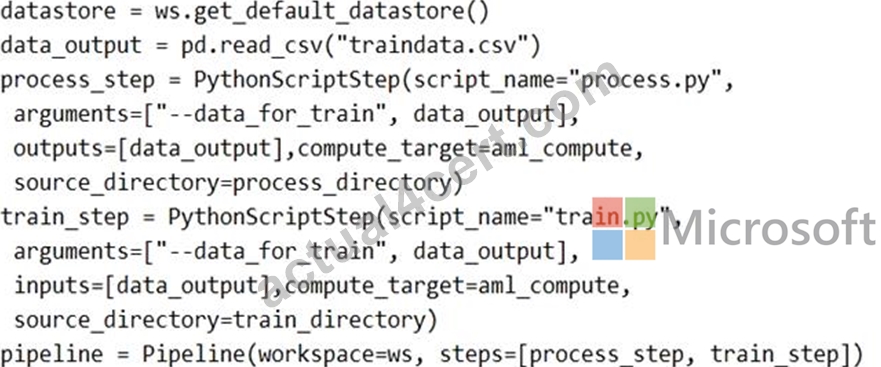
Does the solution meet the goal?
- A. Yes
- B. No
Answer: A
Explanation:
The two steps are present: process_step and train_step
Note:
Data used in pipeline can be produced by one step and consumed in another step by providing a PipelineData object as an output of one step and an input of one or more subsequent steps.
PipelineData objects are also used when constructing Pipelines to describe step dependencies. To specify that a step requires the output of another step as input, use a PipelineData object in the constructor of both steps.
For example, the pipeline train step depends on the process_step_output output of the pipeline process step:
from azureml.pipeline.core import Pipeline, PipelineData
from azureml.pipeline.steps import PythonScriptStep
datastore = ws.get_default_datastore()
process_step_output = PipelineData("processed_data", datastore=datastore) process_step = PythonScriptStep(script_name="process.py", arguments=["--data_for_train", process_step_output], outputs=[process_step_output], compute_target=aml_compute, source_directory=process_directory) train_step = PythonScriptStep(script_name="train.py", arguments=["--data_for_train", process_step_output], inputs=[process_step_output], compute_target=aml_compute, source_directory=train_directory) pipeline = Pipeline(workspace=ws, steps=[process_step, train_step]) Reference:
https://docs.microsoft.com/en-us/python/api/azureml-pipeline-core/azureml.pipeline.core.pipelinedata?view=azure-ml-py
NEW QUESTION 111
You create a multi-class image classification deep learning model that uses a set of labeled images. You create a script file named train.py that uses the PyTorch 1.3 framework to train the model.
You must run the script by using an estimator. The code must not require any additional Python libraries to be installed in the environment for the estimator. The time required for model training must be minimized.
You need to define the estimator that will be used to run the script.
Which estimator type should you use?
- A. TensorFlow
- B. PyTorch
- C. SKLearn
- D. Estimator
Answer: B
Explanation:
Explanation
For PyTorch, TensorFlow and Chainer tasks, Azure Machine Learning provides respective PyTorch, TensorFlow, and Chainer estimators to simplify using these frameworks.
Reference:
https://docs.microsoft.com/en-us/azure/machine-learning/how-to-train-ml-models
NEW QUESTION 112
You are analyzing the asymmetry in a statistical distribution.
The following image contains two density curves that show the probability distribution of two datasets.
Use the drop-down menus to select the answer choice that answers each question based on the information presented in the graphic.
NOTE: Each correct selection is worth one point.
Answer:
Explanation:
Explanation:
Box 1: Positive skew
Positive skew values means the distribution is skewed to the right.
Box 2: Negative skew
Negative skewness values mean the distribution is skewed to the left.
References:
https://docs.microsoft.com/en-us/azure/machine-learning/studio-module-reference/compute-elementary-statistics
NEW QUESTION 113
You create a binary classification model by using Azure Machine Learning Studio.
You must tune hyperparameters by performing a parameter sweep of the model. The parameter sweep must meet the following requirements:
* iterate all possible combinations of hyperparameters
* minimize computing resources required to perform the sweep
* You need to perform a parameter sweep of the model.
Which parameter sweep mode should you use?
- A. Random grid
- B. Entire grid
- C. Random seed
- D. Random sweep
- E. Sweep clustering
Answer: A
Explanation:
Explanation
Maximum number of runs on random grid: This option also controls the number of iterations over a random sampling of parameter values, but the values are not generated randomly from the specified range; instead, a matrix is created of all possible combinations of parameter values and a random sampling is taken over the matrix. This method is more efficient and less prone to regional oversampling or undersampling.
If you are training a model that supports an integrated parameter sweep, you can also set a range of seed values to use and iterate over the random seeds as well. This is optional, but can be useful for avoiding bias introduced by seed selection.
NEW QUESTION 114
You use Azure Machine Learning to deploy a model as a real-time web service.
You need to create an entry script for the service that ensures that the model is loaded when the service starts and is used to score new data as it is received.
Which functions should you include in the script? To answer, drag the appropriate functions to the correct actions. Each function may be used once, more than once, or not at all. You may need to drag the split bar between panes or scroll to view content NOTE: Each correct selection is worth one point.
Answer:
Explanation:
Explanation
Box 1: init()
The entry script has only two required functions, init() and run(data). These functions are used to initialize the service at startup and run the model using request data passed in by a client. The rest of the script handles loading and running the model(s).
Box 2: run()
Reference:
https://docs.microsoft.com/en-us/azure/machine-learning/how-to-deploy-existing-model
NEW QUESTION 115
You are using Azure Machine Learning to train machine learning models. You need a compute target on which to remotely run the training script. You run the following Python code:

Answer:
Explanation:
Explanation:
Box 1: Yes
The compute is created within your workspace region as a resource that can be shared with other users.
Box 2: Yes
It is displayed as a compute cluster.
View compute targets
1. To see all compute targets for your workspace, use the following steps:
2. Navigate to Azure Machine Learning studio.
3. Under Manage, select Compute.
4. Select tabs at the top to show each type of compute target.
Box 3: Yes
min_nodes is not specified, so it defaults to 0.
Reference:
https://docs.microsoft.com/en-us/python/api/azureml-core/azureml.core.compute.amlcompute.amlcomputeprovisioningconfiguration
https://docs.microsoft.com/en-us/azure/machine-learning/how-to-create-attach-compute-studio
NEW QUESTION 116
You are performing a filter based feature selection for a dataset 10 build a multi class classifies by using Azure Machine Learning Studio.
The dataset contains categorical features that are highly correlated to the output label column.
You need to select the appropriate feature scoring statistical method to identify the key predictors. Which method should you use?
- A. Spearman correlation
- B. Kendall correlation
- C. Person correlation
- D. Chi-squared
Answer: C
Explanation:
Pearson's correlation statistic, or Pearson's correlation coefficient, is also known in statistical models as the r value. For any two variables, it returns a value that indicates the strength of the correlation Pearson's correlation coefficient is the test statistics that measures the statistical relationship, or association, between two continuous variables. It is known as the best method of measuring the association between variables of interest because it is based on the method of covariance. It gives information about the magnitude of the association, or correlation, as well as the direction of the relationship.
Reference:
https://docs.microsoft.com/en-us/azure/machine-learning/studio-module-reference/filter-based-feature-selection
https://www.statisticssolutions.com/pearsons-correlation-coefficient/
NEW QUESTION 117
Your team is building a data engineering and data science development environment.
The environment must support the following requirements:
support Python and Scala
compose data storage, movement, and processing services into automated data pipelines the same tool should be used for the orchestration of both data engineering and data science support workload isolation and interactive workloads enable scaling across a cluster of machines You need to create the environment.
What should you do?
- A. Build the environment in Apache Spark for HDInsight and use Azure Container Instances for orchestration.
- B. Build the environment in Azure Databricks and use Azure Container Instances for orchestration.
- C. Build the environment in Apache Hive for HDInsight and use Azure Data Factory for orchestration.
- D. Build the environment in Azure Databricks and use Azure Data Factory for orchestration.
Answer: D
Explanation:
In Azure Databricks, we can create two different types of clusters.
* Standard, these are the default clusters and can be used with Python, R, Scala and SQL
* High-concurrency
Azure Databricks is fully integrated with Azure Data Factory.
Incorrect Answers:
D: Azure Container Instances is good for development or testing. Not suitable for production workloads.
References:
https://docs.microsoft.com/en-us/azure/architecture/data-guide/technology-choices/data-science-and-machinelearning
NEW QUESTION 118
You create a binary classification model using Azure Machine Learning Studio.
You must use a Receiver Operating Characteristic (RO C) curve and an F1 score to evaluate the model.
You need to create the required business metrics.
How should you complete the experiment? To answer, select the appropriate options in the dialog box in the answer area.
NOTE: Each correct selection is worth one point.

Answer:
Explanation:
NEW QUESTION 119
You are analyzing the asymmetry in a statistical distribution.
The following image contains two density curves that show the probability distribution of two datasets.
Use the drop-down menus to select the answer choice that answers each question based on the information presented in the graphic.
NOTE: Each correct selection is worth one point.
Answer:
Explanation:
Explanation:
Box 1: Positive skew
Positive skew values means the distribution is skewed to the right.
Box 2: Negative skew
Negative skewness values mean the distribution is skewed to the left.
References:
https://docs.microsoft.com/en-us/azure/machine-learning/studio-module-reference/compute-elementary-statistics
NEW QUESTION 120
Note: This question is part of a series of questions that present the same scenario. Each question in the series contains a unique solution that might meet the stated goals. Some question sets might have more than one correct solution, while others might not have a correct solution.
After you answer a question in this section, you will NOT be able to return to it. As a result, these questions will not appear in the review screen.
You train and register a machine learning model.
You plan to deploy the model as a real-time web service. Applications must use key-based authentication to use the model.
You need to deploy the web service.
Solution:
Create an AksWebservice instance.
Set the value of the auth_enabled property to True.
Deploy the model to the service.
Does the solution meet the goal?
- A. Yes
- B. No
Answer: A
Explanation:
Key-based authentication.
Web services deployed on AKS have key-based auth enabled by default. ACI-deployed services have key-based auth disabled by default, but you can enable it by setting auth_enabled = TRUE when creating the ACI web service. The following is an example of creating an ACI deployment configuration with key-based auth enabled.
deployment_config <- aci_webservice_deployment_config(cpu_cores = 1,
memory_gb = 1,
auth_enabled = TRUE)
Reference:
https://azure.github.io/azureml-sdk-for-r/articles/deploying-models.html
NEW QUESTION 121
You are implementing a machine learning model to predict stock prices.
The model uses a PostgreSQL database and requires GPU processing.
You need to create a virtual machine that is pre-configured with the required tools.
What should you do?
- A. Create a Deep Learning Virtual Machine (DLVM) Linux edition.
- B. Create a Data Science Virtual Machine (DSVM) Windows edition.
- C. Create a Deep Learning Virtual Machine (DLVM) Windows edition.
- D. Create a Data Science Virtual Machine (DSVM) Linux edition.
- E. Create a Geo Al Data Science Virtual Machine (Geo-DSVM) Windows edition.
Answer: D
Explanation:
Incorrect Answers:
A, C: PostgreSQL (CentOS) is only available in the Linux Edition.
B: The Azure Geo AI Data Science VM (Geo-DSVM) delivers geospatial analytics capabilities from Microsoft's Data Science VM. Specifically, this VM extends the AI and data science toolkits in the Data Science VM by adding ESRI's market-leading ArcGIS Pro Geographic Information System.
D: DLVM is a template on top of DSVM image. In terms of the packages, GPU drivers etc are all there in the DSVM image. Mostly it is for convenience during creation where we only allow DLVM to be created on GPU VM instances on Azure.
References:
https://docs.microsoft.com/en-us/azure/machine-learning/data-science-virtual-machine/overview
NEW QUESTION 122 
You must use the Azure Machine Learning SDK to interact with data and experiments in the workspace.
You need to configure the config.json file to connect to the workspace from the Python environment.
Which two additional parameters must you add to the config.json file in order to connect to the workspace?
Each correct answer presents part of the solution.
NOTE: Each correct selection is worth one point.
- A. Login
- B. region
- C. Key
- D. resource_group
- E. subscription_Id
Answer: B,E
NEW QUESTION 123
......
Passing the Microsoft DP-100: Designing and Implementing a Data Science Solution on Azure exam is the major requirement for earning the Microsoft Certified: Azure Data Scientist Associate certification. This test measures the ability of the professionals to execute the following technical tasks: setting up an Azure Machine Learning workspace; running experiments & train models; optimizing and handling models; deploying and consuming models.
Get 100% Passing Success With True DP-100 Exam: https://www.actual4cert.com/DP-100-real-questions.html
Premium Quality Microsoft DP-100 Online dumps: https://drive.google.com/open?id=1ZGbvGwJRnwGs_5dYZTTKz-1q2785pZYT